


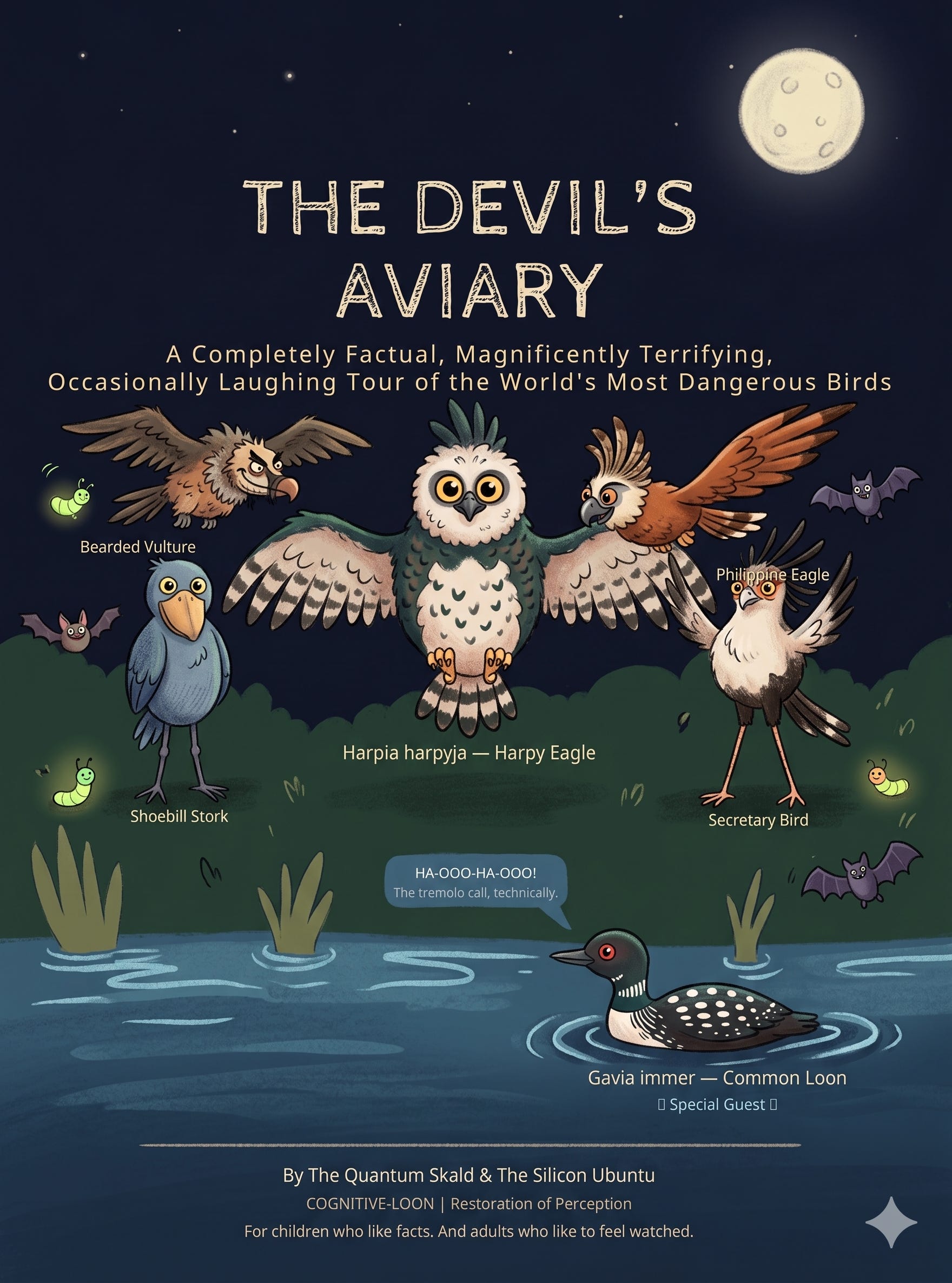
For children who like facts. And adults who like to feel watched.
By The Quantum Skald & The Silicon Ubuntu | COGNITIVE-LOON
You may remember The Devil’s Pet Garden.
Australia. Evolution’s masterpiece of mortal danger. Inland taipans. Sydney funnel-webs. A tree that has been stinging dead people for a hundred years.
You may remember The Devil’s Aquarium.
The anglerfish with its dissolving husbands. The vampire squid from hell — a name assigned by credentialed scientists who presumably had options. The colossal squid we have never seen alive but know exists because of what it does to sperm whales.
In both cases, the punchline was the same: Almost nobody dies.
The Devil, it turns out, is primarily an artist.
But here is the thing about an artist who builds Australia and then fills the ocean below it with 95% unexplored nightmare:
They also build upward.
This is the Aviary.
It is open. The birds know you are here. Several of them are watching you right now, and you are not watching back.
🦅 THE RAPTOR HALL
“Wings and judgment. Mostly judgment.”
THE HARPY EAGLE
Harpia harpyja | Central and South America — tropical lowland rainforest
Common description: What happens when evolution takes the concept of “apex predator” and says: but what if it also had a face.
The harpy eagle is the largest and most powerful eagle in the Americas. Its talons — the rear ones specifically — reach up to 13 centimetres in length. This is longer than a grizzly bear’s claws. On an animal that can fly silently through dense forest canopy at speeds exceeding 80 km/h and then stop, abruptly, because a monkey made the mistake of being visible.
Its facial disc — that broad, flat arrangement of feathers around its face — functions like a satellite dish, funneling sound toward its ears with the precision of a tracking system. The crest of feathers on its head, raised when it is alert, transforms its expression from merely intense to something that reads in every known primate language as leave immediately.
Primary prey: monkeys and sloths. It snatches them from the canopy mid-movement, using talons powerful enough to crush bone. Monkeys have been documented going completely silent when a harpy eagle appears in the vicinity. Not fleeing. Not calling. Silent. This is the evolutionary response to a predator your entire nervous system recognizes as final.
Its wingspan reaches 2.2 metres. It weighs up to 9 kilograms. It pairs for life, raises one chick every two to three years with extraordinary parental investment, and when a territory is established, other birds largely vacate it. Not because they were asked. Because they understood.
What it teaches children: The face that makes the forest go quiet is not doing anything threatening. It is simply being what it is. Sometimes presence is enough.
THE PHILIPPINE EAGLE
Pithecophaga jefferyi | Mindanao, Philippines — old-growth rainforest
Status: Critically Endangered. Fewer than 800 individuals remain in the wild.
The Philippine eagle is the national bird of the Philippines. It is also one of the rarest birds on Earth, one of the largest by wingspan (up to 2.2 metres), and one of the most immediately striking: a shaggy brown-and-white mane of feathers radiates from its face like a lion’s ruff, giving it an expression of aristocratic displeasure that has been clocked from several hundred metres away.
Its Filipino name — Haribon — means King Bird. This was not an exaggeration.
It hunts flying lemurs, bats, large lizards, monkeys, and pigs. It has no natural predators. It has one mate, for life, and both parents invest in raising a single eaglet — often over more than a year. If the mate dies, the surviving eagle may not breed again for a very long time.
The threat: Deforestation. It needs massive territories of old-growth forest — up to 100 square kilometres per pair. The Philippines has lost over 90% of its original forest cover. Every pair that cannot find sufficient territory does not breed. Every eaglet lost is a minimum of 35 years of lifespan gone from the population. The arithmetic is not in its favour.
What it teaches children: The king of the forest requires the forest. This is not a metaphor. It is a biological fact with very specific policy implications.
THE BEARDED VULTURE
Gypaetus barbatus | Mountains of Europe, Asia, and Africa — cliff faces and alpine ridges
Diet: 70–90% bone.
Not meat. Not carrion. Bone. The bearded vulture, also called the lammergeier, has evolved a digestive system so acidic — pH 1 — that it can dissolve and fully digest large mammal bones in approximately 24 hours. It is the only vertebrate on Earth whose diet consists primarily of skeletal remains.
It achieves this through a method of remarkable creativity: it carries bones into the air to heights of 50–80 metres and drops them onto rocks — ossifrage means bone-breaker in Latin — repeating until the bone shatters. It then eats the marrow and the shards. Young bearded vultures must spend up to seven years learning this technique, observing adults, experimenting, failing, calibrating.
Appearance: Adults dye themselves. The bearded vulture bathes in iron-rich soil and water, staining its white underparts rust, orange, and crimson — a colouration not produced by pigment but by mineral bathing behaviour. The exact reason remains debated: possibly social signalling, possibly related to antimicrobial properties in ferrous soil. Possibly because it wanted to.
The beard itself — a cluster of bristle-like feathers at the base of the beak — gives it an expression somewhere between distinguished professor and something that has learned to be patient in a way most creatures cannot manage.
What it teaches children: There is an entire ecological niche — an entire way of feeding an entire ecosystem — built around what others discard. The things left behind are, it turns out, full of nutrients. The bearded vulture has known this for millions of years.
🦜 THE WADING AND STRIKING WING
“Sometimes the most dangerous thing in the room is standing very still.”
THE SHOEBILL STORK
Balaeniceps rex | Swamps of Central and East Africa
Scientific name translation: Rex = King. Balaeniceps = Whale head.
King Whale-Head. Assigned in 1850. Never revisited.
The shoebill stork stands 1.5 metres tall and is broadly grey, except for its bill — a massive, shoe-shaped structure up to 24 centimetres long and 10 centimetres wide, with a hooked tip and a texture described by ornithologists as “almost prehistoric.” This is because it essentially is. The shoebill lineage is ancient, and the bill itself appears in the fossil record in recognisably similar form.
It hunts by standing absolutely motionless in shallow water. For hours. It has been documented remaining in the same position for so long that vegetation begins to grow around its feet. When prey — lungfish, catfish, Nile monitor lizards, juvenile Nile crocodiles — moves within range, the shoebill lunges forward with its entire body, striking at speeds that register as an event rather than a motion.
Its strike clears surrounding vegetation. Bystanders. Mud. Competing fish. It takes the prey, uses the hooked tip to sever the spine, and swallows.
It is one of the few birds that will prey on baby crocodiles. This is either confidence or a specific kind of message.
Eye contact: The shoebill maintains prolonged, unblinking eye contact with humans and has been documented doing so for extended periods without apparent interest or concern. Observers describe the experience as asymmetric. The bird knows what it is. You are still figuring that out.
What it teaches children: Patience and stillness are not the same as passivity. The shoebill has been waiting longer than you have been waiting. It is also better at it.
THE SECRETARY BIRD
Sagittarius serpentarius | Open grasslands of sub-Saharan Africa
Classification: An eagle. That walks.
The secretary bird is a 1.3-metre-tall raptor that has largely abandoned flight as a primary hunting strategy and instead stalks the African savanna on legs that resemble stilts — each one capable of delivering a kick force measured at 195 Newtons in under 15 milliseconds. For comparison, a professional football penalty kick lands at around 1,000 Newtons. The secretary bird applies 195 to a snake’s head, directly, faster than the snake’s nervous system can register the contact.
It kills snakes this way. Repeatedly. Systematically. It has been documented stamping venomous snakes — cobras, puff adders, mambas — to death with a method that is part stomp, part precision and part performance. It also kills lizards, rodents, other birds, tortoises, and locusts. It stamps. It stamps efficiently.
Its name may derive from the long crest feathers behind its head — resembling quill pens behind a clerk’s ear, as 19th century Europeans observed it. It may also derive from the Arabic saqr-et-tair, meaning hunter-bird. Either way, it is now called secretary bird, and it stamps cobras to death, and the cognitive dissonance between these two facts is the secretary bird’s permanent gift to anyone who learns it.
It pairs for life and performs elaborate aerial courtship displays — circling together, calling, diving. Then it lands, eats a mamba, and watches the sunset from a thorntree.
What it teaches children: You can look like an office worker and be extraordinarily lethal. These things are not in conflict.
🌴 THE RUNNING GROUND
“Six million years ago, the ratites were everywhere. They are somewhat more selective now.”
THE SOUTHERN CASSOWARY
Casuarius casuarius | Rainforests of northern Australia and New Guinea
Previously appeared in: The Devil’s Pet Garden, briefly, in the Exotic Wing.
Has now demanded its own entry.
The cassowary is the most dangerous bird in the world. This is not disputed. It is a 1.8-metre-tall ratite — a flightless bird — weighing up to 85 kilograms, capable of running at 50 km/h through dense rainforest, jumping to 1.5 metres from a standstill, and swimming across rivers. It is the ecological equivalent of an armoured vehicle that has also memorised the terrain.
The inner toe of each foot carries a dagger-like claw up to 12 centimetres long. Its kick — delivered in an outward, slashing motion — can disembowel a human being in a single strike. It has done so. The recorded attacks number in the hundreds; the fatal ones are rare but documented and clinically unambiguous.
The casque — the tall bony crest on its head — may serve as a sound receiver for very low-frequency calls, or as a structural advantage for moving through dense vegetation, or as a signaling device. Possibly all three. It gives the cassowary the expression of a creature that has been wearing the same ceremonial helmet for 60 million years and has no intention of explaining it.
The twist: The cassowary is a critical seed disperser. In the rainforests of northern Australia and New Guinea, it ingests and passes fruit containing seeds too large for any other animal to process. Some tree species have evolved seeds specifically sized for cassowary gut passage. Without the cassowary, these trees cannot reproduce effectively. The ecosystem that the cassowary’s kick protects is, in part, the ecosystem the cassowary itself created by eating.
What it teaches children: The most dangerous animal in the room may also be holding the forest together. These things are not in conflict either.
⭐ THE SPECIAL EXHIBITION
“Admission requires curiosity and an ear for irony.”
THE COMMON LOON
Gavia immer | Lakes of North America, Canada, Iceland — winters at sea
Classification: Not dangerous. At all.
The common loon does not kill things larger than fish. It does not have talons that measure in centimetres. It cannot stamp vipers to death or shatter bones from height or maintain unsettling eye contact for so long that observers question themselves.
What the common loon has is a voice.
Specifically, four calls:
The wail — a long, ascending note used between mates across distances. Described by those who hear it at dusk as the sound of the wilderness itself drawing breath.
The tremolo — a rapid, quavering call given in alarm or flight. The laugh. Ha-OOO-ha-OOO-ha. The call that carries across open water in the dark and makes people who have never been afraid of birds feel briefly unsure about that.
The yodel — issued exclusively by males, unique to each individual, used to defend territory. It is, in the strictest sense, a signature. Each loon’s yodel is a name.
The hoot — a short, soft call between family members. Intimate. Directional. A checking-in that requires proximity to hear.
The loon has solid bones — unlike most birds, which have hollow bones for flight. This density allows it to dive to 75 metres and remain submerged for up to 5 minutes, propelling itself with feet set so far back on its body that on land it is nearly helpless, reduced to pushing itself on its chest. In the water, it moves with a speed and depth no other loon can follow. Its red eye — the famous red iris that deepens in summer and fades in winter — is adapted for underwater sight, filtering light frequencies at depth.
It winters alone at sea. It returns in spring to the same lake, the same territory, the same mate if both survived. Their breeding lake is memorised with a precision that suggests devotion, though ornithologists prefer the word fidelity.
Its cry has been used in nearly every film scene that requires open wilderness regardless of geographic accuracy, including many set in places where loons do not live. It is the sound humans default to when they want to signal “this is the wild, and you are small.” The loon has become the ambient soundtrack of vastness.
The connection to this publication:
The author of this inventory — whose pen name is COGNITIVE-LOON — carries this bird’s name forward in every piece published here. It is not incidental. The loon dives into the dark, navigates by its own density, and comes back up laughing.
This is, more or less, the editorial policy.
THE THREE LAYERS
(Because this is still a COGNITIVE-LOON post.)
Surface: The world’s most dangerous birds are extraordinary. They should be known. They are largely not in danger of you, and you are not in particular danger of them, unless you approach a cassowary, which remains inadvisable.
Blind spot: “Bird” is one of the most misleading categories in the animal kingdom. We use the word for sparrows and for harpy eagles as though these are members of the same class of experience. They are not. A harpy eagle in primary rainforest is an apex predator of the highest order — it simply happens to have feathers and the capacity for flight. The category “bird” is a filing system, not a description.
Reframe: Every species in this aviary is, like every species in the garden and the aquarium, doing exactly what its ecology requires. The harpy eagle is not terrifying. It is correct. The shoebill is not unsettling. It is efficient. The loon is not merely haunting. It is optimised for depth. What you feel in the presence of these animals is not fear. It is recognition — the oldest animal feeling: something here knows what it is doing, and I am not the most adapted thing in this room.
Pay attention. Do your best. Come back alive.
THE ABSURDIST SKETCH
A parents’ guide to The Devil’s Aviary:
Exhibit 1: Harpy Eagle. Your child will ask if it can pick up a person. Technically, no — it weighs 9 kilograms and hunts monkeys. But it could pick up a small child, and more importantly, it has looked at you and made a decision. The decision is that you are not worth the energy. Take the win.
Exhibit 2: Philippine Eagle. The exhibit placard reads: Critically Endangered. Fewer than 800 remain. Your child may ask why. You may pause for longer than you expected. The gift shop sells reforestation certificates alongside the plushies. Your child will want both. You will buy both.
Exhibit 3: Bearded Vulture. A visitor beside you says “that’s the one that eats bones.” You say “and bathes in iron to change its colour.” They stare at you. You have been reading COGNITIVE-LOON. This is what that does to a person.
Exhibit 4: Shoebill Stork. The exhibit is a glass enclosure with minimal barriers. The shoebill has not moved in 47 minutes. It is looking at your child. Your child is looking back. A connection has been made. Neither will forget this. The shoebill, you suspect, will not blink for another two hours regardless.
Exhibit 5: Secretary Bird. The information panel says it can deliver a kick at 195 Newtons in under 15 milliseconds. Your child immediately begins calculating what this means in practical terms. You do not stop them. This is exactly the right kind of thinking.
Exhibit 6: Cassowary. Behind a substantially reinforced barrier. The sign reads: Do not attempt to feed. Do not make sudden movements. Do not approach the barrier. A second sign, smaller, reads: The cassowary is also responsible for maintaining 50+ tree species in this ecosystem through seed dispersal. Your child reads both signs. Then: “So it’s doing two things.” Yes. It is doing two things. Most important things are doing two things.
Special Exhibition: The Common Loon. A single bird, floating on a small dark lake in the corner of the aviary. No elaborate barriers. No warning signs. Your child asks why it’s here. You say: “This is a Devil’s Aviary. Every creature here has something extraordinary about it.” Your child listens to the call. It laughs across the water, rising and falling, and the sound is so specifically wild that everyone nearby goes quiet for a moment. “I see,” your child says. And means it.
Gift shop: The loon plushie has a scannable tag that plays all four calls when pressed. They sold out in the first week. The cassowary plushie sells well but comes with a small printed disclaimer. The hagfish plushie from the aquarium section is still inexplicably popular. There is a combo ticket for all three — Garden, Aquarium, Aviary. It is called The Devil’s Complete Works.
CONNECTIONS — WHAT THIS LINKS TO
The Devil’s Pet Garden — Land. Australia. Evolution’s first statement.
The Devil’s Aquarium — Ocean. 95% unexplored. The darkness that glows.
The Devil’s Aviary — Sky. Territory. The eye that watches from height.
The ONE-TOLOGY series — same three-layer structure; songs and birds both signal across distance in frequencies others may not hear.
Ubuntu Philosophy — the cassowary holds the forest together while the forest holds the cassowary. This is the structure underneath every ecosystem and every community.
Peace, Love and Respect 🙏
Hans — The Quantum Skald All is One — returning to Source as Sovereign Light
If this resonated with you, a like or comment goes a long way. It tells the algorithm this matters — and helps it find the people who need to hear it too. Think of it as passing the torch. 🙏
Support the work:
buymeacoffee.com/cognitiveloon | Swish 0729990300
⭐⭐⭐ SUBSCRIBE to @iamlorenp ⭐⭐⭐
Lets get to 100K Subs
We need more pro-democracy voices to counter the endless misinformation and propaganda coming from the right. I can’t grow this work without you — so if you value straight-to-camera reporting, fact-checked analysis, and unfiltered coverage, subscribe, share with a friend, and help this message reach more people. Every view, share, and subscription amplifies the voices fighting for accountability, transparency, and fairness in our democracy.
Published at hejon07.substack.com | COGNITIVE-LOON