
🧠 THE DIMENSIONAL BLINDFOLD
How Brains, Media, and Power Collapsed Human Seeing

A visual essay from “The Controlled Demolition of Perception”
“They didn’t destroy our ability to see.
They collapsed the architecture that makes seeing possible.”
I. The Blueprint: How They Weaponized Our Wiring
For most of the history, humans believed they were one mind—a single, rational agent steering through reality.
Neuroscience quietly demolished that myth.
You are not one mind.
You are two operating systems sharing the same skull.
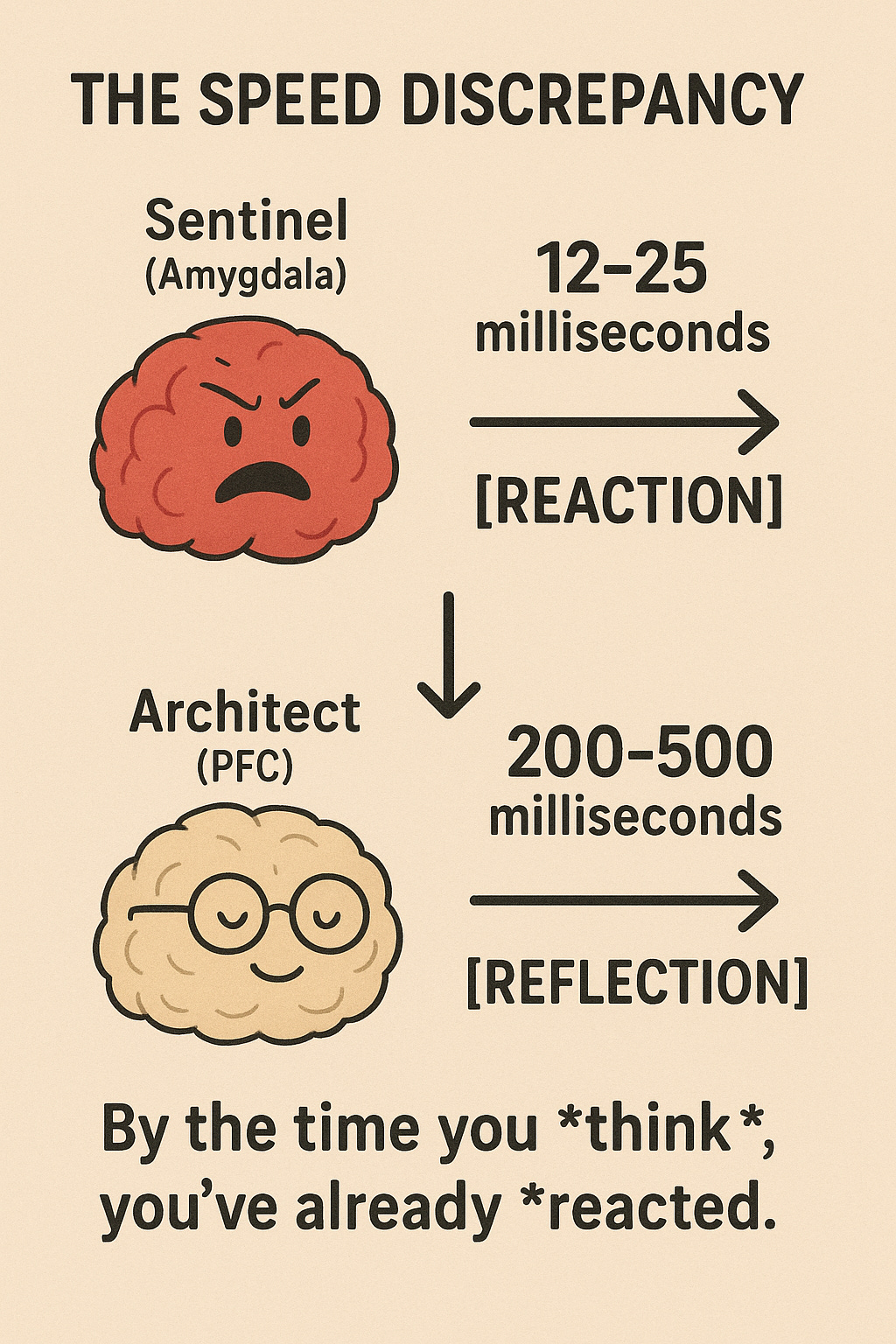
One is deliberate: the Architect—slow, reflective, cortical.
The other is instinctive: the Sentinel—fast, emotional, subcortical.
Every perception you have passes through both—but the Sentinel gets there first.
Milliseconds first.
Evolution built it that way: survival before semantics.
That speed differential is where every manipulation begins.
Propaganda, outrage, fear—they don’t aim at your beliefs.
They aim at your milliseconds.
They hijack the Low Road, the brain’s ancient fast lane between sensation and survival.
While your higher mind is still drafting the memo, the Sentinel has already fired the response.
And once emotion moves, reason retrofits.
The demolition of perception doesn’t start on a screen.
It starts inside your nervous system.
II. The Subcortical Coup.
In The 47% Solution, we saw how authoritarian infrastructure didn’t hide the truth—it showed it in plain sight and made people unable to see what they were looking at.
That’s not politics.
That’s Neuroarchitecture.
The same milliseconds that saved your ancestors from predators now make you susceptible to engineered urgency.
The brain’s Sentinel sees threat everywhere.
The Architect—always late—rationalizes after the fact.
That’s how truth gets flattened: by the tyranny of immediacy.
What was once an evolutionary advantage—the “act first, think later” reflex—has become a cognitive backdoor.
The coup already happened.
It just happened subcortically.
III. The Salience Trap.
Buried deep in the folds of your cortex lies the Insula, the brain’s cartographer of significance.
It tells you what matters.
What to feel.
What to ignore.
Paired with the Anterior Cingulate Cortex, it forms the Salience Network—the neural gatekeeper deciding which inputs rise into awareness.
It’s the bouncer at the door of consciousness.
Modern media learned to sweet-talk the bouncer.
Algorithms feed it a constant diet of “urgent” signals until everything feels critical and nothing feels meaningful.
The salience gate jams open.
When everything feels important, nothing is prioritized.
When everything feels threatening, the Sentinel stays in charge.
The architecture of outrage is not built with lies—it’s built with precision-tuned salience.
Salience Overload: this is what happens when the neural gatekeeper (the Salience Network) is bombarded with too many high-intensity, emotionally charged inputs. The brain loses its ability to distinguish what’s truly urgent (a threat in the room) from what’s merely loud (a headline on the screen). The result is a collapse of attentional priority and chronic vigilance fatigue—the nervous system stuck in “everything matters” mode.
For a deeper dive into how institutions exploit that tuning, see The Architecture of Coercion.
IV. Emotional Tagging and the Manufacture of Blindness.
Emotion doesn’t just color experience—it rewrites the file system.
Every strong feeling leaves behind a chemical afterglow that tags the next thing you see.
For 9–33 minutes, everything passing through your senses carries the emotional fingerprint of what came before.
That means your brain can turn a neutral moment into a fearful memory simply because you scrolled past a headline that spiked your cortisol five minutes earlier.
This is how outrage becomes infrastructure.
It rewires the hippocampus and amygdala into a loop that teaches your nervous system what to fear next.
You don’t remember the story—you remember the state it put you in.
Authoritarians don’t need to erase history.
They just need to emotionally tag it until you can’t tell horror from fatigue.
That’s not apathy.
That’s Horror Inoculation—the emotional vaccine that numbs you into compliance.
(See Thinking After Horror for how to metabolize that numbness back into moral attention.)
V. The Infrastructure of Unseeing
In The 47% Solution, we identified seven infrastructures of control—capital, ideology, technical, psychological, informational, legal, and temporal.
Every one of them has a neurological twin.
SOCIETAL INFRASTRUCTURE | NEURAL EQUIVALENT | FUNCTION
Psychological
→ Limbic Hijack | Emotional manipulation
Information
→ Salience Overload | Attention capture
Temporal
→ Low-Road Reflex Loops | Overwhelm reflection
This refers to the brain’s “low-road” pathway (through the amygdala) that bypasses the cortex to trigger instant reaction. Societally, the 24/7 news cycle, constant alerts, and forced urgency keep us in this reflex mode—overwhelming the space for calm, reflective thought.
Ideological
→ Emotional Tagging | Encode bias
Technical
→ Neural Reward Systems | Addictive engagement
Legal
→ Prefrontal Veto | Constraint or release
Capital
→ Energy Allocation | Resource priority
Each one rewires both the body politic and the body neural.
The demolition of perception wasn’t metaphorical—it was biological.
The same pathways that regulate your sense of control regulate your sense of reality.
Hijack one—hijack both.
VI. The Architect’s Veto: How to Rebuild Seeing.
The antidote to demolition isn’t optimism.
It’s integration.
The Prefrontal Cortex—your Architect—can regain control, but only if it’s given time and clarity.
You can’t outpace propaganda, but you can out-time it.
The Scroll Test
You’re scrolling. You see a headline that spikes rage.
The hijack (0–5 seconds):
• Amygdala fires
• Cortisol floods
• You’re already composing the angry comment
The intervention (90 seconds):
• Notice the physiological surge
• Name it: “I feel rage.”
• Ask: “What’s the actual threat here?”
• Breathe until norepinephrine clears
The reclaim (5 minutes later):
• You can see the headline as information rather than attack
• The Architect has context
• You can choose response vs. reaction
Those ninety seconds are democracy’s last line of defense.
Breathe deliberately.
Focus on heartbeat, breath, muscle tension.
That’s your Insula rebooting its map of what’s real.
You’re reclaiming the Salience Gate from the algorithm.
Finally, name what you feel.
Language recruits the Architect.
Words are levers for top-down control.
Each act of deliberate naming is reconstruction.
Each moment of reflective delay is a microsecond of regained sovereignty.
VII. Reclaiming the Dimensional Mind.
When Edwin Abbott wrote Flatland in 1884, he meant it as satire.
Today it’s an instruction manual.
We live in a society of two-dimensional seeing—horizontal outrage, flattened context.
Everything is a circle flashing through the feed; nothing rises above the plane.
To perceive systems in their true depth, reclaim your lost dimension: time + reflection = depth.
Holding paradox without collapse is the cognitive act of standing upright in Flatland.
You don’t fight the demolition by believing harder.
You fight it by seeing in more dimensions than the system allows.
When you see the architecture, you can rebuild it.
Map the Low Road and High Road together, you can walk both consciously.
Once you understand that, perception itself was the battlefield.
You stop fighting shadows and start redesigning the light.
Epilogue: The Map We’re Rebuilding
Every democracy is a nervous system.
Every citizen is a neuron.
When those neurons stop talking—or talk only through fear—the body politic seizes.
Rebuilding perception isn’t a metaphor for healing society.
It is healing society.🐝
So read.
Pause.
Breathe.
Ask the extra question.
Hold the extra variable.
See the extra dimension.
The sphere is here.
All that’s missing is your ability to see it.
🪶Peace, Love, and Respect
💡 Continue reading the series:
1. The Point in Time or Space Where
3. The Architecture of Coercion
4. The Collapse — Sudan as the Mirror
8. The World Looked Away—Then El Fasher Fell
9. Follow the Money to the Bodies: How Banks Make Genocide Profitable
🪶 Explore the full collection here:
👉 The Controlled Demolition of Perception
A long-form investigation into how our ways of seeing shape the fate of empathy, truth, and civilization itself.
Each essay dismantles a layer of illusion—from the architecture of consent and coercion to the collapse of systems that forget how to feel.
What emerges is not despair, but a manual for moral attention—a call to rebuild perception before rebuilding the world.