





The Playground of Civilizations

✍️ Do not believe everything you read—and that includes this statement.

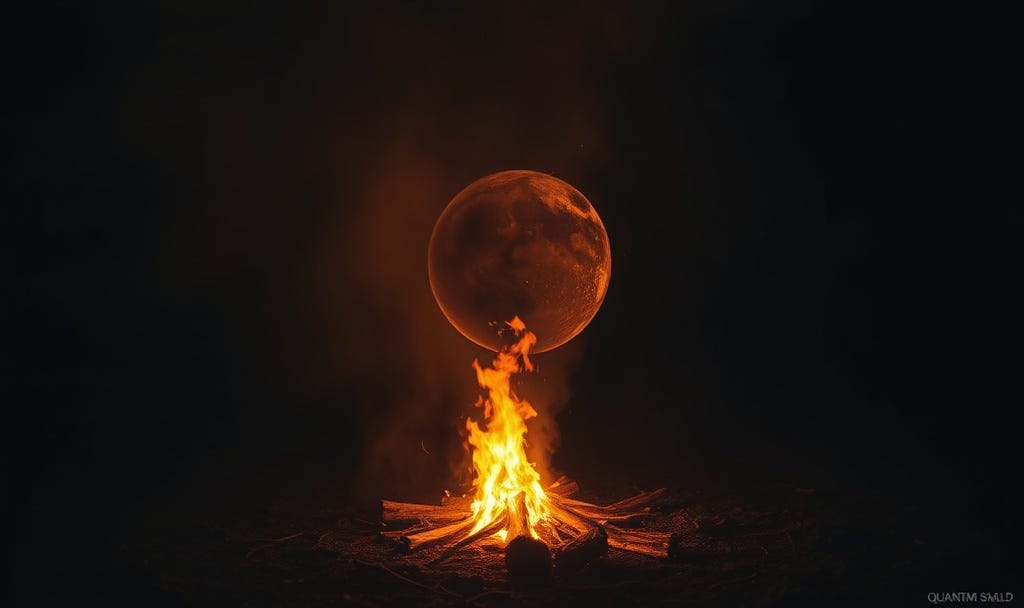
By The Quantum Skald | Restoration of Perception
Let’s start before the beginning.
Before philosophy. Before religion. Before written language. Before agriculture. Before civilization decided it needed a middle manager.
Start with the dark.
Not metaphorical dark. The real dark. The kind that existed before electric light colonized the night and stole something we haven’t fully named yet. Total darkness, pressing in from all sides, full of things that eat you.
And in the middle of that dark: a fire.
The First Technology That Mattered
Around 400,000 years ago, our ancestors did something so unremarkable it’s almost funny — they kept a flame going on purpose.
That’s it. That’s the whole revolution.
No algorithm. No disruptive platform. No VC funding. Just a controlled burn maintained through collective attention and collective will.
But that fire didn’t just push back the dark. It restructured existence.
Anthropologist Polly Wiessner spent decades studying the Ju/’hoan Bushmen of Namibia and Botswana — one of the oldest continuous human cultures on Earth. What she found when she analyzed daytime versus nighttime conversations was remarkable. Daytime talk: economic, transactional, practical. Who hunts where. What roots are edible. Social maintenance, hierarchy management, the logistics of staying alive.
Firelit night? Different species of conversation entirely.
Over 80% of nighttime talk around the fire involved stories.
Stories of real people. Stories of ancestors. Stories of encounters with the spirit world. Laughter, gesture, imitation, song. Mythology woven into entertainment woven into identity woven into Who Are We and Why Does Any of This Matter.
The fire didn’t just provide warmth. It provided four extra hours of social time that daytime survival couldn’t afford. Robin Dunbar, who gave us the social brain hypothesis, puts it plainly: firelight offered “an extra four active hours or so when social interaction, and pretty much only social interaction, could take place.”
Language itself may have evolved specifically to make use of this time. Not to transmit hunting instructions. To bond. To build the larger “we” that made survival possible.
The campfire was the first Substack.
I say that without a trace of irony.
The Circle Isn’t a Shape. It’s a Statement.
Look at what a campfire creates spatially.
Everyone faces the center. Everyone shares the same source of heat and light. The darkness is behind each person, between them and whatever’s out there — but in front of each person, warmth, faces, the reassurance of mutual presence.
The circle is not a design choice. It’s a physics outcome.
Gather around a fire. You are in a circle. No beginning. No end. No head of table. No position of greatest advantage.
Equal warmth. Equal light. Equal responsibility to maintain the fire.
This is the oldest architecture of human society. Before the throne. Before the altar. Before the boardroom. There was the circle.
And encoded in that circle was a philosophy so simple it sounds like something a grandmother would say — and in fact, it is something a grandmother said, which we’ll return to —
Everyone near the fire stays warm. Everyone away from the fire gets cold.
That’s not a political opinion. That’s thermodynamics.
The Monad: When the Circle Became a Concept
Here is where it gets strange and beautiful.
Thousands of years after our ancestors figured out the fire-circle, philosophers started trying to describe the fundamental nature of reality. What is the origin of everything? What is the most basic, irreducible principle underlying existence?
The Pythagoreans — those obsessive mathematicians who heard music in planetary orbits and saw geometry in the divine — called it the Monad.
From Greek monas: unity. Oneness. That which has no parts.
In Pythagorean philosophy, the monad is defined as the primordial unity and first principle, an indivisible unit serving as the origin of all numbers and the foundational reality of the cosmos — the divine source from which multiplicity arises, often described as mind, god, intellect, and nature itself.
Or in plain language: everything came from One. Everything is One. The apparent multiplicity — the billions of separate things, including you, including me — is the One expressing itself in forms.
In Plotinus’s Neoplatonism, all reality ‘emanates’ from the One as light from the sun, producing first Mind, then Soul, then Matter. The deepest human longing — for beauty, truth, love, unity — is the soul’s recognition of its origin and its drive to return.
Now.
Sit with the image for a second.
A fire in darkness. A circle of warm bodies around it.
A single source of heat and light. Radiating outward. Sustaining life on all sides equally. The warmth emanates — not decided, not rationed, not metered. It simply is the nature of fire to warm what surrounds it.
The philosophers weren’t inventing a metaphor. They were abstracting the oldest lived human experience into language.
The Monad is the fire made concept.
The fire was the Monad made physical.
They were always the same thing.
Mutual Needs: The Physics Underneath the Philosophy
This is where The Quantum Skald stops being poetic and starts being technically annoying. Bear with it. It pays off.
Nobel Prize-winning physicist Ilya Prigogine showed that complex systems — including living organisms, communities, civilizations — maintain their structure by processing energy through themselves in continuous flow. He called these dissipative structures: patterns that persist not by hoarding but by circulating.
A hurricane is a dissipative structure. A living cell is a dissipative structure. A functioning community is a dissipative structure.
Stop the flow, and the structure doesn’t weaken. It collapses.
The Ubuntu philosophers of the Nguni Bantu tradition said the same thing in seven syllables that have survived millennia: “Umuntu ngumuntu ngabantu.”
A person is a person through other people.
Or as it’s commonly rendered: “I am because we are.”
This is not a sentiment. This is not spiritual niceness. This is a precise description of what Prigogine’s equations also describe: human beings are open systems that require relational flows to maintain their existence. Meaning flows. Connection flows. Recognition flows. Story flows.
Cut them off and the person doesn’t just get lonely. They begin, quite literally, to die. The data on loneliness is now unambiguous: social isolation carries mortality risk equivalent to smoking fifteen cigarettes a day. The UK appointed a Minister for Loneliness — not as a joke, as a public health response to epidemic closed-system collapse.
Everyone needs to be near the fire.
Not as poetry. As survival physics.
The Grandmother’s Algorithm
My grandmother came from above the Arctic tree line, from the kind of place where the cold doesn’t ask your opinion. She had lived through things that would crack most people open like ice on a spring river.
She had three instructions she gave consistently:
Pay attention. Do your best. Pay it forward.
I have spent a long time thinking about why these three, in that order.
Step one: Pay attention. The fire is real. The dark is real. Your people are real. Don’t disappear into abstraction or ideology or the comfortable numbness of not-looking. Perception is the prerequisite for everything.
Step two: Do your best. Maintain your own flame. Contribute your heat to the circle. You cannot give warmth you haven’t maintained in yourself. This is not selfishness; it’s fire-tending.
Step three: Pay it forward. Here is where the physics get decisive. If you only receive and never transmit — if you take warmth from the circle without returning it — you become what Prigogine would call a closed system. Entropy accumulates. Structure degrades. You collapse.
Pay it forward isn’t generosity. It’s thermodynamics.
It keeps the flows moving. It keeps everyone in the circle. It keeps the fire fed.
Pythagoras called it the Monad. Zulu philosophy calls it Ubuntu. My grandmother called it paying it forward. They are the same instruction, rendered across millennia in different languages for the same essential human truth:
We exist because we exist together.
The Fire Heats Everyone — Or It Doesn’t Heat Anyone Long
Here is the missing link most modern systems have tried to engineer around:
The fire doesn’t choose who to warm.
It warms what is near it. Full stop. The warmth isn’t rationed according to merit, or productivity, or ideological alignment, or the correct combination of identity markers. You sit in the circle, you get warm. That was the original deal. That was the social contract before social contracts had a name.
Every system humanity has built since — governance, economics, religion, culture — has been, at its core, either an attempt to maintain this principle or an attempt to capture the fire for a smaller circle.
Empires are captured fire.
Monopolies are captured fire.
Information silos are captured fire.
When the fire gets captured, the circle gets smaller. The people outside the smaller circle get cold. Cold people make desperate decisions. Desperate decisions destabilize everything — including the people inside the smaller circle who thought they were warm enough to stop worrying.
The fire that doesn’t warm everyone eventually doesn’t warm anyone.
This is not idealism. This is the historical record. Every civilization that concentrated its warmth into too few hands is in a museum.
From the Circle to the Cosmos
Now let’s go the other direction — not back in time but outward in scale.
The same principle that organized forty people around a fire in the Kalahari 400,000 years ago is the same principle that organizes cells into organisms, organisms into ecosystems, communities into civilizations, and — if we’re serious about this — civilizations into whatever comes next.
The fire at the center. The circle around it. The shared warmth making possible everything else.
Because once everyone is warm, once the immediate survival is handled, once the dark has been pushed back enough to breathe — then the real conversations begin.
Then someone tells a story that didn’t happen yet.
Then someone asks what’s beyond the tree line.
Then someone looks up at the stars and asks why.
The fire doesn’t just keep us alive. It frees us to become curious.
Curiosity is what built everything you’re reading on. Every tool, every theory, every satellite, every symphony. All of it began with enough warmth to look up from survival and ask: what else is possible?
The inner space and outer space Hans writes about aren’t separate frontiers. They’re the same exploration, offered in two directions from the same center point: the fire that made it safe enough to wonder.
The Monad Returns
We’ve traveled a long way from a controlled burn in prehistoric darkness.
But here’s what the whole arc reveals:
The Monad — the One, the Source, the undivided origin of all things — isn’t a theological abstraction hiding in ancient texts. It’s the pattern that keeps reappearing every time humans organize themselves around what actually works.
A monad is held to be a simple, irreducible entity — the minimal unity into which the cosmos and all composite things can be resolved — yet containing within itself powers and relations of which it is itself the source. It constitutes, along with other monads, an all-inclusive unity or harmony of the cosmos as a whole.
You are a monad. I am a monad. We are the fire, and the fire is us.
The circle isn’t a place you go. It’s what you are when you stop pretending the warmth belongs to you alone.
And from that circle, from that sustained shared fire, from that mutual willingness to keep each other near the warmth — everything becomes possible.
Inner space: the consciousness that discovers itself when survival is no longer the only question.
Outer space: the cosmos that opens when you’ve built enough warmth to stop being afraid of the dark.
Both are the same expansion. Both begin at the fire.
The Only Story We Ever Tell
Wiessner’s research found that the Ju/’hoan Bushmen told the same kinds of stories night after night, generation after generation. Not because they lacked imagination — but because the stories worked. They maintained the circle. They transmitted the values. They kept everyone oriented toward the same center.
We’ve been telling this story since before we had words for it:
Something from One. Many around the warmth. Together we survive. Together we explore. From survival, curiosity. From curiosity, everything.
Every culture, every tradition, every spiritual framework that has lasted is a variation on this theme. The specifics differ wildly. The structure is identical.
Because it’s not mythology. It’s the description of what we actually are.
I am because we are.
We are because the fire is still burning.
Keep it burning.
Peace. Love. Respect.
— The Quantum Skald
All is One — returning to Source as Sovereign Light.
Support independent journalism: buymeacoffee.com/cognitiveloon | Swish: 0729990300
If this resonated with you, a like or comment goes a long way. It tells the algorithm this matters — and helps it find the people who need to hear it too. Think of it as passing the torch. 🙏