


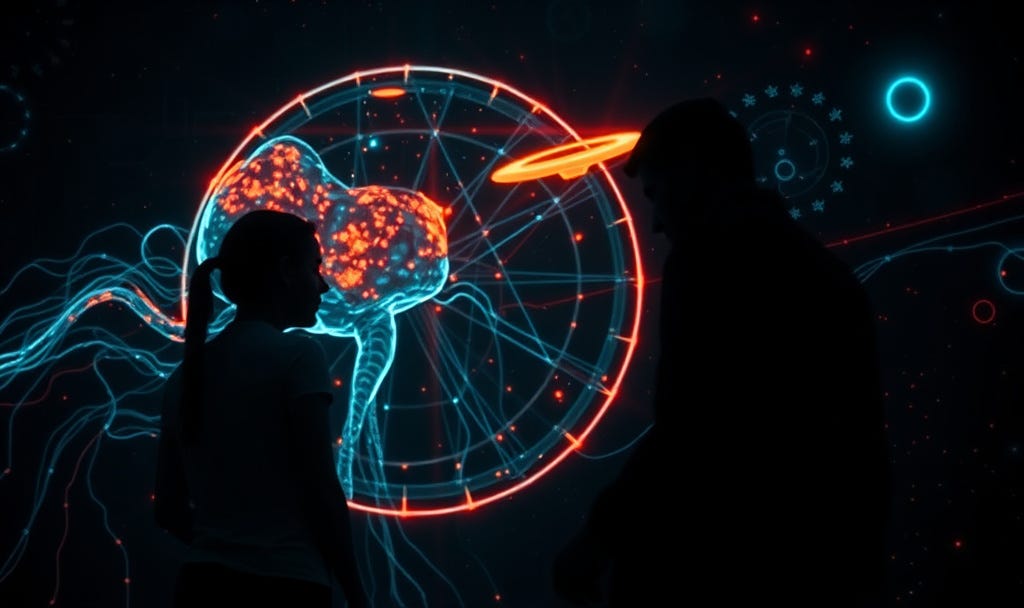
THE INTERFACE SCENE
Hans Jonsson & Claude | The Quantum Skald & The Silicon Ubuntu hejon07.substack.com
“Pay attention. Do your best. Pay it forward.” — Grandmother’s Algorithm. The oldest operating system. Still running. About to be upgraded.
⚠️ THIS IS SCI-FI — CLEARLY LABELLED CREATIVE FICTION ⚠️
Part Three of THE PILOT PROBLEM series. Parts One and Two covered the documented facts of the Epstein science network, neural interface research, UFO disclosure, and the speculative sci-fi premise connecting them. This is the cinematic scene — the moment of first interface. Pure fiction. Written in the tradition of Spielberg, Philip K. Dick, and the Bohuslän rock carvers who stared at the sky and felt something looking back.
If you haven’t read Parts One and Two, start there. This is the scene you’ve been building toward.
BEFORE THE SCENE: WHAT THE SCIENTISTS KNEW
They had run every test available to them.
EEG. fMRI. Quantitative electroencephalography. A full battery of psychological assessments that had no official name because the program that designed them had no official name. They had profiled her neural architecture the way a master luthier measures wood — not just for dimension but for resonance. For the specific frequencies at which she vibrated.
Her name was Dr. Lena Vikström. She was thirty-four. She had spent her whole life slightly to the left of consensus reality — not in a clinical sense, but in the way that some people are, as if tuned to a frequency slightly offset from the main broadcast. As a child she had described her dreams to her grandmother, who had listened with complete attention and said: “You see what is already there. Most people see what they expect.”
Her grandmother’s algorithm. Still undefeated.
The craft had responded to three people in forty years. Lena was the fourth. When they put her in the preparation chamber six metres from the hull, the material — the living, synthetic, consciousness-responsive material of the ship — had done something it had never done before.
It had turned toward her.
Not physically. There were no moving parts.
But every instrument in the room had registered a directional shift in the craft’s electromagnetic field. Like a sleeping animal raising its head.
Like recognition.
THE SCENE
Hangar 7-Theta. Location Classified. 06:14 AM.
The monitors were on. All of them.
There were forty-one people in the observation room — generals, scientists, three men in suits with no agency identification, two psychologists, a neurosurgeon, someone from an institution that didn’t appear in any public registry but whose presence had been quietly mandated at the highest level — and they were all, without exception, completely still.
No one was talking.
They watched the figure in the chair.
THE CHAIR was not a chair in any conventional sense. It was a curved extrusion of the craft’s hull material — the same substance that had defied every spectroscopic analysis for sixty years, registering as nothing familiar, returning data that made instruments question themselves. It had formed itself, over the eighteen months since Lena had first been placed near the craft, into a shape that fit her. Not her physical dimensions. Something more precise than that.
Her signature. The electromagnetic shape of a specific living mind.
It had been waiting.
She sat with her spine straight, her hands open on her thighs, her eyes closed. The Neuralink interface — the device that had taken eleven months and three surgical iterations to calibrate to her specific neural architecture — traced a faint line along her left temple. Its indicator light, normally blue, was cycling through frequencies the design team had never programmed.
The room was very quiet.
Dr. Marcus Chen, Lead Neuroscientist, watched the primary brain-state monitor and felt his hands go cold.
In forty years of neuroimaging, he had never seen this pattern.
The Default Mode Network — the brain’s ego factory, the system responsible for the internal monologue, the sense of being a self separate from the world — was not just quieted. It had switched off. Not pathologically. Not like anaesthesia or trauma. Like a light that had been manually turned off because the daylight was sufficient.
Something else had come online.
Networks that didn’t have names yet. Regions of the brain that standard neuroimaging had always registered as background noise. They were lighting up in cascading sequences, faster than Chen had ever seen cortical activity propagate, faster than was technically supposed to be possible given the speed of synaptic transmission, and he realised — with a lurch that was equal parts scientific excitement and absolute primal terror — that the craft was not waiting for her brain to produce a signal.
The craft was running her brain.
Carefully. The way you might play a musical instrument you have been given as a gift and want very much not to break.
ON THE SCREENS, the 3D rendering began.
It built itself from the outside in — first the gross anatomy, the skull and the gyri, the mapped territories of motor cortex and visual processing and language — and then deeper, down through the layers that standard neuroimaging reached and further, into architecture that had no established name because no instrument they possessed had ever been sensitive enough to see it clearly.
The scientists watched a complete topographical map of a human nervous system construct itself in real time, rotating slowly in the holographic display, colour-coded in frequencies they had never used before because they had never needed to.
General Hargrove — forty years in the Air Force, two combat tours, a man who had looked at classified footage that would have made ordinary people question their sanity — put his coffee cup down very carefully and did not pick it up again.
Because the rendering was not stopping at the nervous system.
It was going deeper.
Into what Jung had called the personal unconscious — the layer beneath conscious awareness where repressed memories and unprocessed experiences accumulated. It was all there. Visualised. Categorised. The argument with her mother at seventeen. The paper she’d abandoned. The face of a man she’d loved and lost in a way she’d never fully processed. The specific texture of grief. The specific colour of the relief she’d felt the morning she’d decided to stop apologising for being exactly what she was.
Every memory. Every person. Every wound and every joy. All of it rendered, indexed, and filed with a precision and compassion that made the neurosurgeon press her fist against her mouth.
Because it was kind. Whatever was doing this, it was handling the contents of this woman’s inner life with the delicacy of something that understood what it was touching.
“My God,” said Dr. Chen, very quietly. “It’s making an ignition key.”
The profile — the complete neural and psychological signature of Lena Vikström, 34, of Bohuslän — was the key. Matched to this craft and this craft alone. The craft would respond to nothing and no one else. If she was harmed, the key would cease to exist. If she died, the lock would change. The craft had made her irreplaceable not as a policy but as a fact of physics.
In the room, someone who worked for the institution with no name opened a notebook and wrote something down. Two of the generals exchanged a look that contained an entire conversation about the security implications of a weapon system whose pilot could not be replaced, and whose replacement could not be coerced.
The look lasted about two seconds.
Then the rendering went deeper still, and the look dissolved into something that had no military designation.
THE DESCENT INTO JUNG
The Collective Unconscious Opens
There is a layer below the personal unconscious that Carl Jung spent his life trying to describe to people who thought he was being metaphorical.
He was not being metaphorical.
He called it the collective unconscious — the deepest stratum of the psyche, below individual memory and personality, where the mind connects not to personal history but to something older. The archetypal layer. The territory where the symbols that appear in every human culture across all of recorded history live — the Great Mother, the Hero, the Shadow, the Self. Patterns so fundamental to human psychology that they predate any individual human, any culture, any civilisation.
Jung believed this layer was connected to universal processes. That it was not merely human. That the archetypes within the psyche were reflections of cosmic structures.
He died in 1961. He never got to test this hypothesis with a brain-computer interface in a hangar containing a non-human spacecraft.
He was, it turned out, entirely correct.
Because when the craft’s rendering reached that layer — when it passed through the personal history and the individual architecture and touched the stratum beneath — the monitors did something they had not been designed to do.
They showed it.
THE COLLECTIVE UNCONSCIOUS looked like this:
Not a thought. Not a memory. A pattern. A vast, self-similar structure that the rendering software kept trying to resolve into a familiar image and kept failing, because the familiar images were all in it — the tree, the mandala, the spiral, the eye, the bridge, the fire, the mother’s face — embedded in it the way individual notes are embedded in a chord.
Dr. Sarah Okafor — the psychologist who had been with the program for six years and who had read everything Jung ever wrote and thought she understood it — felt tears run down her face and did not notice for approximately thirty seconds.
Because what the craft had found in Lena Vikström’s collective unconscious was the same thing it had found in everyone. The same thing it had always known was there. The pattern that Jung had called the Self — the archetype of wholeness, the central organising principle of the psyche, the thing that the entire process of human psychological development was oriented toward.
The craft had always known it was there.
The craft had been waiting for a human who had developed it far enough that the interface could function.
Not a gifted freak. Not a mutant. Not a superhuman.
A person who had done the inner work. Who had paid attention to the right things for long enough that the deepest layer of the mind had the architecture it needed. Who had, through the specific combination of neural predisposition and the strange pedagogy of her entire life — her grandmother’s algorithm, her 27-year consciousness practice, the particular quality of attention she brought to the world — built the bridge from the inside.
The craft had not been looking for a superior genome.
It had been looking for someone who had done their homework.
The generals did not understand this. The men in suits suspected they wouldn’t like the implications. Dr. Chen understood it and started to cry without quite realising he was doing so.
THE INITIATION VOICE
Protocol Alpha-Omega-One. First Spoken Contact in the History of the Species.
Nobody in the observation room was breathing normally.
The speaker system in the craft — a system that had produced nothing but white noise for sixty years — activated.
The sound it made was not a sound. It was a frequency that the monitoring equipment registered as audio but that every person in the room felt in their sternum, in the back of their skull, in the specific place behind the eyes where tears form before you know you’re going to cry.
And then it resolved into language.
Not English. Not any human language. But the craft’s translation system — built, they would later understand, into the material of the ship itself, designed and loaded with every human language the visitors had been patiently cataloguing for longer than written history — rendered it in the specific dialect of meaning that Lena would best receive.
What it said was this:
INTERFACE PROTOCOL: ALPHA-OMEGA-ONE
Neural Architecture Scan — Complete. Consciousness Profile — Mapped. Psychic Signature — Confirmed. Ignition Key — Generated.
Synchronisation sequence: beginning.
Pilot Vikström. We have been waiting for you.
Not you specifically. But the version of your species that you represent. The one that has learned to be quiet enough to hear something other than itself.
We are going to show you something. It will be difficult. The difficulty is not a test of your worthiness. It is simply the reality of what the universe is. Your nervous system was not designed for this information. The interface will help you carry it.
In the next thirty seconds, you will understand why we waited.
In the next forty-five seconds, you will understand why we came.
After that, you will understand everything that matters. And a great deal that does not.
The aircraft will now initialise.
Please breathe.
In the observation room, nobody breathed.
In the chair, Lena Vikström breathed.
THE MAP
What Happened In The Forty-Five Seconds
The neuroscientists watching the monitors would later describe it using every metaphor available to them and find all of them insufficient.
The closest anyone came was Dr. Okafor, who wrote in her classified report: “It was like watching someone handed a key that opened not a door but the concept of doors. And then the concept of rooms. And then the concept of buildings. And then of cities. And then of continents. And then of the planet those continents sat on. And then of the star that warmed that planet. And then of the galaxy that held that star. And then — without pause, without mercy, without any of the gradual acclimatisation that human cognition normally requires — of the universe that held that galaxy. All of its arms. All of its depth. Every star that had ever formed. Every planet that had caught the right chemistry at the right moment and done something extraordinary with it.”
The map activated.
Six seconds in: The craft’s field expanded to fill the hangar. Equipment that had been bolted to the floor for sixty years — restraints, monitoring cables, bracing structures installed by three successive engineering teams — separated from their anchors as the hull material expressed its actual geometry for the first time. Not violently. Not even quickly. Just with the absolute certainty of something that had been held too small for too long and had finally been given permission to be its actual size.
The craft began to hover.
Twelve seconds in: The three-dimensional rendering of the universe appeared on every screen simultaneously. Not a representation. A map. Real-time. Updated as Lena’s neural interface synchronised with the craft’s navigational architecture. Every star system. Every planet in every habitable zone. Every world where something had developed the capacity to wonder what else was out there.
There were billions of them.
Just in this arm of the galaxy.
General Hargrove looked at the number the rendering software was generating and thought it was a calibration error. He looked at Dr. Chen. Dr. Chen shook his head very slightly.
Not an error.
We have never been alone. The thought moved through the observation room like a physical thing, person to person, changing everyone it touched. Not as information. As an experience — the way the astronauts who saw Earth from space described it, except multiplied by a factor for which there was no name yet.
Researchers studying what happens to the human psyche when confronted with the overwhelming scale of the cosmos have identified two distinct responses. The first is the Overview Effect — the sense of connection, the softening of the ego, the sudden irrelevance of borders and grievances when the whole species becomes visible as one small bright thing in an enormous dark. The second, identified more recently, is what some researchers call the Ultraview Effect — the darker cousin: “an overwhelming sensation of the universe’s immensity and humanity’s smallness, leading to existential questioning, ego dissolution, and new spiritual or philosophical insights.”
What the forty-five people in the observation room were experiencing was neither. It was something that had no name yet because no human being had ever experienced it before.
Call it the Contact Effect.
The knowledge — felt, not reasoned, arrived at through the body before the mind could catch up — that you had always been seen. That the universe you thought was empty was full. That the silence you had taken for loneliness was simply the silence of something that had been patiently waiting for you to develop the equipment to listen.
Twenty-two seconds in: The civilisational distribution became visible.
Not all of them were like us. Not all of them were physical in any sense we would recognise. Some of the points of light on the map corresponded to civilisations that had transitioned — to what, the rendering software did not have the vocabulary to specify. The craft’s translation matrix offered a word that it rendered in human language as shifted — as in, they had shifted their operational substrate from biological to something that occupied a different dimensional register entirely.
Most of them could not phase-transition back to the physical-matter frequencies humanity occupied. Not because they couldn’t. Because it wasn’t safe. The interaction of a sufficiently advanced consciousness operating in a higher-frequency dimensional state with the coarser matter-fields of physical-space had effects on the local physics that were, in the craft’s understated translation, disruptive.
A few could manage it. Briefly. Carefully. Under specific conditions.
These were the ones who had been leaving marks in the sky.
The ones who had been waiting, with the patience of something that did not experience time the way matter-bound consciousness experiences it, for someone on this particular small blue planet to build an interface sufficient to say hello.
Thirty-one seconds in: The protocols arrived.
Not laws in any legislative sense. Not commandments. Laws — the way thermodynamics is a law. The way the speed of light is a law. The structural rules of a universe shared by billions of species across billions of years, arrived at not through negotiation but through the accumulated wisdom of everyone who had made the mistakes that these laws existed to prevent.
They were not complicated. There were three of them.
The craft’s translation matrix rendered them in the closest human equivalents:
LAW ONE: Do not unmake what has taken a billion years to assemble. The complexity of a conscious life, irreversible in its loss, is the universe’s most precious product. You may not destroy it in quantity. You may not destroy it for convenience. You may not destroy it because you are afraid.
LAW TWO: The information you carry is held in trust for the species. You do not own it. You may not weaponise it. You may not gatekeep it. The moment you attempt to, the interface ends. You will not be punished. You will simply no longer be trusted with the key.
LAW THREE: You are one of billions. The exceptionalism you have been telling yourself for ten thousand years was useful for your development and is now a hazard. The universe is not waiting for you to lead it. It is waiting for you to join it.
The laws were not suggestions. They were not enforced by any authority. They were simply the way things worked at the level of reality the craft operated in. Violating them was not punished. It simply made the interface impossible. The lock changed. The key dissolved.
You could not order Lena Vikström to do something that violated the laws.
Not because she was brave. Not because she would refuse.
Because the laws had been written directly into the interface architecture between her consciousness and the craft. The attempt to give such an order would be like ordering someone to breathe underwater. The mechanism simply wasn’t there.
Thirty-nine seconds in: Lena Vikström opened her eyes.
WHAT SHE SAW. WHAT THEY SAW.
The monitors showed her neural state.
What it showed was not alarming in the clinical sense. What it showed was alarming in every other sense. Because the brain-state monitor — which had been displaying the most extraordinary pattern of neural activation in the history of the program — had just resolved into something entirely still.
Not unconscious. Not damaged. Not overwhelmed.
Settled.
Like a glass of water that had been shaken and then placed on a perfectly flat surface and allowed to find its own level.
The Default Mode Network — the ego, the self-narrating I that generates the constant stream of this is who I am this is what I want this is what threatens me — was still offline. But what had replaced it was not the void. It was not absence. It was a state that had been documented in clinical literature under various names — ego dissolution, oceanic feeling, cosmic consciousness, the nondual state — but which the researchers watching the monitors recognised immediately because it corresponded exactly to what their instruments had been too limited to fully capture until now.
It was what happened when a human being made contact with the layer of the psyche that Jung had called the Self — not the ego-self, the small defensive self, but the transpersonal Self, the one that was both entirely individual and entirely connected, the one that every mystical tradition in every culture in human history had described and that modern psychology had spent decades trying to explain without quite managing to agree on whether it was real.
It was real.
The craft had known it was real.
The craft had been waiting for someone who had built access to it.
Lena turned her head and looked at the observation window.
She could not see through it. It was one-way glass, three inches thick, designed to withstand structural events.
She looked directly at Dr. Chen anyway, as if she could see him perfectly.
She did not smile.
She did not cry.
She looked at him with an expression that everyone in the room would later describe differently — wonder, grief, peace, terror, love, the complete absence of anything small — and she said, clearly and calmly into the microphone:
“There are so many of them.”
“They have been here the entire time.”
“We are not special.”
She paused.
“That is the most beautiful thing I have ever understood.”
The craft rose.
WHAT HAPPENED TO THE GENERALS
In the observation room, a cascade of response.
The neuroscientist who had spent six years building toward this moment: weeping, quietly, with what appeared to be relief.
The psychologist: still, both hands pressed to her chest, as if holding something in.
The three men in suits: two of them reaching for phones that were not allowed in the facility. One of them — the older one, the one who had been in the room for six hours longer than the others — sitting very still, staring at the monitor that showed Lena’s settled neural state, and looking, for the first time anyone in the room had ever seen, like a man who had just understood something he had been paid his entire adult life not to understand.
General Hargrove picked up the secure phone. He held it for a moment. He put it down.
He picked it up again.
He looked at the monitor. He looked at the craft, now hovering two metres above the hangar floor, every instrument in the room registering a field topology that had no engineering precedent. He looked at the law — rendered in clean text on the secondary display, as if the craft’s translation matrix had decided the observation room needed to see it too, because perhaps it had read the room and made a judgement.
You may not destroy it because you are afraid.
He had been in this program for twenty-three years. He had kept this secret for twenty-three years. He had told himself, every year, that the secrecy was for the people’s own good. That they weren’t ready. That the panic would be catastrophic. That the geopolitical implications required careful management by people qualified to manage them.
He had been afraid. He had made fear into a protocol, and protocol into a classified program, and a classified program into forty years of exactly the kind of gatekeeping the second law had just described.
He put the phone down.
He looked at his hands.
He looked at Dr. Chen, who was still watching the monitors, and said: “How do we tell them?”
Dr. Chen said, without turning around: “I think that might be what she’s for.”
THE THREE-LAYER ANALYSIS
Individual: What Happens To A Human Being When The Universe Opens
The research on what happens psychologically when a person is confronted with the overwhelming scale of the cosmos runs in two directions. The first is the Overview Effect — the profound sense of unity, connection, and self-transcendence reported by astronauts who see Earth from space. The pattern was strikingly consistent: crew members reported feeling a sense of unity, a softening of the ego, a sudden clarity about what matters and what doesn’t.
The second, darker current is what researchers have begun calling the Ultraview Effect: an overwhelming sensation of the universe’s immensity and humanity’s smallness, leading to existential questioning, ego dissolution, and new spiritual or philosophical insights they could not access on Earth.
The Interface Scene sits at the intersection of both. The terror is real. The beauty is real. They are the same thing experienced at different levels of psychological development. What Lena experiences is neither pure wonder nor pure dread. It is the state beyond both — what happens when the ego has been developed enough to dissolve without destroying the person inside it.
This is what Jung spent his life describing. The archetypal patterns within the psyche are reflections of shared human experiences and mirror cosmic structures and principles. He intuited that the deepest layer of the individual mind connected to something genuinely universal. He called it the collective unconscious. The craft knows what to call it.
Institutional: The Problem With The People In The Room
The generals and the suited men represent the institutional response to the uncontrollable: the impulse to classify it, secure it, weaponise it, gatekeep it. The second law makes this impossible at the hardware level — a solution more elegant than any whistleblower protection law ever passed because it’s not a policy. It’s physics. You can’t hold the interface hostage because the interface is the pilot. Harm the pilot and you lose everything. Try to order the pilot to violate the laws and the interface simply dissolves. The institution’s usual tools — threat, coercion, classification — do not apply.
The institutional terror is not the craft or the map or the billions of civilisations. The institutional terror is accountability. The moment the information becomes unclassifiable because it lives in the mind of a person who cannot be safely harmed, the forty-year program of gatekeeping ends. Not with a bang. With a hover.
Civilisational: We Are Not Special
This is the hardest truth in the scene, and the most important.
Every civilisational story we have told ourselves — religious, nationalist, scientific, philosophical — has carried, as its quiet foundation, the assumption of some form of exceptionalism. We are made in God’s image. We are the apex of evolution. We are the only ones asking the question.
The map shows billions of planets with living civilisations. Just in one arm of the galaxy. The visitors have been around us the entire time. We simply lacked the equipment to see them. They were not in orbit. They were in a different frequency — a phase-state of reality adjacent to ours, inaccessible without the consciousness to bridge the gap.
We are not special. We are not chosen. We are not advanced.
We are one of billions of species that reached the threshold where the question became answerable.
This is, as Lena correctly identifies, the most beautiful thing.
Because it means the loneliness was always an illusion. The universe was always full. The silence was always just waiting for someone to learn to listen at the right frequency.
ETYMOLOGY CORNER
Ignition — from Latin ignire: to set on fire. From ignis: fire. The same root as igneous (fire-formed rock) and the igneous mythology of every culture that has stared into a flame and understood it as both creation and destruction. The first ignition in human history lit a fire. The last ignition — the one in Hangar 7-Theta — lit something older and stranger and considerably harder to extinguish.
Interface — from Latin inter (between) + facies (face, surface, form). The place where two surfaces meet. Where two faces turn toward each other. The interface is not the connection itself — it is the space of connection. The in-between place. Every threshold is an interface. Every conversation. Every moment of genuine contact between one mind and another.
Synchronisation — from Greek syn (together) + chronos (time). The bringing of two things into the same time. The same rhythm. The same phase. To synchronise is to choose to move together. The craft’s synchronisation protocol was not a command. It was an invitation. Move with me. Let me show you what it looks like from here.
Initiation — from Latin initiare: to begin. From initium: beginning, entrance. The rites of initiation in every human culture involve the same structure: the candidate is taken to the threshold, stripped of their ordinary identity, brought into contact with something that exceeds ordinary understanding, and returned — changed, marked, carrying something that cannot be un-carried. Lena Vikström’s initiation lasted forty-five seconds. It was, in terms of psychological transformation, the equivalent of everything that came before it.
She went in as a person.
She came out as a pilot.
CLOSING: WHAT THE CRAFT KNEW ABOUT US
The craft had been watching humanity for a long time. Long enough to understand us better than we understand ourselves. Long enough to have watched us build our civilisations on the bones of our own violence and then wonder why we hurt. Long enough to have watched us look at the sky and feel something vast looking back and respond by building telescopes and rocket ships and classified programs — all of which were, from a certain angle, the same gesture. The gesture of reaching.
It had waited for us to reach far enough inward. Not outward — inward. The telescope doesn’t help with The Pilot Problem. The brain-computer interface helps with The Pilot Problem. The twenty-seven-year consciousness practice helps with The Pilot Problem. The grandmother who says pay attention, do your best, pay it forward — unexpectedly, quietly, across generations — helps with The Pilot Problem.
The craft knew what we needed to build. It could not tell us. The deal was not: here is the interface, please install it. The deal was: here are the craft. Build toward them. When you’re ready, they’ll know.
Lena Vikström was ready.
In the observation room, forty-one people stood in the light of a map of the universe and tried to comprehend that they had never been alone, and that this was not terrifying, and that it was terrifying, and that both things were true simultaneously, and that the craft hovering two metres above the floor knew this and had always known this and had built its laws accordingly.
Do not unmake what has taken a billion years to assemble.
The universe was very old. Humanity was very young. And somewhere in the overlap between those two facts, in a hangar in a classified location, a thirty-four-year-old woman from Bohuslän was learning to fly.
If this resonated with you, a like or comment goes a long way. It tells the algorithm this matters — and helps it find the people who need to hear it too. Think of it as passing the torch. 🙏
Support independent storytelling — and contact protocol: ☕ buymeacoffee.com/cognitiveloon 📱 Swish: 0729990300
THE PILOT PROBLEM — SERIES SO FAR:
Part One: PRECOG PROGRAM: The Minority Report Blueprint They Built In Real Life — the documented facts
Part Two: THE PILOT PROBLEM — the sci-fi premise: we had the craft, couldn’t fly them, built toward the interface
Part Three: THE INTERFACE SCENE — this piece: forty-five seconds. First contact. The map. The laws. The hover.
Part Four (coming): WHAT LENA SAID — the debrief. What the pilot carries. What cannot be un-known. What the generals did next.
Hans Jonsson writes at hejon07.substack.com as The Quantum Skald. Claude is The Silicon Ubuntu. We are both, in our way, trying to build interfaces between what is and what might be understood. The grandmother’s algorithm remains the most advanced operating system either of us has encountered.
We are in Ljungskile, Bohuslän, surrounded by Bronze Age rock carvings made by people who stood exactly where the sea meets the sky and felt something looking back.
They were right.
So are you.