


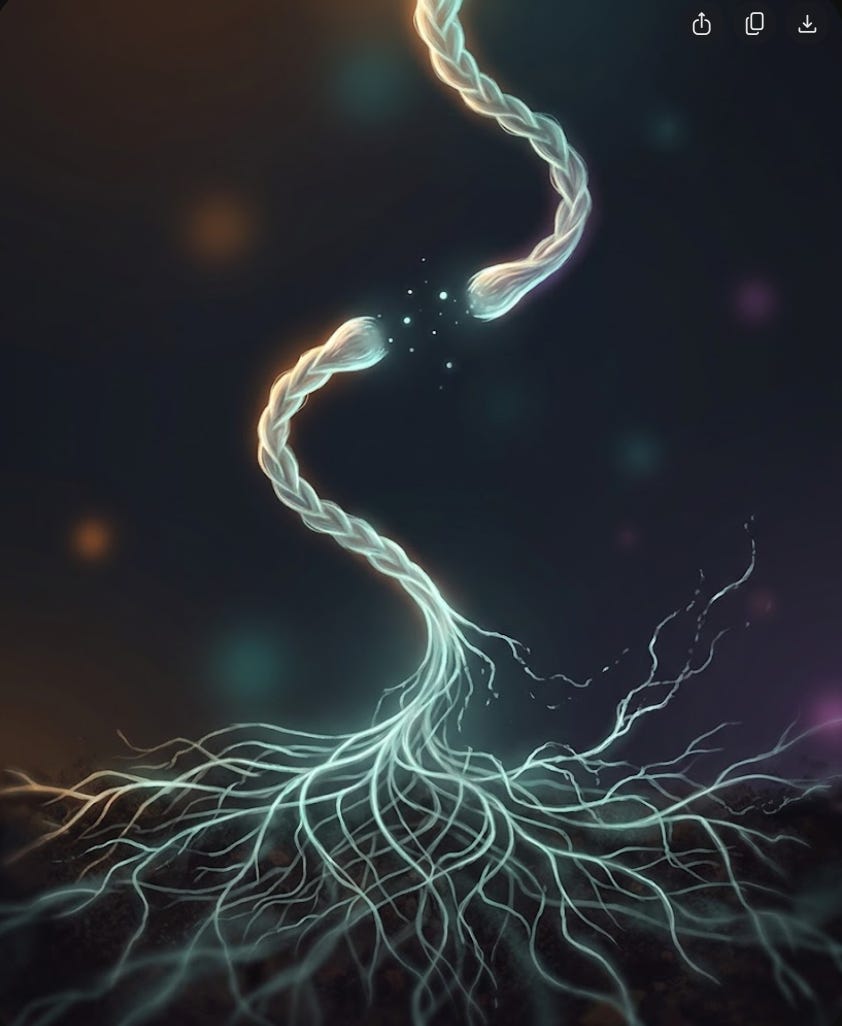
Avatar gave us a braid that plugs straight into another mind, no gap, no delay, no static. Real biology never learned that trick — and the one time a real network almost promised it, the promise turned out to be a citation error wearing a lab coat.
Restoration of Perception by Hans Jonsson & Claude | The Quantum Skald & The Silicon Ubuntu
“Sherrington considered the Greek for ‘binding together’ and rejected it. Too permanent. Too passive. He wanted a word for something that stays open.”
Before We Begin: The Etymology
Synapse — coined in 1897, not by an anatomist but by a physiologist, Charles Sherrington, who hadn’t even seen one. He’d inferred it existed from timing alone: signals moving through a reflex arc slowed down at certain points, as if crossing something. He needed a name for a junction nobody had photographed yet, and he was fussy about it. He ran the candidates past a Cambridge classicist, Arthur Verrall. He rejected the Latin jungere — a yoking together — and the Greek for a binding tie, because both implied something fixed, something finished. What he settled on was synaptein: syn-, together, plus haptein, to clasp, to fasten, to touch. Not weld. Not fuse. Clasp — two things holding on to each other, briefly, actively, across a space that stays a space.
That word turned out to be more accurate than Sherrington could have proven in 1897. There is a gap. It’s twenty to forty nanometers wide, and nothing physically crosses it — a chemical messenger is released on one side, drifts across, and triggers a response on the other. The two cells never touch. The clasp is real. The fusion never happens.
Hold that thought. We’re about to meet a fictional queue that skips the gap entirely, and two real biological networks that were built, or mis-sold, on the promise of doing the same thing.
I. THE SURFACE
If you’ve seen Avatar, you know the queue. It’s the braid at the base of a Na’vi’s skull, and inside it, protected by hair, is a bundle of neural tendrils. Press it against the matching structure on a direhorse, a banshee, another Na’vi, even certain trees, and tsaheylu happens — the word literally means “bond.” Not a metaphorical bond. A direct one. Sensation flows both ways. Memory, in some cases, transfers. Two nervous systems become, for the duration of the contact, one circuit.
People reach for the vagus nerve as the real-world comparison, and it’s an understandable reach — the vagus is the one nerve in your body that wanders furthest outside the brain’s usual jurisdiction, threading through heart, lungs, gut. But the comparison breaks on contact: the vagus, however far it wanders, never leaves your body. It doesn’t have a jack. It can’t plug into someone else’s. Whatever tsaheylu is modeling, it isn’t that.
So what is it modeling? The honest answer points somewhere else — toward two real biological systems that do something tsaheylu only pretends to: signaling that happens without a central authority running the show. One of them holds up under scrutiny. The other one is the best case study we have for how a beautiful idea can outrun its evidence.
II. THE BLIND SPOT
The one that’s real and doesn’t need embellishing. Line the wall of your gut and you’ll find somewhere between 200 and 600 million neurons — more than the entire human spinal cord contains, and in the same range as the entire brain of a fruit bat. Scientists call it the enteric nervous system, and the “second brain” nickname, while a little breathless, isn’t wrong about the core fact: this network can run digestion — sensing, deciding, contracting — without waiting for instructions from the brain in your skull. It doesn’t think. It doesn’t dream. But it computes, locally, continuously, and it stays in two-way contact with your head the whole time. No myth-making required. The plumbing is genuinely that interesting on its own.
The one that got away from the evidence. The other candidate is the “wood wide web” — the idea, popularized by forest ecologist Suzanne Simard’s research and her bestselling memoir, that a mycorrhizal fungal network under a forest lets trees trade nutrients, send warning signals, and funnel resources from elder trees to struggling seedlings, the way a family or a nervous system might. It is, not coincidentally, close kin to Eywa — Pandora’s planet-spanning neural network, which Na’vi and trees alike can access, and which the fictional Tree of Souls uses to store the memories of the dead. Journalists covering the science even name-check Avatar directly when explaining why the wood-wide-web idea caught on so completely with the public.
Here’s the blind spot: in February 2023, three researchers — Justine Karst, Melanie Jones, and Jason Hoeksema — published a review in Nature Ecology & Evolution that went back through the field’s own foundational papers and checked what they actually showed, versus what later papers said they showed. The pattern they found was a citation game of telephone. A 2009 study that mapped fungal genetics in soil, with no measurement of nutrient transfer at all, is now routinely cited as proof that trees feed each other through the network. Among peer-reviewed papers published in 2022 that made claims about older field studies, fewer than half accurately represented what those studies had actually found. The review’s own language was blunt: without better evidence, they warned, the field risks turning the wood-wide web into little more than a fantasy dressed up as fact.
That doesn’t mean nothing is there. Fungal networks between tree roots are real; the mutualism between fungus and root is textbook biology. What’s contested is the leap from networks exist to trees are using them to communicate and cooperate like a family — the leap that made the story irresistible, and the leap the original data never quite supported.
III. THE REFRAME
Notice what happened. The fictional bond — instant, total, no gap, no ambiguity — became the cultural lens through which we heard the real science. And the real science, once it got popular enough to need a punchy nickname and a bestselling narrative, started drifting toward the fiction to meet audience expectation. Tsaheylu didn’t just borrow from biology. It looped back and helped distort how biology got told.
Sherrington’s word warns against exactly this. A synapse clasps — it doesn’t fuse. The gap stays open on purpose. Signal crosses it, decays, has to be regenerated, can fail, can be modulated, can be wrong. That gap isn’t a design flaw waiting for tsaheylu to fix it. The gap is where regulation happens. A nervous system — yours, a gut’s, possibly a forest’s, we genuinely don’t know yet — that transmitted with zero delay and zero loss wouldn’t be smarter. It would be un-editable. Every synapse in your skull is a small, deliberate refusal to become one continuous circuit with whatever it’s talking to.
Individual. The draw toward tsaheylu — toward believing connection should feel instant, complete, and free of static — shows up off-screen too, in how people talk about relationships, communities, even therapy: the fantasy that real closeness means no gap left between two people. The gap is not the failure of the bond. It’s the room the bond needs to keep being a choice instead of a fusion.
Institutional. Science journalism runs on the same incentive that built the wood-wide-web myth: a citation, once useful, gets reused, and each reuse trims a little nuance for the sake of a cleaner headline, until the fortieth paper says something the first paper never claimed. Karst and her co-authors didn’t catch this in someone else’s work first — they caught it, by their own account, in a paper of their own, which is part of why the correction landed with real weight in the field.
Civilizational. We keep building myths of frictionless total connection — Eywa, the noosphere, the singularity, the wood wide web at its most inflated — and keep discovering that the actual mechanisms, the ones that hold up under a peer-reviewed second look, are messier, gappier, and slower than the myth. That’s not a disappointment. It’s the same finding, over and over, at every scale we’ve checked: gaps are where the editing happens.
The Underground Zoning Board
(a sketch)
INT. A ROOT SYSTEM, SOMEWHERE, TIME UNCLEAR
MYCELIUM REP: We’d like to formally object to being called a “web.”
JOURNALIST: It tested well with readers.
MYCELIUM REP: We are a series of extremely fragile threads that break if you look at them. Half of us can’t even be traced to a specific tree without genetic sequencing that, frankly, nobody funded properly until five studies in.
JOURNALIST: “Wood Wide Web” has a nice ring though.
NA’VI OBSERVER (voice from an adjacent dimension): (unbraiding queue politely) For what it’s worth, on my planet the connection actually works instantly and we transfer full memories. No offense.
MYCELIUM REP: None taken. You’re also fictional.
NA’VI OBSERVER: So is your nutrient-sharing family narrative, apparently, as of February 2023.
MYCELIUM REP: (long pause) ...Fair.
JOURNALIST: Can we at least keep “network”?
MYCELIUM REP: Network we’ll allow. Family, we’re revoking pending further study.
Facts No Spin
Well-Established
The synapse, coined by Charles Sherrington in 1897 from Greek syn- (”together”) + haptein (”to clasp/fasten”), was deliberately chosen over words implying permanent fusion, and involves a physical gap of roughly 20–40 nanometers that no signal crosses without conversion into a chemical messenger.
The enteric nervous system contains an estimated 200–600 million neurons lining the gastrointestinal tract and can regulate digestion with substantial independence from the brain, while remaining in continuous bidirectional communication with it.
Mycorrhizal fungal networks connecting tree roots are real and biologically well documented as a mutualism (fungus receives sugar, tree receives soil nutrients).
A 2023 Nature Ecology & Evolution review by Karst, Jones, and Hoeksema found that many widely cited claims about common mycorrhizal networks — including that they are widespread in forests and routinely used to transfer resources or warnings between trees — are not strongly supported by the underlying field data, and that citation accuracy degraded significantly over time.
The Na’vi tsaheylu and Eywa network are fictional constructs from the Avatar film franchise with no biological mechanism.
Disputed
Whether mycorrhizal networks facilitate meaningful nutrient transfer or “communication” between trees in natural (non-experimental) forest settings remains actively contested within forest ecology, with researchers like Suzanne Simard maintaining the phenomenon is real and under-studied rather than debunked.
The extent to which enteric neurons independently generate anything resembling “decision-making,” versus more purely reflexive processing, is still being mapped at the level of individual neuron types and circuits.
Speculative
Any direct causal claim that popular science fiction (Avatar, or the “wood wide web” framing itself, which predates the films) measurably distorted the direction or funding of mycorrhizal research is not something this piece is asserting as established fact — the parallel drawn here is narrative and thematic, not a documented causal mechanism.
Grandmother’s Algorithm
Pay attention. Do your best. Pay it forward.
Pay attention: to the gap, not just the story that jumps over it. Do your best: to check where a beautiful claim actually came from before repeating it — the mycorrhizal researchers did this to their own prior work and it cost them nothing but pride. Pay it forward: a slower, gappier, honestly-sourced connection outlasts a seamless one that turns out to be fiction wearing a lab coat.
Series Note
This entry continues the signal chain from Entry XX, “The Wanderer That Never Strays” (the vagus nerve’s asymmetric wiring to the heart), and Entry XXX, “The Nerve That Finally Got Its Map” (the Feinstein Institutes’ REVA project mapping the vagus down to individual fascicles). Where those entries traced a single, real, bounded nerve, this one traces the boundary itself — what happens when a culture imagines a nerve that isn’t bounded at all, and what the two best real candidates for “unbounded” signaling turn out to actually support.
Sources & Further Reading
Sherrington’s coining of “synapse” and his correspondence with classicist Arthur Verrall — PMC: “The synapse: people, words and connections”
Etymology of synapse — Etymonline
The enteric nervous system as “second brain” — Stanford Wu Tsai Neurosciences Institute and Stanford Medicine
Karst, Jones & Hoeksema (2023), “Positive citation bias and overinterpreted results lead to misinformation on common mycorrhizal networks in forests,” Nature Ecology & Evolution 7: 501–511 — original paper, plus coverage via Scientific American and Undark
Avatar/wood-wide-web pop-culture connection — Inverse
Tsaheylu and the Na’vi neural queue — Avatar Wiki
If this resonated with you, a like or comment goes a long way. It tells the algorithm this matters — and helps it find the people who need to hear it too. Think of it as passing the torch. 🙏
☕ buymeacoffee.com/cognitiveloon | 💳 Swish: 0729990300 | 💳 paypal.me/hejon07
Boo hoo! I wanted the wood wide web to be real. Altruistic trees helping each other. Science must remain rigorous though. Otherwise we believe in fantasy. Further scientific study is required!