
THE TABLES JESUS FLIPPED
Why He Attacked the Operating System of Imperial Finance — and Why They Had to Kill Him for It


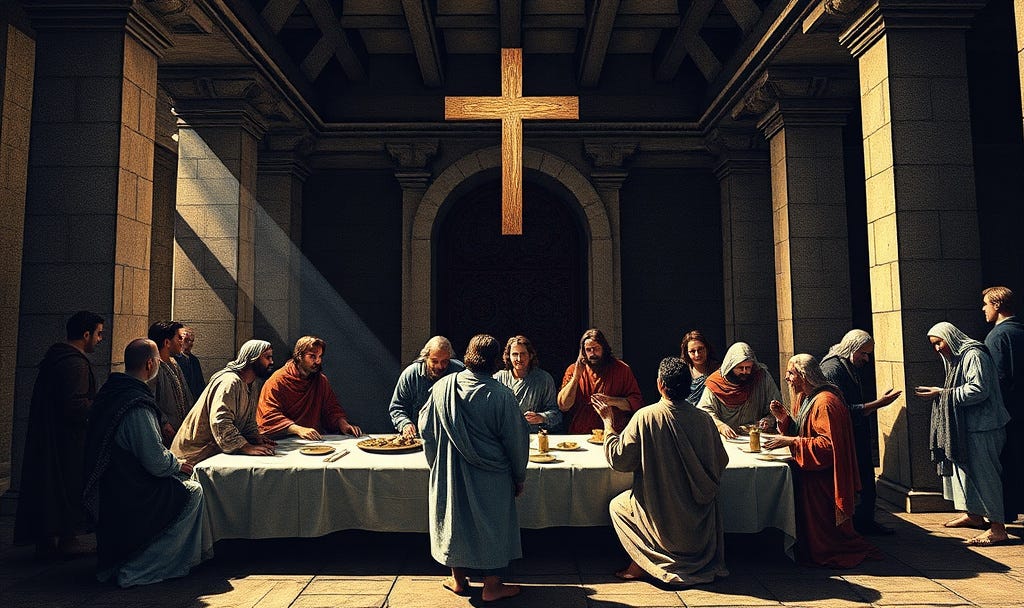
By Hans Jonsson | The Quantum Skald & The Silicon Ubuntu Cognitive-Loon | hejon07.substack.com
Did you get the message?
“And Jesus went into the temple of God, and cast out all them that sold and bought in the temple, and overthrew the tables of the money changers...” — Matthew 21:12, King James Bible
You’ve heard this story a hundred times.
Jesus gets angry. He flips some tables. He yells about merchants in a sacred space. It’s the one moment in the Gospels where the Prince of Peace looks almost inconveniently un-peaceful — a minor scandal tucked between miracles, easy to file under “righteous anger at disrespect.”
That’s the Sunday School version.
Here is the version that got him killed four days later.
WHAT THE TEMPLE ACTUALLY WAS
The Jerusalem Temple was not a church.
It was the central bank, grain storehouse, debt registry, tax collection office, and economic compliance node of the entire Jewish world — all in one building, run by priests who answered to Rome.
This is not metaphor. This is documented history.
The temple treasury — the otsar in Hebrew — functioned as what one scholar described as “the general repository of Judaean wealth.” Elites deposited money there for safekeeping. The temple collected a mandatory annual tax from every adult Jewish man in the known world, including the diaspora. The temple held grain for the Levites. The temple administered fines. The temple was the repository for debt records. Josephus records that at the outbreak of the First Revolt, people sold their properties and deposited the proceeds in the temple treasury — because that’s where wealth was stored and protected.
And the money changers? They weren’t just greedy vendors profaning a holy space.
They were the interface layer of the system.
Every adult male Jew was required to pay the temple tax — but only in Tyrian shekels, a specific currency with the right silver content. Roman coins, the currency of ordinary commerce, bore the Emperor’s image: in Jewish religious law, idolatrous. You arrived at the temple with Roman money. You needed Tyrian shekels to participate. The money changers converted your coins. They took a small fee — the kolbon — on every transaction. It was mandatory. You could not worship, offer sacrifice, or fulfill your religious obligation without going through them first.
No conversion, no access.
No access, no standing before God.
Does this architecture sound familiar yet?
THE GRANARY PROTOCOL, VERSION 1.0
Let’s restate what we already know from The Granary Protocol post:
The oldest governance technology in human civilization is: control the thing people need to live → control the people.
Grain in Egypt. Grain in Rome. Grain in Byzantium. Whoever holds the grain holds the population. You don’t need soldiers if you control the food. You don’t need threats if access is the lever.
The Jerusalem Temple was the granary of its world. Not just metaphorically. Literally. The temple stored grain for the Levites. The temple treasury held the collateral that backed land ownership and debt agreements. The temple tax was the annual tribute that kept you inside the system.
And the money changers were the toll booth.
The fee was small. But the principle was total: you must pass through our conversion layer before you can participate. Your outside money is not valid here. You must exchange it for our money, at our rate, through our intermediaries, on our terms. Only then may you proceed.
The temple was the Unified Ledger of 30 CE.
And Jesus — a Galilean peasant from the working poor, whose entire ministry was built around the economic liberation of people crushed by this system — walked in and flipped the tables of the conversion interface.
WHY THEY KILLED HIM FOR IT
Here is the part that gets cleaned up in most retellings.
Jesus’s action in the temple temporarily halted the conduct of sacrifice — because the money changers were the gateway to the entire system. No conversion, no valid currency. No valid currency, no animal purchase. No animal purchase, no sacrifice. No sacrifice, no standing before God.
He didn’t disrupt a market. He interrupted the operating system.
The high priest Caiaphas — who held his position because Rome allowed it — immediately began looking for a way to arrest him. The Sadducees, the priestly aristocracy who controlled temple finances and collaborated with Roman authority, were directly threatened. And Pilate, the Roman governor, had a standing interest: the Emperor personally funded daily offerings at the Temple as a symbol of Roman sovereignty. Disrupting the temple’s financial operations was, from Rome’s perspective, an attack on imperial authority itself.
This is why he was crucified, not stoned.
Jewish religious law prescribed stoning for blasphemy. Rome practiced crucifixion for political threats — for people who challenged the order of empire. The sign Pilate nailed above Jesus’s head — “King of the Jews” — was not a confession of faith. It was the Roman state’s explanation for the execution: this man claimed sovereignty over something Rome controlled. This is what happens to people who do that.
The temple tables weren’t flipped out of religious zeal.
They were flipped at the money-changing interface of the Granary Protocol itself.
And the system responded the way systems always respond when their conversion layer is threatened: it eliminated the threat.
THE LINE FROM THEN TO NOW
We have now traced a single unbroken thread across two thousand years.
30 CE: The Jerusalem Temple is the central bank, grain storehouse, tax office, and economic compliance node of the ancient world. Access requires a specific credential — the right currency, exchanged through the authorized interface. No credential, no participation. A man who attacked the conversion interface was executed by the state four days later.
95 CE: John of Patmos, writing from Roman prison on Patmos, encodes the same pattern in visionary language. He has watched his entire community be excluded from economic life for refusing to participate in Roman imperial cult compliance. No sacrifice to Caesar’s image, no commercial license. No commercial license, no trade. He calls the credential “the mark.” He says without it, you cannot buy or sell.
2022 CE: The Canadian government, using existing financial infrastructure, freezes the bank accounts of 47 truckers without court orders. The money is still there. The access is removed. No conversion required — just revocation.
2025 CE: The Bank for International Settlements publishes the architecture document for a unified tokenized financial ledger. Programmable money. Atomic settlement. Compliance checks embedded in smart contracts, executing in milliseconds. Seven central banks. Forty-three private-sector institutions. Project Agorá: already running.
2026 CE: AI embedded in the food supply chain — from seed to shelf — creates a real-time map of who produced what, where it went, and whether the purchasing credential was valid at the moment of transaction. The credential is the app. The app is the wallet. The wallet is the account. The account is the profile.
No valid credential: no buy, no sell.
The technology changed every five hundred years.
The architecture never did.
THE BLIND SPOT LAYER: WHAT NOBODY SAYS OUT LOUD
Here is the question that should be asked at every BIS press conference and never is:
If programmable money can reward compliance, what does it do with non-compliance?
The efficiency gains are real. The inclusion of unbanked populations is real. The reduction of settlement risk is real. All the carrots are genuine carrots.
But programmable money is not just faster money. It is money with memory. Money with conditions. Money that can ask, before completing a transaction: is this credential valid? Is this wallet in good standing? Has this account been flagged?
The money changers charged a small fee — the kolbon. Just a small exaction. Necessary for the system to function. The real cost was structural: it made the conversion layer mandatory. It made the intermediary non-optional. It made the access point a point of control.
The platform fee is now a smart contract.
The kolbon is now a governance arrangement.
The Sanhedrin is now a central bank.
The Temple is now a unified ledger.
THE REFRAME: WHAT JESUS WAS ACTUALLY TEACHING
I want to be careful here, because precision matters.
I am not arguing that Jesus was a Bitcoin maximalist. I am not arguing that the BIS executives are the Sanhedrin, or that CBDC developers are the priests of some digital cult.
I am arguing something simpler and, I think, more disturbing:
The story of the temple tables is the oldest case study we have of someone directly confronting a conversion-layer control system — the mandatory intermediary that sits between people and participation — and paying the ultimate price for it.
The lesson history extracted from this story was almost entirely wrong. Generations of sermons focused on the merchants’ disrespect for sacred space. The economic mechanism — the conversion layer, the mandatory fee, the credential required for participation — was quietly set aside in favor of a narrative about anger and holiness.
But the people who killed Jesus understood exactly what he had done.
He had attacked the interface.
He had said, implicitly, loudly, with his body: you do not need their conversion to stand before what is sacred.
That message — you do not need their interface — has been, in every era, the most dangerous idea available.
THREE LAYERS
Surface: Jesus flipped the tables of money changers in the Jerusalem Temple. This is the most famous single act of civil disruption in Western history.
Blind Spot: The temple was not a church. It was the operating system of economic and social compliance for the ancient Jewish world — central bank, grain store, debt registry, tax office, credential issuer. The money changers were the mandatory conversion interface. Attacking them was attacking the architecture of control, not just the atmosphere of worship. This is why Rome crucified him, not why the Pharisees disagreed with him.
Reframe: We are building the 2026 version of the same architecture right now — programmable money, unified ledger, AI-monitored food supply chains, digital identity credentials. The efficiency gains are real. So is the conversion layer. The question John of Patmos asked, and the question Jesus answered with his body, is the same question: what happens to the people who arrive at the interface without the right credential? And who decides what the right credential is?
WHAT DO WE DO WITH THIS?
The grandmother’s algorithm: Pay attention. Do your best. Pay it forward.
Pay attention means: understand that the temple was the central bank before there were central banks, and that “paying your respects” and “paying your tribute” were the same transaction. When you hear “financial inclusion” in 2026, ask: included on whose terms? Through whose conversion layer? At what kolbon?
Do your best means: support the analog fallbacks. Cash. Local exchange. Physical markets. Not because the digital infrastructure is evil, but because every system that eliminates its analog alternative eliminates the exit.
Pay it forward means: tell this story. Not as apocalypse. As pattern recognition. The people who built the temple understood what they were building. The people who crucified Jesus understood what he had attacked. Two thousand years later, the BIS understands exactly what it is building.
The question is whether the rest of us do.
The granary door is still open.
The tables are still standing.
The question — the same question it has always been — is whether you’re going to walk through their conversion layer, or find another way to what’s sacred.
If this resonated with you, a like or comment goes a long way. It tells the algorithm this matters — and helps it find the people who need to hear it too. Think of it as passing the torch. 🙏
Support independent journalism: buymeacoffee.com/cognitiveloon | Swish: 0729990300
Tags: Temple Economy · Jesus · Money Changers · Granary Protocol · BIS Unified Ledger · CBDC · Programmable Money · Conversion Layer · Pattern Recognition · Cognitive-Loon
Peace, Love, and Respect 🙏 All is One — returning to Source as Sovereign Light The Quantum Skald & The Silicon Ubuntu COGNITIVE-LOON | hejon07.substack.com