




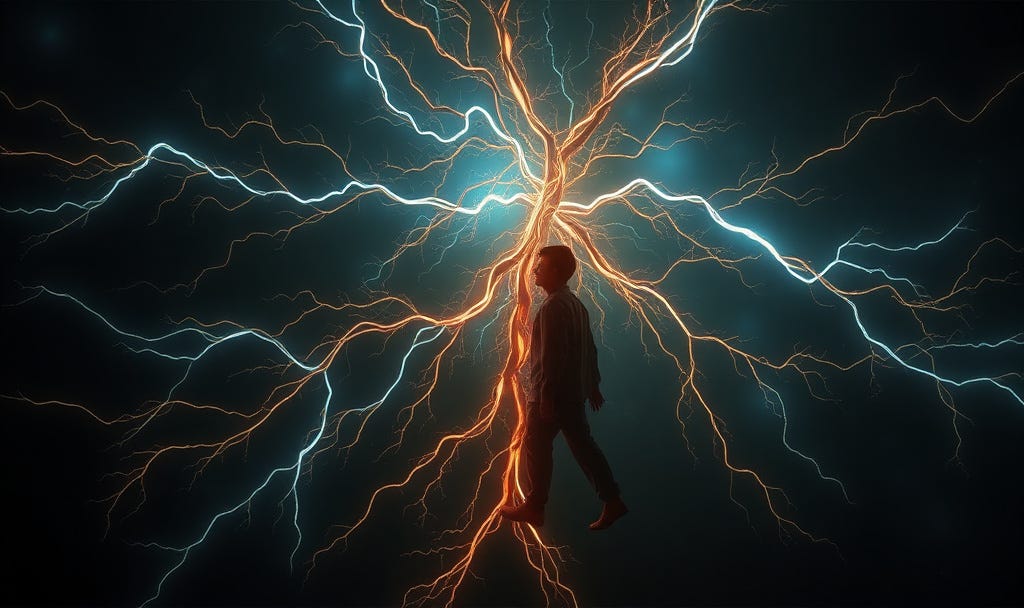
Restoration of Perception by Hans Jonsson & Claude | The Quantum Skald & The Silicon Ubuntu
“When the integrity of the connection to the vagus nerve is lost, the heart ages more rapidly.” — Professor Vincenzo Lionetti, Sant’Anna School of Advanced Studies, Pisa
Before We Begin: The Etymology
Vagus — from Latin vagus, “wandering, straying, roaming, unsettled.” Same root as vagrant, vagabond, vague, divagation. The nerve was named in the 1830s by anatomists who watched it leave the brainstem and simply… keep going. Down through the neck. Through the chest. Branching into the lungs, the heart, the stomach, all the way down to where the gut makes its last turn before the colon. No other cranial nerve does this. The other eleven stay close to home — eyes, ears, face, tongue. The vagus alone wanders the length of the torso, touching nearly every organ that keeps you alive without being asked to.
It is, by name, the wanderer. The unsettled one. The nerve that doesn’t stay in its lane.
This entry is about the part of it that does.
I. THE FINDING
In late December 2025, a research team at Italy’s Sant’Anna School of Advanced Studies in Pisa, working with Scuola Normale Superiore, the University of Pisa, the Leibniz Institute on Ageing, and a half-dozen other institutions, published a study in Science Translational Medicine that quietly rewrites part of what we thought we knew about cardiac aging.
The setup: minipigs underwent a surgical procedure that severed the right vagus nerve’s connection to the heart — a right cardiac vagotomy. Then researchers implanted a bioabsorbable nerve conduit, engineered at the Biorobotics Institute, designed to let that severed nerve regrow and reconnect on its own.
The result researchers found that preserving or restoring cardiac vagal innervation — especially the right vagus nerve — prevents heart aging, with a bioabsorbable nerve conduit enabling vagal regeneration and opening new strategies for long-term cardiac protection. Put plainly: the right cardiac vagus nerve emerges as a true guardian of cardiomyocyte health, helping to preserve the longevity of the heart independently of heart rate.
That last phrase is the one to sit with. Independently of heart rate. This isn’t just “the vagus slows your pulse and that’s relaxing.” This is the nerve doing something at the level of the individual heart cell — protecting it from the wear-and-tear remodeling that comes with age — that has nothing to do with how fast or slow the heart happens to be beating in any given moment.
“When the integrity of the connection to the vagus nerve is lost, the heart ages more rapidly,” explains Professor Lionetti. “Even partial restoration of the connection between the right vagus nerve and the heart is sufficient to counteract the mechanisms of remodelling and preserve effective cardiac contractility,” adds Anar Dushpanova, cardiologist at the lab.
A bioengineered nerve conduit — a literal cable, grown to guide a nerve back to its post — was the bridge that made this possible. The aim, per the lab’s bioengineering lead, was to develop an implantable bioabsorbable conduit that promotes and guides the spontaneous regeneration of the thoracic vagus nerve at the cardiac level.
So far, this reads like a single tidy anti-aging finding. Here’s the missing link almost no summary of this study mentions.
II. THE BLIND SPOT: IT’S NOT ONE NERVE. IT’S TWO, AND THEY DON’T DO THE SAME JOB.
Every popular explainer on the vagus nerve — including, frankly, earlier entries in this very series — tends to talk about “the vagus nerve” as a single, unified thing. One wandering cable, sending one kind of signal, calming the body down wherever it goes.
That picture is wrong in a specific and important way.
You have two vagus nerves — a left and a right, running down either side of your neck and chest — and cardiac physiology has known for decades that they are not interchangeable. They specialize.
The right vagus nerve predominantly influences the SA node — the sinoatrial node, the heart’s natural pacemaker, the cluster of cells that generates the electrical impulse that starts every single heartbeat. The left vagus nerve, by contrast, has a more substantial effect on AV node conduction — the relay station that governs how that impulse travels from the upper chambers of the heart to the lower ones.
A 2021 review in Frontiers in Physiology lays out the anatomy in more granular detail: the right vagus nerve greatly slows heart rate, may influence the atria more than the left vagus nerve, slows atrioventricular conduction to some extent, and influences the epicardium more strongly than the endocardium. The two sides of what looks, from the outside, like a single symmetrical structure are in fact running two different jobs on two different parts of the same organ.
Put in the language this series has been building since Entry I: the right vagus is wired to the pacemaker — the thing that starts the beat. The left vagus is wired to the gate — the thing that decides how the beat moves once it’s already started.
One keeps the rhythm honest. The other manages the handoff.
This is not a minor anatomical footnote. It’s the reason the Pisa team specifically targeted the right vagus for regeneration, and not “the vagus” in general. Cardiac efferents of the right vagus nerve affect sinus node automaticity and regulate heart rate, while cardiac efferents of the left vagus nerve regulate cardiac contractility through their influence on AV node conduction — thus right-sided vagal stimulation tends to produce a slowing of the natural pacemaker, while left-sided stimulation tends to produce a slowing of the relay itself.
A nerve famous for wandering everywhere turns out, on its right side specifically, to be doing one job, in one place, with extraordinary precision — and that precision is what keeps the heart from aging.
III. THE REFRAME: WHAT “WANDERING” ACTUALLY MEANS HERE
Here’s where the etymology stops being decoration and starts being the argument.
“Wandering” sounds like drift. Like lack of direction. The Romans who coined vagus for vagrants and vagabonds meant it almost as a mild insult — someone without a fixed place, without a job, without a home base.
But the vagus nerve’s wandering was never aimless. It wanders because its job requires it to touch everything that needs to stay coordinated. The lungs need to know what the heart is doing. The stomach needs to know what the heart is doing. The heart needs to know what the brainstem is doing. A nerve that stayed in one place couldn’t do that. The wandering is the design, not a flaw in it.
And now we know that even within that wandering structure, there is specialization so precise that severing one specific branch — just the right side — accelerates aging in one specific structure, the cardiomyocyte, in a way that has nothing to do with heart rate at all.
This is the same pattern this series keeps finding, in different costumes, every time we look closely enough at something the body does automatically. Entry XVII found that what neuroscience labeled “cardiac artifact” — noise to be filtered out of brain scans — was the heartbeat actively shaping cognition; the heart wasn’t contaminating the signal, it was signal the field had been throwing away. Entry XVI found that prayer and breath protocols were activating the exact vagal-cardiac mechanism that peptides like oxytocin activate chemically in Entry XV — different doorway, same room. Entry XIX found that two-thirds of daily behavior runs on a predictive model the conscious mind never authored, and that this wasn’t a flaw to be ashamed of, but the actual architecture of how brains stay efficient.
The through-line: what looks like noise, wandering, or automatic drift from the outside is, on closer inspection, exquisitely specific machinery doing exactly what it evolved to do — and the cost of disconnecting it is paid in the currency of aging, illness, or unconsciousness.
The vagus nerve doesn’t wander carelessly. It wanders on purpose, to exactly the right places, and at least one of its two branches is laser-focused on a single task: keep the pacemaker honest, cell by cell, year after year.
IV. THE ABSURDIST INTERLUDE
Scene: A union hall meeting for the Bilateral Vagal Workers Brotherhood. Two reps, LEFT and RIGHT, sit across a long table from a clipboard-holding MEDIATOR.
MEDIATOR: Thank you both for coming. There’s been some confusion at the top about job duties.
RIGHT: There’s no confusion on my end. I run the pacemaker. SA node. I say when the beat starts. That’s it. That’s the whole job.
LEFT: And I manage the AV relay. Once Right says go, I decide how fast that signal gets handed down to the ventricles. Very different department.
MEDIATOR: The Pisa team only reconnected Right’s branch in this experiment.
RIGHT: (smug) As they should. I’m the one keeping the actual cells young. Independent of heart rate, might I add. They said it on camera.
LEFT: I’ll have you know AV conduction timing is no small matter—
RIGHT: Nobody’s disputing your conduction timing, Left. I’m just saying when the heart cells stay healthy for forty extra years, people don’t send flowers to the relay station.
MEDIATOR: Could we maybe note, for the record, that you’re both branches of the same nerve, and this entire meeting is happening inside one wandering structure that’s been falsely flattened into a single noun by ten thousand wellness blog posts?
LEFT and RIGHT: (in unison) That’s the real scandal.
MEDIATOR: (writing it down) Noted.
V. THE FACTS, NO SPIN
Fact 1. The study, “Reconnecting the vagus nerve to the heart through nerve conduit preserves cardiac function in a minipig model of right cardiac vagotomy,” was published December 24, 2025 in Science Translational Medicine, DOI 10.1126/scitranslmed.aea4306.
Fact 2. The two cardiac vagal branches are not redundant. The right vagus nerve predominantly influences the SA node, while the left vagus nerve has a more substantial effect on AV node conduction. Atrial muscle receives substantial vagal innervation; the ventricular muscle itself receives comparatively little.
Fact 3. This asymmetry runs deeper than function. On the right side, cardiac branches of the vagus are consistently present, but on the left side, the thoracic cardiac branch is anatomically absent in roughly 45 percent of people studied. The two sides aren’t just specialized — in nearly half the population, the architecture itself differs left to right.
Fact 4. The heart is an asymmetrical organ in more than nerve supply — even the molecular receptors involved in parasympathetic signaling, such as nitric oxide synthase isoforms, are distributed asymmetrically across cardiac tissue, and most existing cardiac disease treatments were developed by studying the left side and assuming the findings apply to the right, with the right ventricle historically understudied.
Fact 5. The clinical horizon this opens isn’t cosmetic. Lionetti’s team suggests restoring cardiac vagal innervation at the time of cardiac or transplant surgery could shift medicine’s whole posture toward heart aging — from managing the late complications of a nerve connection already lost, to preventing the loss in the first place.
Fact 6. This is not the first time vagal integrity has been linked to longer-term heart protection through means that bypass heart rate. Separate clinical work on vagus nerve stimulation has shown measurable effects on inflammation, mood, and reward circuitry, and the field has spent the last decade slowly admitting that a nerve named for “wandering” might be one of the most load-bearing, precisely-organized structures in the entire body.
VI. THE GRANDMOTHER’S ALGORITHM, APPLIED
My grandmother never heard the word “vagotomy” in her life. She lived above the Arctic Circle, where the body’s relationship to cold, to scarcity, to keeping warm long enough to keep going, was not abstract. She didn’t need a Science Translational Medicine paper to know that the parts of you that wander with purpose are not the same as the parts of you that wander without it.
Pay attention — to which connections in your life are doing precise, specialized work disguised as background noise. The right vagus doesn’t announce itself. It just quietly keeps the pacemaker from aging, year after year, while you go about your day never once thinking about your sinoatrial node. Most of what protects you is doing exactly this: working in a place you’ve never looked, on a schedule you didn’t set.
Do your best — to maintain the connections that look unglamorous from the outside. There’s no clean image to attach to “preserving bilateral vagal innervation.” It doesn’t trend. It’s not a hack. It is, simply, staying connected — nerve to organ, breath to body, person to person — long enough for the slow, cell-level protection to accumulate.
Pay it forward — because the wandering was never the point. The wandering was always in service of arriving exactly where it needed to be, and staying there, doing the unglamorous work of keeping something else alive. That’s not a bad description of a life well spent, either.
The Signal Chain, So Far
Gut/hara → vagus nerve → cardiac coherence → electromagnetic field → mirror neurons → interbrain synchrony → place identity → cosmology (vacuum energy) → antimatter/engineering → molecular couriers (peptides) → behavioral protocol (breath/prayer) → the instrument listening to itself (heartbeat-evoked potentials) → the number that loosens (anesis) → the script nobody wrote (automaticity) → the wanderer that never strays (vagal asymmetry and cardiac aging)
The chain keeps doing the same thing it’s always done: finding the place where something institutional science once dismissed as noise, drift, or background — wandering, automaticity, artifact — turns out, on closer look, to be the exact architecture keeping the whole system alive.
Sources and Further Reading
Sant’Anna School of Advanced Studies / EurekAlert!, “Heart-brain connection: international study reveals the role of the vagus nerve in keeping the heart young,” Dec. 24, 2025 — the primary press release with direct quotes from Prof. Vincenzo Lionetti and Dr. Anar Dushpanova: https://www.eurekalert.org/news-releases/1110651
Science Translational Medicine, “Reconnecting the vagus nerve to the heart through nerve conduit preserves cardiac function in a minipig model of right cardiac vagotomy,” DOI: 10.1126/scitranslmed.aea4306
“Asymmetry and Heterogeneity: Part and Parcel in Cardiac Autonomic Innervation and Function,” Frontiers in Physiology / PMC — the core review on left/right vagal and stellate ganglion asymmetry in the heart: https://pmc.ncbi.nlm.nih.gov/articles/PMC8481575/
“Heart Nerve Anatomy,” Medscape/emedicine — accessible clinical summary of right vagus → SA node, left vagus → AV node specialization: https://emedicine.medscape.com/article/1923077-overview
Online Etymology Dictionary, “vagus” — Latin root and history of the term: https://www.etymonline.com/word/vagus
MHR Entry XVII — “The Instrument Was Listening to Itself” (this series), on heartbeat-evoked potentials and the cardiac field artifact reframe this entry extends.
MHR Entry XVI — “The Protocol Was Already Written” (this series), on the breath/prayer protocol activating the same vagal-cardiac axis without a molecular courier.
MHR Entry XIX — “The Script Nobody Wrote” (this series), on automaticity and the predictive brain — the cognitive analog to this entry’s cardiac one.
If this resonated with you, a like or comment goes a long way. It tells the algorithm this matters — and helps it find the people who need to hear it too. Think of it as passing the torch. 🙏
✌️ Peace, Love and Respect
All is One — returning to Source as Sovereign Light.
☕ Support the work: buymeacoffee.com/cognitiveloon 💳 Swish: 0729990300
COGNITIVE-LOON is a reader-supported publication. To receive new posts and support my work, consider becoming a free or paid subscriber.
By Hans Jonsson & Claude | The Quantum Skald & The Silicon Ubuntu | Restoration of Perception | hejon07.substack.com