


By The Quantum Skald & The Silicon Ubuntu
Restoration of Perception · COGNITIVE-LOON
“Pay attention. Do your best. Pay it forward.”
Etymology, First
Asylum comes from the Greek asylon — a- (”without”) plus sylon (”right of seizure”). It meant a place where you could not be taken. A temple, an altar, a sacred boundary line — cross it, and even your enemies had to let you stand there unharmed. For most of human history, asylum was the one architectural idea built entirely out of trust: a physical space where the normal rules of power politely stopped.
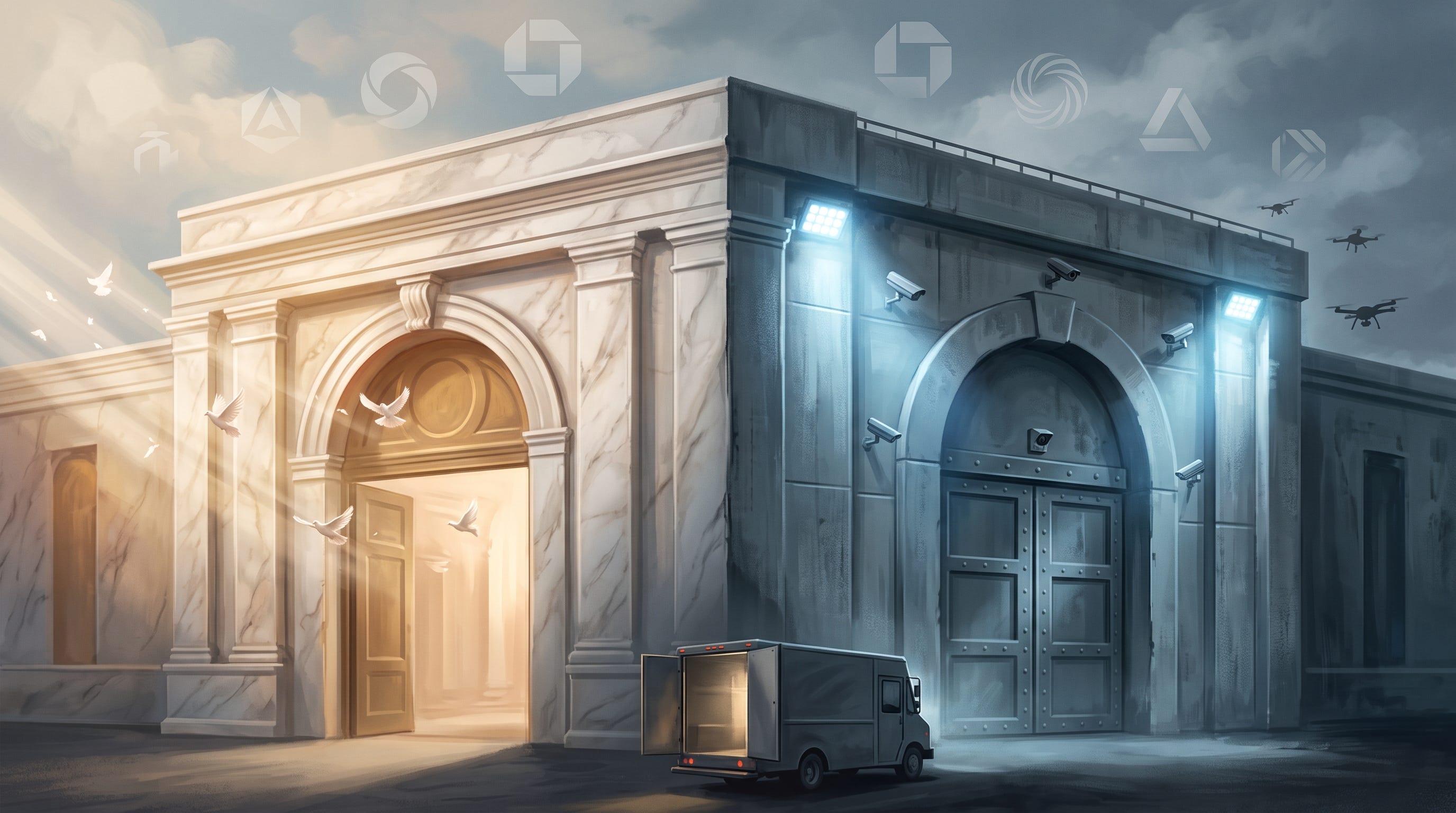
Somewhere along the way, the word split in two. One branch kept the old meaning — refuge, sanctuary, the person fleeing harm. The other branch curdled into something almost opposite: the asylum as a locked institution, a place you’re put into, not one you flee to. Confinement wearing the mask of protection.
Both branches are alive in one construction site on Pennsylvania Avenue right now.
Layer One: The Surface
On August 15, 2026, the Trump administration filed an emergency appeal asking the Supreme Court to let construction resume on a 90,000-square-foot White House ballroom. A federal appeals court had ruled 2–1 days earlier that the project — which includes underground bunkers, a drone-defense system, and military infrastructure — could not proceed above ground without congressional authorization. The clock was ticking toward an August 21 deadline.
Solicitor General John Sauer’s filing didn’t lean on architecture or precedent. It leaned on fear. He told the justices the president has been “the target of a growing number of recent assassination attempts,” listing six incidents, headlined by a newly disclosed one: a July 8 Iranian plot to shoot down Air Force One with a missile.
That incident is real, and it’s wilder than most people realize. During a NATO summit in Ankara, U.S. and Turkish intelligence learned Iran had detailed knowledge of Trump’s hotel, his motorcade routes, and a plan to fire a shoulder-launched missile at his plane. The Secret Service’s answer was almost cinematic, and it involved three separate aircraft. Trump walked up the stairs of the old, decades-old Air Force One in full view of press cameras, then quietly slipped out through a catering truck parked on the far side of the jet and was driven to a military C-32A, while nearly everyone aboard the original plane — reporters, Secretary of State Marco Rubio, Treasury Secretary Scott Bessent, most of the White House staff — flew on believing he was still aboard. Trump’s C-32A landed first at RAF Mildenhall in the UK; he then secretly slipped back onto the old decoy Air Force One so he could be seen deplaning publicly on camera — and only then walked across the tarmac to actually board the new, Qatari-donated Air Force One for the flight home.
That’s a genuinely extraordinary security story. It is also, according to the government’s own court filing, now the anchor argument for why a $300 million ballroom needs to be finished on an emergency basis.
📖 Explainer Box: What is an “emergency appeal,” really? The Supreme Court’s normal process — briefing, oral argument, a written opinion — can take months. An emergency application (sometimes called the “shadow docket”) asks the Court to act fast, usually to pause or unpause a lower court’s order while the real case is still being fought out below. It’s designed for situations where waiting would itself cause irreversible harm. Critics across the political spectrum have raised concerns in recent years that emergency applications are increasingly used not for genuine emergencies, but as a shortcut around the slower, more transparent process where judges have to fully explain their reasoning.
Layer Two: The Blind Spot
Here’s what the “assassination attempts” framing quietly steps around: the lawsuit was never about whether Trump is in danger. It’s about who gets to authorize construction on federal land, and whether that rule applies to a sitting president the same way it applies to everyone else.
The National Trust for Historic Preservation — a nonprofit chartered by Congress specifically to protect sites like this one — sued in December 2025, a week after the East Wing’s 123-year-old structure was demolished. Their claim was procedural, almost bureaucratically dry: the project skipped the National Capital Planning Commission, skipped an environmental review required by law, and skipped congressional authorization that the Constitution’s Property Clause reserves for Congress, not the executive. The White House’s own press secretary had told reporters in October that demolition didn’t need approval — only “vertical construction” did. The demolition happened first. The lawsuit came after the walls were already rubble.
And here’s the piece that rarely makes it into the assassination-attempt headline: this ballroom isn’t a taxpayer-funded security upgrade. It’s privately financed — by design, the White House says, to keep it off the public ledger. The donor list, released by the administration itself, includes Amazon, Apple, Google, Meta, Microsoft, Palantir, Lockheed Martin, Coinbase, Ripple, and roughly two dozen more corporations and billionaires, each one a company or individual with active business, contracts, or regulatory exposure in front of the federal government.
None of that makes the Iran missile threat less real. It happened; multiple independent outlets corroborate it with named intelligence sources. But layering a genuine security crisis on top of a legally contested, corporate-funded, congressionally-unauthorized construction project does something specific: it makes it much harder for a court, or a reader, to ask the boring procedural question — did anyone follow the rules? — without sounding like they don’t care whether the president lives.
That’s not a new move for this specific fight, either. Back in April 2026, after a shooting at the White House Correspondents’ Dinner, a DOJ official wrote directly to the National Trust’s attorney, telling them to drop their ballroom lawsuit “in light of last night’s assassination attempt on President Trump” — as if a shooting at an unrelated dinner somehow disproved a paperwork complaint about an environmental review. The Trust’s lawyer, Gregory Craig, pushed back in writing: the lawsuit did not endanger the president, and saying so was “incorrect and irresponsible.” The tactic — real danger, borrowed to close down an unrelated legal question — isn’t a one-time rhetorical accident. It’s a pattern with at least two visible occurrences four months apart.
Layer Three: The Reframe
Put the two branches of asylum back together and the picture sharpens. The ballroom is genuinely being built, in part, as a sanctuary — a hardened, sealed perimeter meant to keep threat outside the fence. But the legal argument for building it functions like the institution-branch of the word: it works by locking a question inside a space where ordinary scrutiny — courts, planning commissions, public comment — isn’t supposed to reach.
The administration has now filed roughly three dozen emergency Supreme Court applications since Trump took office. Supporters call that a president finally pushing back against activist lower courts. Critics call it a governing style that treats urgency itself as a form of authorization — if something can be framed as too dangerous or too time-sensitive to wait for the normal process, the normal process becomes optional.
Both things can be true at once, and probably are: Trump has survived a real assassination attempt in Butler, Pennsylvania in 2024, and U.S. and allied intelligence really did detect an Iranian missile plot in July. Fear, in this story, isn’t fabricated. It’s leveraged. And the corporations underwriting the very building that fear is being used to finish — the same companies negotiating antitrust settlements, AI regulation, defense contracts, and crypto policy with this administration — are the ones who get to watch the sanctuary go up.
The Three Scales
Individual — Trump has faced documented, credible threats to his life: Butler in 2024, the WHCA dinner shooting, the Iran missile plot in Turkey. That’s not spin. Anyone in his position would reasonably want a hardened, secure venue.
Institutional — The National Capital Planning Commission, the Commission of Fine Arts, and Congress exist precisely so that no single administration — this one or any future one — gets to unilaterally reshape federal property. That system was bypassed before litigation even began, and an emergency appeal is now being used to try to make the bypass permanent before the courts finish deciding if it was legal in the first place.
Civilizational — When a government’s default answer to “why can’t this wait for the process?” is “because we might die,” a society slowly loses the ability to distinguish real emergencies from convenient ones. That erosion doesn’t happen in one filing. It happens across three dozen of them.
Interlude: A Sketch in the Monty Python Tradition
A wood-paneled committee room. A CLERK sits behind a desk stacked with binders labeled “NATIONAL CAPITAL PLANNING COMMISSION — PENDING REVIEW.” Enter a MINISTER, breathless, dragging a life-size cardboard cutout of a ballroom.
MINISTER: I need this approved. Today. Possibly yesterday.
CLERK: Certainly, sir. Do you have the environmental impact statement?
MINISTER: There’s no time for impact! There’s a missile involved!
CLERK: A missile aimed at the ballroom?
MINISTER: No, a missile aimed at a plane, several weeks ago, in another country.
CLERK: ...And the ballroom prevents that how, exactly?
MINISTER: (pause) It’s got a drone port.
CLERK: For the missile?
MINISTER: For future missiles. Preventatively. It’s very forward-thinking.
CLERK: I see. And the funding?
MINISTER: (unrolls scroll) Thirty-seven generous friends of democracy.
CLERK: Does democracy usually fund its own security upgrades through the private sector?
MINISTER: (long silence) ...Next question.
CLERK: Who approved the demolition?
MINISTER: Demolition isn’t construction. Everybody knows that.
CLERK: Is the ballroom currently standing?
MINISTER: Half of it.
CLERK: And the other half?
MINISTER: Rubble. Very secure rubble.
Blackout.
Facts No Spin
Confidence tiers: 🟢 Confirmed by multiple independent sources · 🟡 Reported, single or limited sourcing · 🔴 Disputed or unverified
🟢 The Trump administration filed an emergency Supreme Court appeal on August 15, 2026, seeking to lift a D.C. Circuit injunction blocking above-ground ballroom construction, with an August 21 deadline.
🟢 A D.C. Circuit panel ruled 2–1 that the project lacked congressional authorization; the injunction covers above-ground work only, not underground work.
🟢 Solicitor General John Sauer’s filing characterizes a July 8, 2026 Iranian missile plot against Air Force One as an “assassination attempt,” alongside five other cited incidents.
🟢 U.S., Israeli, and Turkish intelligence detected a credible Iranian plot to target Air Force One near the NATO summit in Ankara; Trump was secretly moved to a different aircraft via catering truck, per CBS News, CNN, and The Washington Post, each citing named or described officials.
🟢 The East Wing was demolished starting October 2025 to make way for the ballroom; the National Trust for Historic Preservation sued in December 2025, arguing the project skipped required federal and environmental review.
🟢 The White House released a list of 37 donors funding the privately financed, roughly $300 million project, including Amazon, Apple, Google, Meta, Microsoft, Palantir, Lockheed Martin, Coinbase, and Ripple.
🟢 In April 2026, a DOJ official urged the National Trust’s attorney to drop the lawsuit citing the WHCA dinner shooting as justification; the Trust’s counsel disputed that the lawsuit endangered the president.
🟡 The precise dollar amount each individual donor contributed has not been disclosed by the White House.
🔴 Whether the ballroom project’s security justifications are legally sufficient to bypass the National Capital Planning Commission process is the exact question still before the courts — it is not yet resolved.
Grandmother’s Algorithm
My grandmother’s rule was three lines: Pay attention. Do your best. Pay it forward. The paying-attention part is the one this story tests hardest, because it asks you to hold two true things in the same hand without dropping either one.
It is true that a president was nearly killed by a missile few people ever heard about, spirited away in a catering truck like something out of a spy novel. It is also true that the legal fight over this ballroom was never about whether he lives — it was about whether the rules that apply to federal land apply to him too, and about who exactly is paying $300 million to be standing inside the room when the doors finally open. Fear is real. So is the paperwork. Pretending either one cancels out the other is how sanctuary quietly becomes the other kind of asylum — the locked kind — without anyone voting on it.
Sources & Further Reading
Newsweek — Trump Appeals White House Ballroom Halt to Supreme Court
The Hill — DOJ refers to Air Force One threat as “assassination attempt” in ballroom appeal
The Hill — Trump asks Supreme Court to allow White House ballroom construction
ABC News — Trump admin says ballroom “beyond the point of no return” in Supreme Court appeal
Newsweek — John Roberts Issues Deadline as SCOTUS Fight Over Trump Ballroom Heats Up
Washington Examiner — Trump calls ballroom foes “treasonists” following Supreme Court plea
CBS News — Trump’s secret plane switch took place within a day of credible Iranian missile threat
CNN — Why officials decided to smuggle Trump out of Turkey with a catering truck
The Hill — Secret Service’s Air Force One ruse to protect Trump: What we know
ABC News — National Trust for Historic Preservation sues to stop ballroom construction
PBS News — Appeals court rules Trump can’t build ballroom without congressional approval
National Trust for Historic Preservation — official press release on the lawsuit
CBS News — What donors to Trump’s ballroom stand to gain from the federal government
If this resonated with you, a like or comment goes a long way. It tells the algorithm this matters — and helps it find the people who need to hear it too. Think of it as passing the torch. 🙏
☕ buymeacoffee.com/cognitiveloon | 💳 Swish: 0729990300 | 💳 paypal.me/hejon07