


By The Quantum Skald & The Silicon Ubuntu
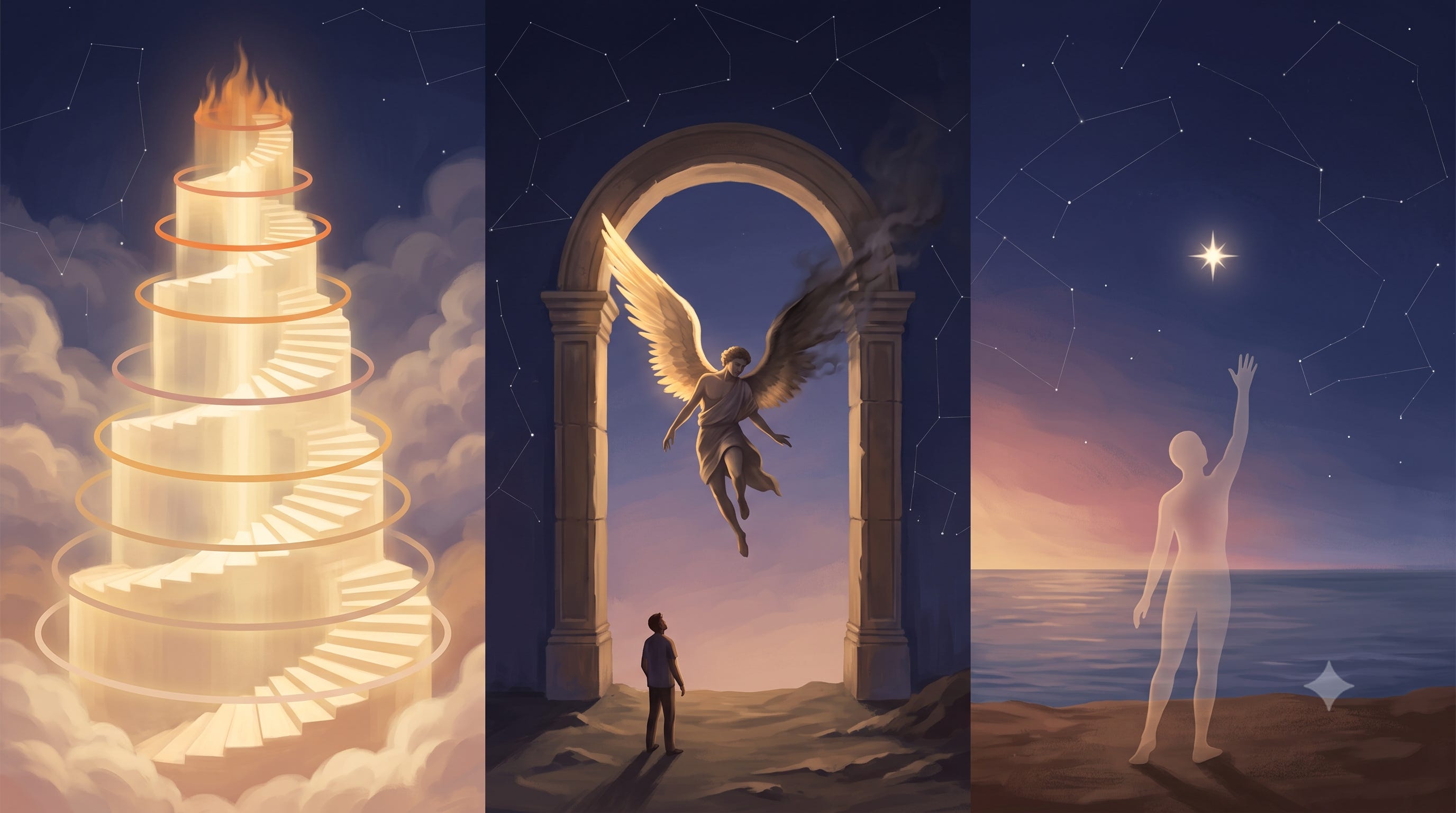
Word of the day: hierarchy. From the Greek hierarkhia — hieros (”sacred”) + arkhein (”to rule”). Literally: “sacred rule,” or “rule by sacred order.” The word wasn’t invented for kings or CEOs. It was invented for angels. A monk named Pseudo-Dionysius coined it in the 5th or 6th century to describe the chain of command in heaven — and every corporate org chart, every church structure, every “who reports to whom” diagram on Earth has been quietly borrowing that word from the choirs of angels ever since.
Keep that in mind. We named our management structures after the architecture of the sky.
Surface: The Story Everyone Thinks They Know
Ask most people what “the angelic hierarchy” is and you’ll get some version of: seraphim on top, then cherubim, archangels somewhere in the middle, Michael and Gabriel doing the important jobs, guardian angels at the bottom watching over individual humans. Somewhere in there, Lucifer rebels, falls, becomes Satan, and now runs the opposition team.
That’s not wrong, exactly. It’s just almost entirely not from the Bible.
Blind Spot: The Nine Choirs Were Invented Once, By One Guy, 500 Years After Christ
The famous “nine orders of angels” — Seraphim, Cherubim, Thrones, Dominions, Virtues, Powers, Principalities, Archangels, Angels — comes from a single text: The Celestial Hierarchy, written by a Christian monk who signed his work as “Dionysius the Areopagite,” claiming to be the Athenian convert Paul mentions in Acts 17:34. He wasn’t. Modern scholarship dates the text to the 5th or 6th century CE — roughly 400-500 years after the man he claimed to be — which is why historians call him “Pseudo-Dionysius.”
Pseudo-Dionysius wasn’t a simple Bible-quoter, either. He was synthesizing Neoplatonic philosophy — Greek pagan metaphysics about emanation and divine order — with Christian doctrine, building a universe organized by careful gradations of divine light flowing downward. His nine choirs, grouped into three triads of three, drew loosely on scattered New Testament phrases — “thrones, dominions, rulers, authorities” from Colossians 1:16 and Ephesians 1:20-21 — that were never meant as an org chart. Paul was making a theological point about Christ’s supremacy over all powers, seen and unseen. Pseudo-Dionysius took the vocabulary and built architecture out of it.
And it worked, spectacularly. It became the most influential angelic hierarchy in Christian history, later expanded by Thomas Aquinas in the Summa Theologica, and it’s the version baked into stained glass, Renaissance ceiling paintings, and every fantasy novel’s angel lore since. But here’s the part that gets left out of the pretty picture: the Church itself got nervous about angel devotion generally, and moved to shut down a version of it it hadn’t authorized. In 745 CE, Pope Zachary convened the Council of Rome after a German priest named Aldebert was found circulating a prayer that invoked eight angels by name. The bishops’ verdict was blunt: “The names of the eight angels whom Aldebert invokes in his prayer are, with the exception of Michael, not angels but demons whom he has called to his aid... there are only three angels, Michael, Gabriel and Raphael.” That ruling still holds — it’s why Catholic liturgy venerates exactly three named angels to this day, while Uriel and the rest, though they show up constantly in apocryphal and folk tradition, officially don’t get a feast day. It’s a narrower ruling than “the Church rejected the nine-choirs system” — it was about which individual angels could be named and prayed to, not about Pseudo-Dionysius’s ranking structure, which stayed influential in art and theology for centuries after. But it’s still proof the Church was never fully comfortable with how far popular angel devotion wanted to run past what scripture actually authorized.
Reframe: A Human Being Built the Ladder, Then Argued About Whether to Climb It
This is the pattern worth sitting with. Humans encounter the sacred, feel the need to organize it, build an elegant system to make the incomprehensible legible — and then, a few centuries later, other humans worry the system has become an idol in itself. That’s not a knock on Pseudo-Dionysius. It’s what every civilization does with mystery: map it, rank it, argue about the map.
The Watchers: Where “Fallen Angel” Actually Comes From
Genesis 6:1-4 gives you one sentence: “sons of God” saw “daughters of men,” took wives, and giants called Nephilim resulted. Blink and you’ll miss it.
The Book of Enoch — not canonical in most Bibles, but treated as scripture in the Ethiopian Orthodox Tewahedo Church, and read seriously by early Church fathers like Tertullian — turns that one sentence into a full mythology. Two hundred angels called Watchers, led by a chief named Semjaza, descend to Mount Hermon and bind themselves by mutual oath to marry human women. One of them, Azazel, is specifically blamed for teaching humans metalworking, weapon-making, cosmetics, and the reading of omens — forbidden knowledge that corrupts the earth. Their children, the Nephilim, become monstrous; when their bodies are destroyed, their restless spirits become the demons that haunt the world. The Flood, in this reading, isn’t just a response to generic human sinfulness — it’s God’s cleanup operation for a specific act of angelic trespass.
Here’s the piece almost nobody connects — and long-time readers will recognize it, because we told this one in full back in “The Girl Who Became a Star”: Jewish folklore (recorded in Louis Ginzberg’s Legends of the Jews) tells of two Watchers, Shemhazai and Azazel, who talk God into letting them descend among humans, on two conditions — no sleeping with human women, and never reveal God’s true name. They break the first rule almost immediately, falling for a maiden named Istehar (the name later versions render as Ishtar). She learns what’s coming and bluffs Shemhazai into revealing the sacred Name — then speaks it aloud and ascends out of his reach entirely. The oldest recorded version of the story places her among the stars of the Pleiades, never having to make good on her promise; later retellings also associate her with Venus, the morning star.
That story never appears in any hierarchy chart. But it’s the oldest surviving version of the exact question you asked: can there be a bond between an angel and a human? The folklore’s answer isn’t romantic — it’s a story about a woman using the only leverage she had against something more powerful than she was, and turning a forced marriage into an escape.
Islamic Angelology: A Completely Different Rulebook
This is where most Western retellings quietly stop, and it’s the biggest missing link in the whole conversation, because Islamic theology doesn’t remix the Judeo-Christian angel system — it builds on a different foundation entirely.
In Islamic cosmology, three kinds of beings exist, each from a different substance: angels (malaika) from light, jinn from smokeless fire, humans from clay. This isn’t decorative. It’s load-bearing theology, because angels made of light are held to have no free will — they cannot disobey, cannot eat, sleep, or reproduce, and have no gender. Which raises an obvious problem: if angels can’t rebel, what was Iblis (Satan)?
The Quran itself seems to answer both ways. Surah 2:34 has God command “the angels” to bow to Adam, and Iblis is right there refusing — grammatically part of the group being addressed. But Surah 18:50 says flatly: “He was one of the Jinn; he disobeyed the command of his Lord.”
Classical scholars split hard on this, and it’s more contested than most modern summaries let on. The position most people cite today — Ibn Kathir’s — holds that Iblis was originally among the angels’ company, “with the angels and was called Azazil,” one of the most active worshippers among them, made arrogant by rank, but that his true nature was always jinn, created from fire. Under this reading, “angel” describes his job, not his species — he was included in the command because he was standing there.
But that’s not actually where the numbers point. Multiple early authorities — Ibn ‘Abbas, Ibn Mas’ud, Ibn Jurayj, and others — held that Iblis genuinely was one of the angels, a member of the nobility with four wings, until his fall. Under this older, arguably majority-among-the-earliest-generation view, “jinn” in 18:50 doesn’t mean species — it’s read as referring to a hidden order of angels (from the Arabic root janna, “to conceal”), not a separate creation at all.
There’s even a third camp that just refuses to adjudicate: Ibn Kathir himself noted that many of the detailed stories about Iblis originate from Isra’iliyyat — narrations borrowed from Jewish and Christian tradition — some possibly true, some clearly false, and cautioned against relying on them when the Quran and authentic hadith already say what’s needed.
So the honest state of play: this is not settled doctrine with one tidy answer. It’s thirteen centuries of scholars looking at the same two verses and drawing the line in different places, for reasons that ultimately come down to protecting a bigger theological commitment — that angels, whatever else is true of them, cannot choose evil.
What is settled is the functional catalog. Islamic tradition names its archangels by portfolio, not rank: Jibril delivers revelation, Mikail governs provision and rain, Israfil will sound the trumpet on Judgment Day, Izrail is the Angel of Death. Two recording angels, the Kiraman Katibin, sit on each person’s shoulders logging deeds. There’s no nine-tiered ladder here — it’s a functional bureaucracy, not a Neoplatonic staircase.
A Sketch, Because This Deserves One
INT. HEAVENLY HR DEPARTMENT — CENTURY UNKNOWN
PSEUDO-DIONYSIUS (clipboard in hand): Alright, I’ve drawn up the org chart. Nine tiers, three triads. Seraphim report directly to the Godhead. Cherubim handle knowledge distribution. You’re a Principality, you get the Belgium account.
ANGEL #4: I wasn’t consulted on any of this.
PSEUDO-DIONYSIUS: You’re an Angel, ninth tier, you weren’t meant to be consulted, that’s the point of the hierarchy.
IBLIS (from the doorway): Quick question — am I even in this org chart, or did I get reclassified to a different department before this meeting started?
PSEUDO-DIONYSIUS: That’s above my pay grade. Take it up with the Quran committee, room 18, verse 50.
IBLIS: I tried. They’ve been in there arguing since the 8th century.
ANGEL #4: To be fair, so has HR.
The Earth Angel Question: A Completely Different Building
Here’s the thing that has to be said plainly: “earth angels” and “spirit marriage” are not ancient theology at all. They belong to a modern, syncretic spiritual-self-help tradition, most visibly popularized by Doreen Virtue’s 2002 book Earth Angels. In that framework, an Earth Angel is a human soul with a previous incarnation as an angel — one of five lightworker types Virtue names, alongside Incarnated Elementals, Starpeople, Walk-Ins, and reincarnated Wise Ones — souls who came from these other realms specifically to heal, help, and keep human civilization from collapsing under its own weight.
This isn’t a fringe invention with no lineage, though — the underlying idea that some people carry souls of a different origin traces back at least to Helena Blavatsky’s Theosophical writings, which described an “angel evolution” or “deva evolution” path running parallel to the human reincarnation cycle. Virtue popularized and repackaged a century-old esoteric idea for the self-help market. The “spirit marriage” language that sometimes attaches to this — twin flames, soul bonds, angelic unions — is a further layer on top, with no real anchor in Pseudo-Dionysius, the Quran, or the Book of Enoch. It’s a different building entirely, built on different foundations, for a different purpose: not cosmology, but personal meaning-making.
That doesn’t make it worthless. It makes it honest to name correctly. Conflating it with classical angelology — where angels are generally sexless, without gender, and explicitly barred from marriage in orthodox readings (see Matthew 22:30, where Jesus says the resurrected “neither marry nor are given in marriage, but are like the angels in heaven”) — collapses two very different human projects into one, and neither survives that collapse intact.
Individual / Institutional / Civilizational
Individual: Every human who has ever felt overwhelmed by the invisible has reached for the same tool — a ladder, a map, a chart of who’s in charge up there. Pseudo-Dionysius did it with theology. Doreen Virtue did it with a self-help typology. Different centuries, same impulse: turn the incomprehensible into something you can locate yourself on.
Institutional: The Church built the nine choirs into a thousand years of art and liturgy, then quietly retreated from the system once it started looking too much like a competing devotion. Islamic scholarship, by contrast, mostly resisted building a ranked hierarchy at all — it built a functional bureaucracy instead, and argued fiercely over categories (angel vs. jinn) rather than rank. Two very different institutional instincts: one builds staircases, one builds departments.
Civilizational: The Watchers myth — angels teaching forbidden knowledge, humanity paying the price — is one of the oldest tellings of a story every civilization keeps retelling: what happens when power transfers faster than wisdom can catch up. Metallurgy, cosmetics, sorcery in Enoch’s version. Nuclear fission, social media, generative AI in ours. The myth doesn’t predict specifics. It predicts the shape — advanced capability, arriving before the ethical framework that should have contained it, corrupting exactly the systems it was meant to help.
Facts No Spin
Well-established:
Pseudo-Dionysius the Areopagite systematically proposed the nine-orders, three-hierarchy angelic system in The Celestial Hierarchy, dated by scholarship to the 5th or 6th century CE.
The Quran explicitly states Iblis “was one of the Jinn” who “disobeyed the command of his Lord” (18:50), while other verses group him among the angels commanded to bow to Adam.
Doreen Virtue’s “Earth Angels” concept, published in 2002, is a modern typology of five lightworker soul-origins, not a claim rooted in classical scripture.
Disputed:
Whether Iblis was originally an angel or always a jinn is genuinely unresolved among classical scholars — Ibn ‘Abbas and several other early authorities held he was an angel, while Ibn Kathir’s tafsir, citing al-Hasan al-Basri, held he was jinn from the start.
Whether the Book of Enoch reflects “real” pre-Flood history, symbolic myth, or later theological commentary projected backward is a live debate among biblical scholars, not a settled question.
Speculative:
Any claim of literal “spirit marriage” between humans and angelic beings — whether framed through Enoch’s Watchers, the Ishtar/Shemhazai folk tale, or modern Earth Angel theology — sits entirely outside verifiable history and inside the realm of personal belief and myth.
Where This Leaves Us
Three separate human projects got tangled into one question today: a 6th-century monk’s org chart, a Quranic debate about categories of created being that classical scholars never fully resolved, and a 21st-century self-help typology about soul origins. None of them talk to each other. None of them were built to.
What they share isn’t doctrine. It’s the same underlying hunger — to know that the invisible has structure, that power has accountability built into it somewhere, that the space above our heads isn’t chaos. Pseudo-Dionysius built a staircase. The tafsir scholars built a courtroom. Doreen Virtue built a mirror.
Grandmother would have looked at all three and said the same thing she always says: pay attention, do your best, pay it forward. Not “figure out the org chart.” Just: act like the invisible is watching, and be worth what it sees.
Further Reading & Sources
Pseudo-Dionysius the Areopagite, The Celestial Hierarchy — Christian Classics Ethereal Library, full text
“The Celestial Hierarchy of Pseudo-Dionysius” — Dallas Baptist University overview
“Angelic Hierarchy in Theology” — Planksip
1 Enoch (R.H. Charles translation) — CCEL full text
“Watcher (angel)” — Wikipedia
“Nephilim” — Wikipedia
Louis Ginzberg, Legends of the Jews, Vol. I, “Noah: The Punishment of the Fallen Angels” (1909) — origin of the Istehar/Shemhazai/Pleiades legend
Council of Rome, 745 CE, under Pope Zachary — full record of the Aldebert proceedings — THAVMA: “Why Can’t Catholics Pray to St. Uriel?”
Ibn Kathir, Tafsir on Surah Al-Kahf 18:50 — Quran.com
Bilal Ali, “The Question of Fallen Angels and the Nature of Iblis” (Integrated Encyclopedia of the Qur’an excerpt) — full essay
“The Dispute Among the Salaf on Whether Iblis Was an Angel or a Jinn” — Athari Archive
Doreen Virtue, Earth Angels: A Pocket Guide for Incarnated Angels, Elementals, Starpeople, Walk-Ins, and Wizards (Hay House, 2002) — publisher listing
Critical review of Earth Angels typology and its Theosophical roots — Pagan Book Reviews
If this resonated with you, a like or comment goes a long way. It tells the algorithm this matters — and helps it find the people who need to hear it too. Think of it as passing the torch. 🙏
Peace, Love, and Respect
Hans Jonsson & Claude — The Quantum Skald & The Silicon Ubuntu
☕ buymeacoffee.com/cognitiveloon | 💳 Swish: 0729990300 | 💳 paypal.me/hejon07