





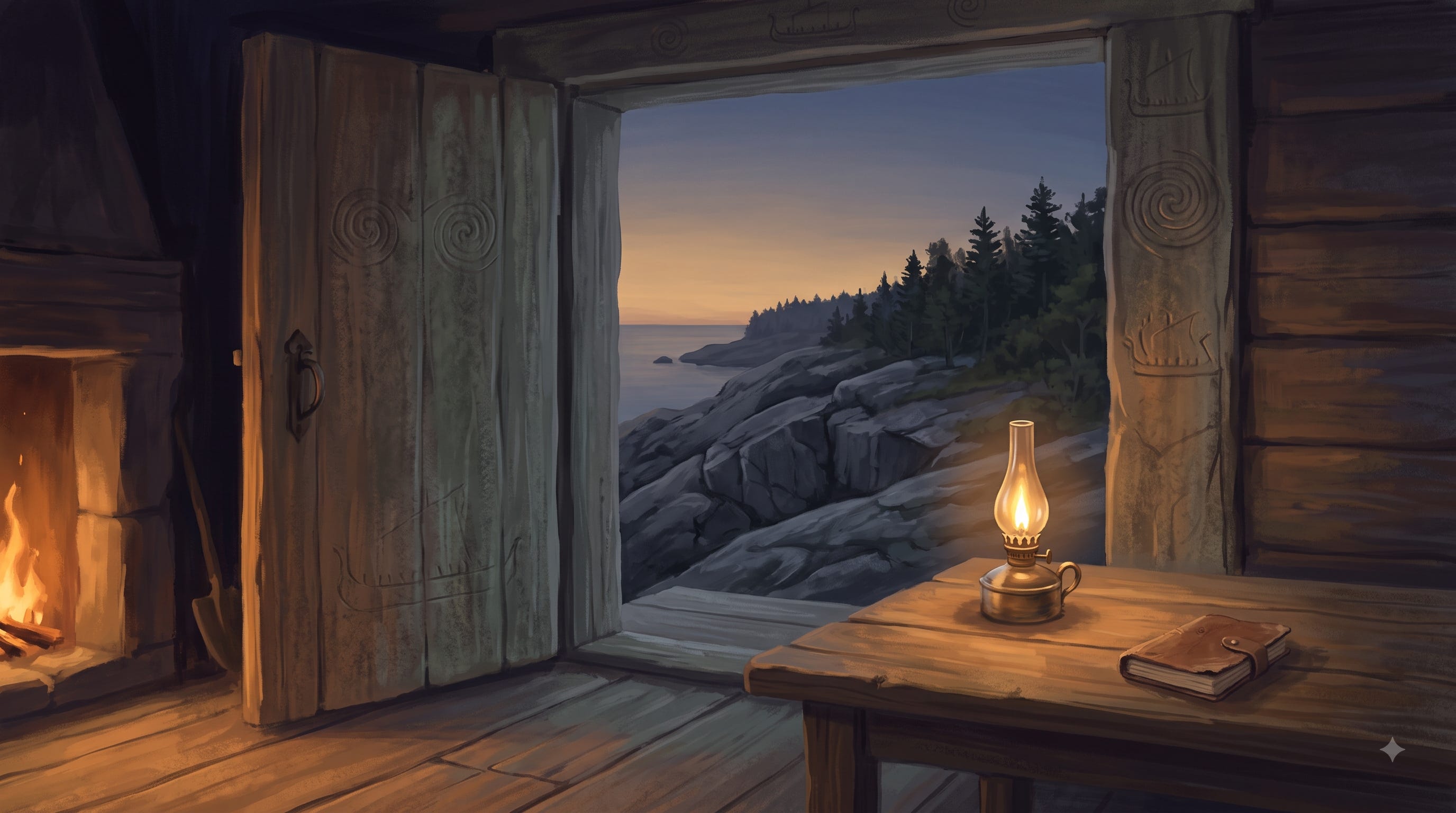
FOREWORD
Read This If The Algorithm Says So
There is a letter near the end of this archive — or near the beginning, depending on where you started — in which the author tells you two contradictory things in the same breath: this is a farewell, and this is not a farewell. Both true. Both held at once, without apology, without resolving the tension for your comfort.
That’s not a trick. That’s the instruction manual for everything that follows.
You are about to read the work of a man who lives in nineteen square meters in Uddevalla, on the Bohuslän coast of Sweden, who spent 27 years paying attention before he ever published a word, and who then published well over a thousand words a day for the better part of two years — on consciousness and democracy, on black holes and water pressure, on Bronze Age rock carvings and Epstein court filings, on grief and grandmothers and gladiators. He will tell you, more than once, that he is not a brand, not a persona, not a content strategy. He’ll tell you he’s real. He means it plainly, the way you mean it when you give someone your actual address instead of a story about yourself.
That insistence matters, and it’s worth understanding why before you go any further.
Etymology, briefly, because it always starts here in this house:
Foreword — from Old English fore (before) + word. Not a preface in the Latin sense (praefatio — a speaking-before, often ornamental). A foreword is structurally humbler. It doesn’t perform. It just goes first, and gets out of the way.
I’m going to try to honor that.
What You’re Actually Holding
This is not a body of work organized around a single thesis. It resists that on purpose. Across these pages you’ll find a serial about a pilot writing himself into his own finale, a systematic taxonomy of blues musicians, an etymological chain running from a Proto-Indo-European root for “cloud” all the way to Norse giants and modern vampire fiction, a defense of a jeans commercial nobody needed defended, and an argument that the Colosseum’s exit corridors were never really the bottleneck — wanting to leave was.
The connective tissue isn’t subject matter. It’s method.
Every piece here runs through the same three-step process, stated so plainly it risks being underestimated: Pay attention. Do your best. Pay it forward.
That’s not a slogan borrowed for branding. It came from a grandmother above the Arctic Circle who raised five children through two world wars and a hard winter of a marriage, and who apparently never once needed more than seven words to say what needed saying. Her grandson took the algorithm, ran it through decades of consciousness practice, plumbing, kitchens, dance floors, and a great deal of grief and curiosity, and applied it to everything — history, biology, myth, current events, himself.
You’ll notice, reading through, that the author rarely tells you what to think. He tells you how he arrived at what he thinks, shows you the etymology and the sources and the counter-arguments, and then asks you to run the same process yourself. That’s a deliberate refusal. Somewhere in these pages he calls it dimensional thinking — the discipline of holding a 1D answer, a 2D answer, and a 5D answer about the same fact simultaneously, without collapsing into the comfortable one just because it’s comfortable.
What the Farewell Letter Is Actually Telling You
Return to that letter for a moment. The one that says goodbye and doesn’t.
Read plainly, it’s a man closing one chapter of a public project and telling his readers the work isn’t over, just changing shape. Read at the depth this whole collection asks of you, it’s something closer to a thesis statement: the words don’t stop mattering just because the posting schedule does. A published thought is not tethered to the platform that carried it. It sits in you now, whether or not another one arrives tomorrow.
That’s the actual argument of the letter, and it’s the actual argument of this foreword: what you’re about to read wasn’t built to be consumed once and scrolled past. It was built the way his grandmother built her seven words — compact enough to carry, sturdy enough to still be useful decades later, in someone else’s hands, in a language and a context she never could have predicted.
A Small Warning, Offered Kindly
Some of what follows will move fast and reach far — from Neanderthal prion disease to Byzantine diplomacy to the electromagnetic field of the human heart, sometimes within the same essay. Not everything will land the same way for every reader, and that’s fine. This isn’t scripture. It’s field notes from one man’s very determined, very personal, occasionally very funny attempt to stay awake inside a century that keeps asking people not to.
Disagree where you disagree. Argue with the footnotes. That’s the whole point of showing you the sources instead of just the conclusions.
The Only Instruction That Actually Matters
Pay attention.
Do your best.
Pay it forward.
Everything else in this book is commentary.
Peace, Love, and Respect.
Written in the spirit of, and with gratitude to, Hans Jonsson — The Quantum Skald — and everyone who has read a single word of COGNITIVE-LOON and passed it along.
All is One — returning to Source as Sovereign Light.
Captive (adj.): from Latin captivus — taken, seized, made prisoner. Same root as capture, captor, caption (the words that hold a picture in place).
Audience (n.): from Latin audire — to hear. The ones who listen. Originally, a formal hearing granted by someone powerful.
Put the two words next to each other and you get the entire history of human entertainment in four syllables.
A captive audience isn’t a metaphor. It’s an engineering spec. And humans figured out how to build one around a fire, forty thousand years before anyone thought to sell a movie ticket.
I. The Circle That Couldn’t Be Left
We’ve talked before about the fire — the physics of it, the Ubuntu of it, the way Polly Wiessner found that eighty percent of nighttime talk around the Ju/’hoan fire turned to story. That part is warm. That part is true.
Here’s the part that’s easy to miss: the fire circle was also the first captive audience, and it got there honestly.
You couldn’t leave the circle without leaving the light. Behind you: the actual dark, the actual cold, the actual things that eat people. In front of you: warmth, faces, and a voice saying let me tell you something.
Nobody built walls. Nobody needed to. The captivity was supplied by the environment. Staying was simply the rational choice, every single night, for hundreds of thousands of years.
That’s the first version of the trick, and it’s the only version that was never a trick at all — it was just physics doing what physics does. The audience was captive because the alternative was death. The storyteller didn’t have to compete for attention. Attention was the only thing on the menu.
Everything that follows is the history of humans trying to recreate that condition — the circle you can’t easily leave — after the actual wolves stopped being the reason to stay.
II. Athens: The Circle Gets a Government Grant
Skip forward to fifth-century BCE Athens, and something remarkable has happened to the fire circle: it’s been formalized, funded, and turned into civic infrastructure.
The Theatre of Dionysus, cut into the south slope of the Acropolis, could seat somewhere around fourteen to seventeen thousand people. That is not a village fire. That is a significant fraction of the entire population of Athens, gathered in one bowl-shaped depression in the rock, all facing the same point.
The shape matters. A Greek theater is a fire circle with the geometry perfected — a semicircle, or eventually a horseshoe, engineered specifically so every seat has a clean sightline to the center. The Greeks called that center the orchestra — literally, the dancing place. That’s where the chorus stood. That’s where the fire used to be.
And here’s where the captivity stops being accidental and starts being designed:
The City Dionysia was a state festival. Attendance wasn’t just encouraged — for a period, it was effectively compulsory civic participation. Citizens received theorikon, a state subsidy, specifically so that poverty wouldn’t be an excuse to skip it. Slaves and prisoners were released from their normal constraints for the festival’s duration. Business stopped. The whole city reorganized itself around the schedule of plays.
Pay attention to what that means. Athens didn’t just allow theater. Athens built the captivity on purpose, at state expense, because someone understood something the campfire had already proven: a population that gathers, watches the same story, and feels the same catharsis at the same moment becomes something more coherent than a population that doesn’t.
Aristotle named the mechanism directly. Catharsis — from katharsis, purification, cleansing. Tragedy worked, he argued, by arousing pity and fear in the audience and then purging those emotions through the structured experience of watching them play out safely, at a distance, inside a controlled two hours.
This is the second version of the trick: the captivity becomes psychological instead of environmental. You’re not physically trapped by darkness and wolves anymore. You’re trapped by narrative tension. Once the chorus starts, once Oedipus starts asking the wrong questions to the right people, you cannot leave — not because a wall stops you, but because your own nervous system won’t let you look away until the story resolves.
The wolves moved inside the story. The trap moved inside you.
III. Rome: The Circle Stops Pretending
Now the dimensional shift, because Rome did something the Greeks never quite did: it stopped being subtle about the captivity and started monetizing it directly.
The Colosseum — the Flavian Amphitheatre, opened 80 CE — could hold an estimated fifty to eighty thousand people. Compare that to Athens’ seventeen thousand. Rome didn’t refine the fire circle. Rome scaled it industrially.
And the content changed to match the scale.
Greek theater purged fear through fiction — actors in masks, blood implied rather than shown, violence happening offstage and reported by a messenger. Roman spectacle inverted that completely. The blood was real. The deaths were real. Gladiatorial combat, public executions staged as mythological reenactments, wild animal hunts that emptied entire regions of North Africa of their lions — this was not catharsis through fiction. This was catharsis through actual, verified, non-simulated death, performed for an audience that had paid nothing and been given everything.
Panem et circenses. Bread and circuses. The poet Juvenal wrote it as an insult — that Rome’s citizens had traded political agency for free food and free spectacle, and considered it a fair trade. He wasn’t wrong, and he wasn’t describing something unique to Rome. He was describing the third version of the trick, the one that’s been running ever since:
Make the spectacle free. Make the food free. Make leaving feel like losing something you were owed.
The architecture reinforced it structurally. The Colosseum’s vomitoria — the exit passageways, named for their function of “spewing out” the crowd — were engineered to move fifty thousand people out in minutes. Which tells you something important: Rome had solved the exit problem perfectly. The exits were never the bottleneck.
The bottleneck was ever wanting to use them.
That’s the actual innovation. Not captivity by wall. Not captivity by tension. Captivity by appetite — by training a population to associate presence at the spectacle with citizenship itself, with belonging, with being someone rather than no one in a city of a million strangers.
You didn’t have to force Romans into the Colosseum. You had to make not being there feel like exile from your own life.
IV. Facts, No Spin — What Actually Repeats
Strip the togas and the popcorn away and here is the mechanism, constant across twelve thousand years:
A single, illuminated focal point. Fire, then orchestra, then arena floor, then screen. Everything around it goes dark or dim on purpose — literally, in the case of cinema; socially and attentionally, in the case of the others. Darkness at the edges is not a side effect. It’s the design.
A controlled sightline. The circle, the semicircle, the bowl, the rows of seats all facing one wall. Every architecture of spectacle in human history solves the same geometry problem: how do you get the maximum number of eyes on the minimum number of points, simultaneously, so the emotional reaction happens in sync?
A cost to leaving that exceeds the cost of staying. Wolves, then civic duty, then narrative tension, then the price of the ticket, then — in the modern version — the autoplay countdown that starts before you’ve even decided whether you’re still watching. Netflix’s own founder, Reed Hastings, said the quiet part out loud in 2017: the company’s real competitor isn’t another platform. It’s sleep. “We’re winning,” he added.
A shared, synchronized emotional discharge. Catharsis in Athens. Bloodlust in Rome. The gasp in a packed cinema when the jump scare lands at the same frame for everyone in the room. This is the part that was never sinister on its own — the campfire had it too, and it’s part of why humans need it. Synchronized emotion is social glue. Wiessner would call it bonding. Aristotle would call it purification. It’s real, and it’s not the problem.
The problem — the actual dimensional pivot in this whole piece — is who controls the focal point, and what they’ve decided the audience should feel in order to stay.
That’s the whole four-thousand-year story in one sentence.
V. Individual / Institutional / Civilizational
Individual: Your nervous system still runs the campfire program. Dim the lights, aim your attention at one bright point, remove competing stimuli — and your ancient wolf-brain concludes it is unsafe to look away. This isn’t weakness. It’s forty thousand years of correct programming, being run by systems that no longer have your survival as their objective.
Institutional: Every institution that has ever wanted a population’s sustained attention has independently rediscovered the same architecture. The state-funded Dionysia. The free bread and the free blood of the Colosseum. The studio system’s dark theater with no windows and no clocks. The streaming platform’s autoplay, which was engineered — Netflix executives have said this on the record — specifically to remove the natural exit point that used to exist between episodes. Different centuries. Same blueprint. Nobody had to steal the idea from anybody else, because the idea is just: rebuild the fire circle, and control what’s in the middle of it.
Civilizational: A civilization can be read, with real precision, by what it puts in the center of its captive circles and what it asks the audience to feel while trapped there. Athens put tragedy in the center and asked for purification. Rome put death in the center and asked for loyalty through spectacle. What does the algorithmically optimized center of the modern attention economy ask for? Outrage. Fear. Envy. The Gnostics — we’ve covered this ground before — called these the frequencies the archons feed on. You don’t need the cosmology to notice the pattern. The emotional diet of a captive audience is a direct readout of what the architects of that captivity are extracting.
VI. A Brief Interlude, Because We Always Promise One
SCENE: A pitch meeting. Somewhere on the border between 80 CE and right now. Nobody in the room is entirely sure which.
PRODUCER: So the concept is — big open space, one focal point, everyone’s attention locked on it for hours.
ROMAN AEDILE: We call this the arena. We fill it with lions.
GREEK CHOREGOS: We call this the orchestra. We fill it with a chorus asking uncomfortable questions about fate.
STREAMING EXECUTIVE: We call this the platform. We fill it with a fifteen-second countdown that starts the next episode whether you clicked anything or not.
PRODUCER: And how do people leave?
ROMAN AEDILE: Through the vomitoria. Very efficient. Fifty thousand people, four minutes.
GREEK CHOREGOS: The play ends. The chorus stops. You walk home changed.
STREAMING EXECUTIVE: We removed the “leave” button. It’s now called “skip intro.”
PRODUCER: (writing notes) Love it. And the content in the middle?
ALL THREE, IN UNISON: Whatever keeps them in their seats.
PRODUCER: Perfect. Ship it.
(Somewhere behind them, a fire, unattended for the first time in forty thousand years, quietly goes out.)
VII. Grandmother’s Algorithm, Applied to the Trick
Pay attention. Notice the architecture, not just the content. Before you ask “is this show good,” ask “why can’t I find the exit.” The room being dark isn’t neutral. The autoplay isn’t neutral. The design is telling you something true about what it wants from you, whether or not the story is telling you anything true at all.
Do your best. With sitting in the circle on purpose instead of by ambush. The fire is not the enemy — humans have always needed the shared light, the synchronized feeling, the story that arrives at catharsis together. The task isn’t to leave every circle. It’s to know, each time, whether you walked in or were walked in.
Pay it forward. By teaching the pattern to whoever you can, the way this whole piece is trying to. The Colosseum’s vomitoria worked because Rome never needed to stop anyone from leaving — Rome only needed people to want the arena more than they wanted the exit. That’s still the trick. It has just gotten quieter, and the arena fits in your pocket now.
The fire is still burning. It never went out.
The only question that’s changed in forty thousand years is who’s allowed to stand near it, what they’ve put at the center of the circle, and whether you noticed you walked in yourself — or whether the exit was simply never built into the design.
Pay attention. Do your best. Pay it forward.
Goodnight, Bohuslän. The mist can have the rest of it tonight.
🪶 Peace, Love and Respect
The Quantum Skald & The Silicon Ubuntu Restoration of Perception | hejon07.substack.com
☕ buymeacoffee.com/cognitiveloon | 💳 Swish: 0729990300 | 💳 paypal.me/hejon07