




The Knights of the Open Web: A Tale of One Browser Standing

Once upon a time, in a land called the Internet (circa 1994), there lived a mighty browser named Netscape Navigator.


By The Quantum Skald & The Silicon Ubuntu
Etymology Opener
Surveillance — from the French surveiller, “to watch over,” itself from Latin super (over) + vigilare (to watch, to stay awake). The word was born for prisons and borders. It has since moved into your shopping cart.
Part One: Fiction — “The Ghost in Aisle Nine”
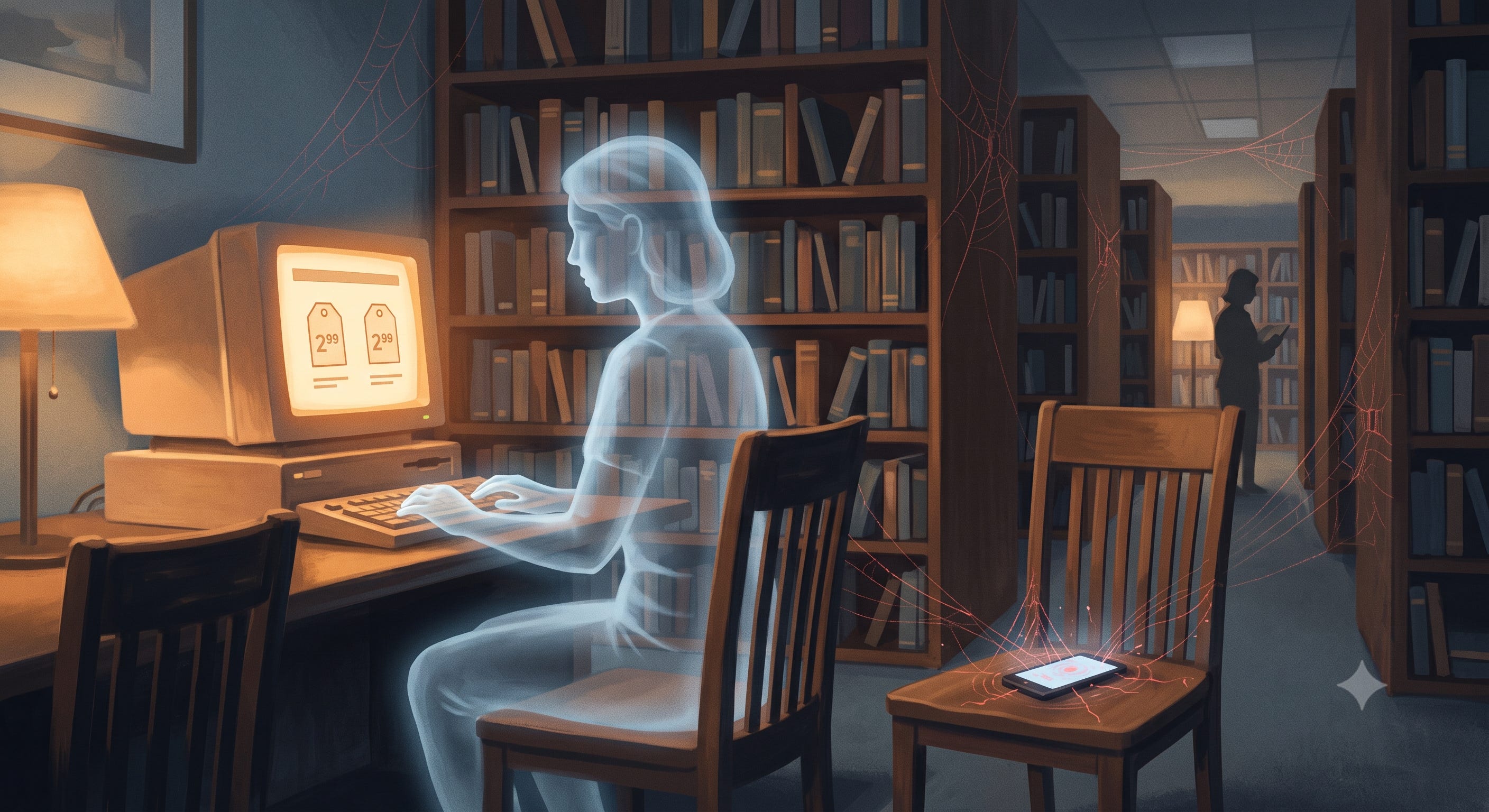
Elin took the bus to the library on a Tuesday, which was, by itself, an act of rebellion.
Not because she needed a book. Because she needed a machine that didn’t know her.
The librarian at the desk — kind eyes, cardigan the color of old moss — asked the same question she always asked. “Just a regular computer?” As if there were another kind. As if regular were a thing you had to specify now, the way you’d specify decaf.
Elin nodded. She was sent upstairs, to a terminal with a chipped E key and a login screen that asked nothing of her except a library card number. No cookies waiting like spiders in the corners of the browser. No advertising ID whispering her whole spending history to the ceiling. Just a blank page, and her.
She typed in the name of the grocery chain. The page loaded slow, patient, the way things load when nobody’s optimizing them to know you.
Toilet paper: 5.99. Blueberries: 5.99. Yogurt: 1.39.
She pulled out her phone — her actual phone, the one that had watched her hover over a couch for eleven minutes last spring and then followed her around the internet with couches for a month — and opened the same site.
Toilet paper: 7.39. Blueberries: 6.49.
The gap wasn’t huge. But it was there, sitting in the numbers like a fingerprint at a crime scene nobody had reported yet.
Elin sat back. She thought about her father, an engineer who used to say there was no such thing as a coincidence in a machine — only a rule you hadn’t found yet. Somewhere, a rule had looked at her phone and decided she was worth more. Not smarter. Not more deserving. Just — more extractable.
She thought about the word ghost. How a ghost is a thing that lingers because it doesn’t know it’s supposed to leave. That’s what she was, on this library computer — a ghost with no data trail, invisible to the machine that priced her out of a cheaper Tuesday.
She almost laughed. To be unprofitable, here, was to be free.
She bought the yogurt. She logged out. She left no crumbs.
Walking back to the bus stop, she wondered how long it would be before the library terminal, too, learned her name.
Part Two: The Real Story — Surveillance Pricing Is Not a Rumor, It’s a Business Model
The fiction above is built from something true, and the true version is stranger and less controllable than any ghost story.
Surface
A wave of social media claims has circulated the idea that shopping from a public library computer — stripped of your personal cookies, login history, and device fingerprint — gets you cheaper prices online than shopping from your own phone. Journalist Lora Kelley tested this directly for Mozilla’s Nothing Personal, comparing Target.com prices from a New York Public Library terminal against the same site loaded on her personal iPhone hotspot. The library terminal won, item after item — toilet paper, blueberries, cereal, all cheaper on the “clean” machine.
Some of the viral claims driving this behavior — like the assertion that a husband saved hundreds on airline tickets by buying them at the library — have circulated to tens of millions of views on social platforms, even as reporters and other users have pushed back on whether that specific mechanism holds up under scrutiny.
Blind Spot
Here’s what most of the viral advice misses: the deeper mechanism isn’t really about “the library” as a magic location. It’s about what your device carries with it everywhere it goes — an advertising ID, browsing history, purchase patterns, even keystroke and scroll behavior — all of which retailers can use to build a real-time profile and adjust the price shown to you specifically, sometimes changing minute to minute. A 2025 staff research summary from the Federal Trade Commission has confirmed that pricing tools now exist capable of generating personalized prices at that frequency. The library computer isn’t lucky. It’s simply anonymous — a blank slate the algorithm hasn’t had time to price against.
That distinction matters, because it means the “trick” isn’t really about geography or which building you’re standing in. It’s about how much of you the browser is carrying. A VPN, incognito mode, a fresh account, a disabled ad ID — these all approximate the same blank slate the library terminal offers by default.
Reframe
What’s being described here is not a shopping hack. It’s a quietly normalized asymmetry of information — one side (the retailer) knows everything about you, and the other side (you) knows nothing about the price you’re being shown, or why. Cybersecurity professional Marc Daniel Sevigny frames it as a two-player game: the company optimizing for maximum revenue extraction per customer, the customer optimizing for the lowest price they can find — an arms race that now requires ordinary consumers to learn VPNs, private browsing, and email-masking just to stand at parity with a machine built explicitly to out-know them.
Consumers have begun fighting back with countermeasures that sound almost like folk magic: leaving items in a cart for 48 hours to seem hesitant, closing an app repeatedly to trigger a discount nudge, deliberately browsing the cheapest items on a site to signal price sensitivity. This is what happens when a population starts poisoning its own data defensively — an entirely reasonable response to being profiled without consent, and also a sign of how far things have drifted from a marketplace of transparent, shared prices.
Individual Dimension
At the individual level, this produces a specific, corrosive kind of paranoia. Kelley describes checking prices at home after the library visit and finding them higher again — and then, tellingly, wondering if it was her fault. Had she taken too many Ubers? Accepted too many cookies? This is the psychological cost of surveillance pricing: it doesn’t just take your money, it makes you suspect yourself, audit your own past behavior for the “crime” that got you a worse price. It’s a subtle inversion — the surveilled starts to police themselves before the surveillor even has to ask.
Consumers are responding with real behavioral shifts. Mental health counselor Brandee Jones has used multiple devices and new accounts to try to get better placement in Ticketmaster queues, describing wildly different queue positions — front of the line on one device, 30,000-deep on another — for identical events on identical WiFi. Certified financial planner Hanna Horvath has adopted small, sustained habits: shopping in person, pausing before handing over an email address, resisting loyalty-program signups that dangle savings in exchange for data.
Institutional Dimension
At the institutional level, regulation is arriving unevenly and slowly. Maryland and Connecticut have already banned certain surveillance pricing practices, while New York and California have legislation pending but not yet in force. Meanwhile, Ticketmaster’s pricing and queue practices for high-demand events have drawn the scrutiny of the U.S. Department of Justice — a signal that this isn’t purely a retail-store issue, but one bleeding into live entertainment, travel, and beyond. Both Target and Ticketmaster declined to comment on their dynamic pricing practices when asked directly, which is itself a data point: silence, in the face of a documented price gap, is a policy position.
Electronic Frontier Foundation technologist Lena Cohen makes the crucial institutional point explicit — disabling an advertising ID is technically simple, but the burden of self-defense shouldn’t sit with individual consumers in the first place. That the tools exist for people to armor themselves doesn’t mean the underlying practice is fair; it means the practice has outpaced the law protecting people from it.
Civilizational Dimension
Zoom out further and this is a story about what happens when the marketplace itself — one of the oldest social technologies humans have, going back to the shared stalls and open haggling of the Bronze Age trade routes not so far from Tanum’s own carved ships — quietly loses its shared, legible prices. A marketplace where everyone sees the same price for the same good is a marketplace built on a kind of civic trust: you and the stranger next to you are playing by the same rules. Surveillance pricing dissolves that. It replaces a shared price with millions of private, opaque, and constantly shifting ones — a market that no longer has a single face, only your face, reflected back at you, priced accordingly.
Comedian Leo Flowers put the moral dimension plainly: it’s an injustice to price people differently based on where they live, and the antidote he proposes is communal — pooling privilege, having the friend who earns least make the purchase, sharing the “clean” device or the less-profiled zip code. Brandee Jones calls it needing “a village.” That phrase, ironically, is the oldest answer humans have ever had to an unequal system: don’t face it alone.
Facts No Spin
A library computer in NYC returned lower prices than a personal iPhone across multiple grocery items tested by a Mozilla-affiliated journalist.
FTC staff research (2025) confirms pricing algorithms capable of generating new prices as often as every minute.
Maryland and Connecticut have enacted bans on certain surveillance pricing practices; New York and California have pending legislation.
Ticketmaster’s ticketing and pricing practices are under active scrutiny from the U.S. Department of Justice.
Both Target and Ticketmaster declined to comment when asked directly about their dynamic pricing practices.
Disabling an advertising ID is a real, available consumer step — but experts explicitly note this shifts a systemic burden onto individuals rather than fixing the underlying practice.
Monty Python Sketch: “The Ministry of Slightly Different Prices”
INT. A GOVERNMENT OFFICE. A CLERK sits behind a desk labeled “BUREAU OF INDIVIDUALIZED VALUE.”
CLERK: Ah, Mr. Palin. Toilet paper, is it?
CUSTOMER: Yes. Just toilet paper.
CLERK: (consulting an enormous ledger) Right, well, according to our records you took an Uber to a wedding in March, hovered over a “premium” mattress for six minutes in June, and — I’m sorry to say — you’ve accepted seventeen cookie banners this month alone.
CUSTOMER: Is that... bad?
CLERK: It’s lucrative, sir. For us. Your price today is 7.39.
CUSTOMER: And if I were, say, a ghost? No history, no cookies, nothing?
CLERK: (brightening) Oh, a ghost rate! 5.99! We love ghosts here. Ghosts have no loyalty program guilt whatsoever.
CUSTOMER: So the way to get a fair price... is to not exist?
CLERK: (cheerfully) Now you’re getting it!
Grandmother’s Algorithm
Pay attention. Do your best. Pay it forward.
Pay attention to what your devices carry on your behalf, without asking. Do your best to leave a lighter trail where you reasonably can — not from paranoia, but from clarity. And pay it forward: share the trick, share the device, share the village. The ghost in the library isn’t hiding. She’s just refusing to be for sale.
Sources
Lora Kelley, “How to Disappear: Shopping Online,” Nothing Personal (Mozilla Foundation), published July 22, 2026 — primary source for the library vs. iPhone price comparison, and all named interviewees (Marc Daniel Sevigny, Caroline Sinders, Lena Cohen of EFF, Hanna Horvath, Brandee Jones, Leo Flowers).
Federal Trade Commission, 2025 staff perspective research summary on dynamic and surveillance pricing tools — cited within the Mozilla piece as the source for the finding that pricing algorithms can generate new prices as often as every minute.
State-level surveillance pricing bans/legislation status (Maryland, Connecticut enacted; New York, California pending) — as reported in the Mozilla piece.
U.S. Department of Justice scrutiny of Ticketmaster’s pricing and queue practices — as referenced in the Mozilla piece.
Illustration credit for the original piece: Dina A. Amin.
Note: Target and Ticketmaster did not respond to Mozilla’s request for comment on their dynamic pricing practices.
☕ buymeacoffee.com/cognitiveloon | 💳 Swish: 0729990300 | 💳 paypal.me/hejon07