


By Hans Jonsson & Claude | The Quantum Skald & The Silicon Ubuntu COGNITIVE-LOON | Restoration of Perception
“You don’t fix three leaks with three buckets. You fix the pipe.”
We’ve spent this year building three arguments that we kept treating as separate stories.
The Sovereign Library argued that your creative work should live in a vault you control, licensed out on your terms, revocable when a platform breaks the deal.
The Sovereign Node: Ticket Edition argued that a fan stuck in position 80,000 while a bot walks straight to the front isn’t a bug — it’s what happens when nobody outside one company can see how the queue actually works.
We Wrote The Books argued that the entire creative economy got fed into AI training runs without consent, without payment, and without so much as a thank-you note.
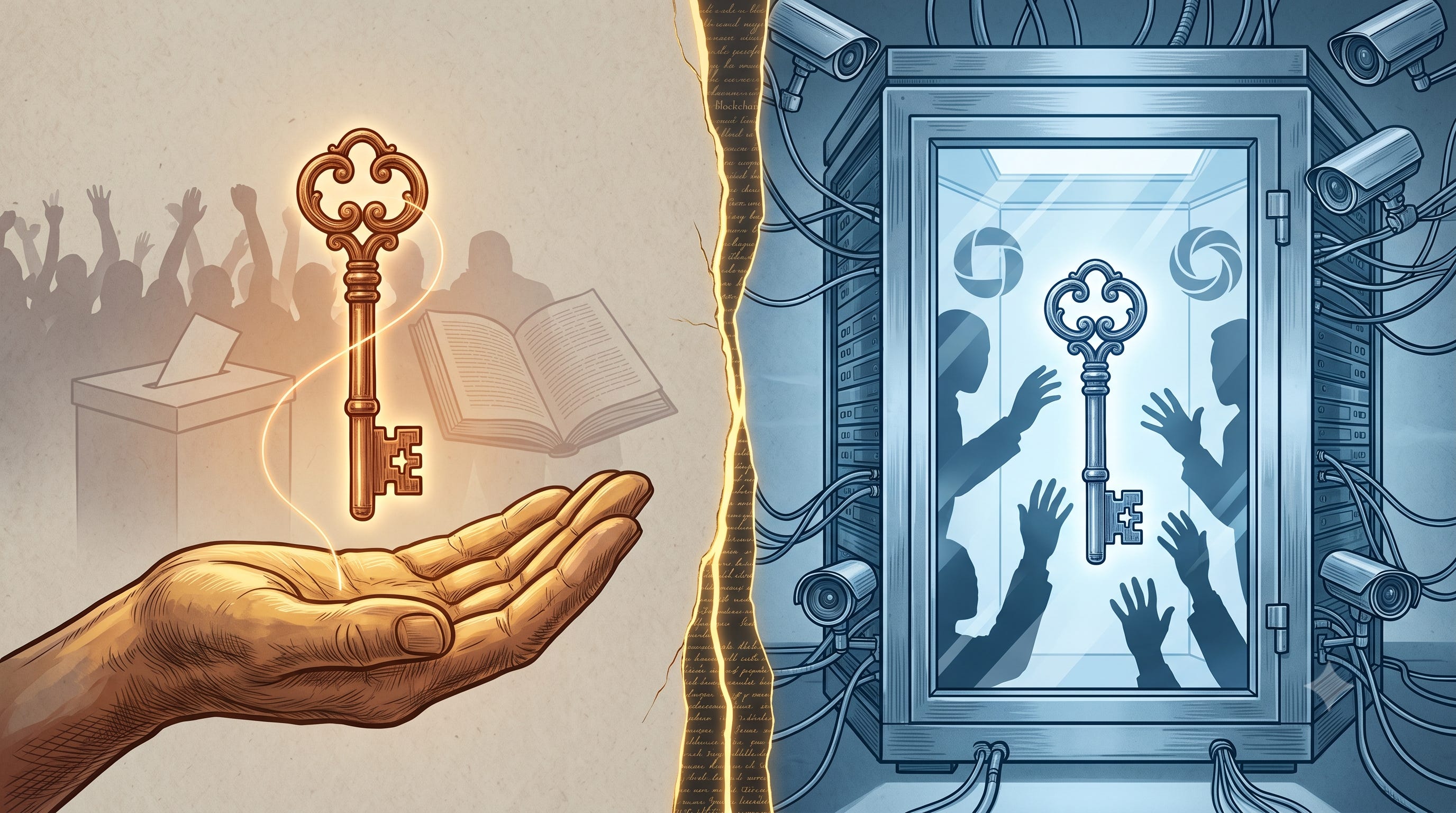
Here’s the thing we missed until a reader — you — connected it out loud: these aren’t three problems. They’re one problem wearing three outfits. In every case, somebody who isn’t you controls a ledger that should belong to you: who owns the work, who’s allowed to touch it and on what terms, and who your actual audience is. Fix the ledger once, and you’ve fixed the queue, the covers, and the training-data question in the same motion.
Let’s build it.
ETYMOLOGY CORNER
License — from Latin licere, “to be permitted.” Not a wall. A door with a lock you hold the key to. The word never meant “forbidden.” It always meant “permitted, on stated terms.”
Ledger — from Middle English legger, something that “lies” in one place — a book that stays put, that everyone can check against, rather than a story that changes depending on who’s telling it.
Fan — from fanatic, from Latin fanaticus, “of the temple.” Someone who shows up not because an algorithm nudged them that day, but because the thing itself matters to them. The oldest fans in history didn’t need a platform to prove it. They just kept showing up.
Put them together and you get the whole proposal in three words: a ledger of licenses, kept honest by the fans who actually show up.
SURFACE / BLIND SPOT / REFRAME
Surface: Streaming platforms rip artists off. Ticketmaster is a monopoly. AI companies stole everyone’s work. Three villains, three outrages, three separate fights.
Blind Spot: All three run on the same missing piece: there is no shared, checkable record of who made this, who’s allowed to use it, on what terms, and who actually cares about it. Because that record doesn’t exist anywhere neutral, every platform gets to write its own version — a Terms of Service nobody read, a queue algorithm nobody can see, a training dataset nobody consented to. Three companies, three black boxes, same root cause.
Reframe: Build the record once, in public, owned by no single company — and license out from it to every platform you choose, on terms that are actually enforced instead of promised. A kid covering your song isn’t a copyright violation you have to chase down. It’s a transaction the ledger already knows how to handle: automatic attribution, automatic small cut, automatic link back to the original — because the permission was written into the work at the moment you published it, not negotiated after the fact by a lawyer. And the same ledger that tracks “who is allowed to use this” can track “who has shown up for this artist, over time” — which is exactly the data a ticket queue needs to reward a real fan over a bot in a trench coat.
THE ARCHITECTURE: ONE LEDGER, THREE JOBS
We already sketched the Vault, the Ledger, and the Kill Switch in the Sovereign Library series. Here’s what changes when you point that same architecture at covers, licensing, and ticketing instead of treating them as separate problems.
Job One: Provable authorship, permissive by design. Every song, essay, or performance you publish gets signed into the ledger at the moment of creation — the same cryptographic fingerprint we described for the Vault. But instead of a blanket “all rights reserved,” you attach a license schema to the work itself: “covers permitted, 10% of resulting revenue routed back to original, attribution link required.” That’s not a EULA nobody reads. It’s a smart contract — code that just does the thing, the moment someone’s cover starts earning money. The kid doesn’t need your lawyer’s phone number. The ledger already knows the deal, because you set it once, at the source.
Job Two: The permission economy replaces the theft economy. This is the direct answer to We Wrote The Books. Right now, AI companies argue they can’t practically license millions of individual works, so they don’t. That argument only works because there’s no standing infrastructure that makes licensing cheap and automatic. A ledger where every work already carries machine-readable terms — “trainable, opt-in, at this rate” or “not trainable, full stop” — removes the excuse. The UMG/WMG v. Udio settlement already proved the industry can build opt-in licensing at scale. There’s no reason that has to stay locked inside major-label deals instead of being available to every independent writer and musician publishing today.
Job Three: The fan ledger is the ticket queue. Here’s the part that ties back to the Ticketmaster piece, and it’s the part we think is genuinely new: the same ledger that records who’s licensed to use your work can also record who has actually shown up for you — bought the album, followed the Substack, attended the last three shows, tipped the busker. Not scraped engagement metrics a platform owns. A record you and the fan both hold, portable across platforms, the way GET Protocol and GUTS Tickets already route resale caps back to artists by code instead of policy.
Ticket allocation stops being “whoever’s account looked most bot-like to a black box” and becomes: verified, ledger-recorded fans get first access, sorted by an honor system that’s actually auditable — years followed, shows attended, direct support given — instead of a queue position nobody can explain. Not a paywall dressed up as loyalty. An actual record of actual attention, the same “pay attention, do your best, pay it forward” principle, encoded as infrastructure instead of left as a sentiment.
The honor system, gamified without being corrupted. This is where the BookForward instinct — Forward Points that unlock capacity rather than cash — belongs here too. A fan doesn’t earn points to resell. They earn standing: earlier ticket windows, a name check in the liner notes, the kind of thing money can’t just buy outright. The moment you let points convert to cash, you’ve rebuilt scalping with extra steps. Keep the reward non-financial and the whole system stays aligned with why anyone became a fan in the first place.
THE ABSURDIST SKETCH: THE NOTARY WHO ACTUALLY READS THE FILE
[Scene: A small office. A NOTARY sits behind a desk stacked absurdly high with identical folders, all labeled “TERMS OF SERVICE.” A MUSICIAN enters holding a guitar and a single sheet of paper.]
MUSICIAN: I wrote a song. A kid on the internet covered it. Am I in trouble, or is he?
NOTARY: (doesn’t look up) Neither. Says here — (taps the one-page ledger entry) — covers permitted, ten percent back to you, link to the original required.
MUSICIAN: That’s it? No lawyer?
NOTARY: You wrote the deal when you published the song. The kid’s cover just... executes it.
MUSICIAN: What about the AI company that wants to train on my back catalog?
NOTARY: (flips to a different tab) Says: opt-in, at your rate, or not at all.
MUSICIAN: And if they train on it anyway?
NOTARY: Then it’s not a philosophical debate about fair use anymore. It’s just breach of contract. Much less interesting to argue about. Much easier to win.
MUSICIAN: (pause) And the concert tickets?
NOTARY: (gestures at a second, much shorter stack) Same ledger. Turns out the people who actually bought your last three albums are the same people who show up to the shows. Wild coincidence.
MUSICIAN: So the bots—
NOTARY: The bots have no listening history. The bots go to the back of the line. For the first time in recorded history.
[The MUSICIAN stares at the one-page folder for a long moment.]
MUSICIAN: This is annoyingly simple.
NOTARY: Most theft only looks complicated from the outside. (stamps the folder) NEXT.
INDIVIDUAL / INSTITUTIONAL / CIVILIZATIONAL
Individual: You stop having to choose between “let anyone use my work for free” and “lock it down so tightly nobody discovers it.” The license terms travel with the work itself, so a twelve-year-old covering your song on YouTube and a Fortune 500 AI lab training on your archive get handled by the exact same mechanism — just with very different terms attached, set by you, once.
Institutional: Platforms — streaming services, ticket vendors, publishers — stop being the only entity that can see the whole picture. A venue doesn’t need Ticketmaster’s blessing to check whether a buyer is a verified fan. A cover-song platform doesn’t need a legal team to know the terms. The ledger is the shared infrastructure; the platforms become channels again, not gatekeepers.
Civilizational: This is the same pattern as the Sovereign Node water tower and the Sovereign Digital Consent medical journal: the fix for concentrated, invisible control was never “find a nicer monopolist.” It’s making the underlying record — of ownership, of permission, of attention — something anyone can check without needing anyone’s permission first. Ticketing, songwriting, and AI training turn out to be the same civilizational question asked three different ways: who gets to hold the ledger, and can the rest of us actually see it?
FACTS. NO SPIN.
Smart contracts already enforce licensing terms as executable code rather than PDF language that lawyers reinterpret after the fact — this is the same mechanism the Sovereign Digital Consent research described for medical records, just pointed at royalties instead.
The UMG/WMG v. Udio settlement established opt-in licensing — copyright owners choosing in, rather than being forced to opt out — as a working precedent in the music industry, not a hypothetical.
GET Protocol, GUTS Tickets, and SeatlabNFT are already running blockchain-verified ticketing for real festivals and venues in Europe, with resale caps and artist cuts enforced by code rather than policy memo.
TIX, built by ex-Ticketmaster veterans, has already facilitated real ticket sales and venue financing on a public ledger — small next to Ticketmaster’s scale, but operating, not theoretical.
None of this requires the existing platforms to disappear. Substack, Spotify, and even Ticketmaster can stay exactly what they are: distribution channels. What changes is who holds the master record underneath them.
WHERE THE HONEST PUSHBACK LIVES
Because this deserves the strongest counterargument, not just the version we like:
A universal permission ledger only works if enough platforms actually honor the tokens and revocations — and right now, none of the major players are contractually required to. Regulation or critical-mass creator adoption gets you there; wishful thinking doesn’t.
A fan-loyalty ledger that rewards “years followed, shows attended” can quietly punish new fans and reward nostalgia over discovery — worth designing against explicitly, not assuming away.
And any system that scores fans risks becoming its own kind of surveillance, just run by artists instead of platforms. The honor system only stays honorable if what it tracks is minimal, transparent to the fan themselves, and impossible to sell to a third party. That’s a design commitment, not a guarantee.
THE SAME HAT, A DIFFERENT HEAD: WHY THIS IS ALSO THE VOTER ID DEBATE
Here’s the uncomfortable part we shouldn’t skip past, because it’s the whole training exercise: “how do we verify who someone is” is not a new question we invented for fan ledgers. It’s the exact question underneath the digital ID debate, the age-verification laws spreading across the US, and the fight over voter ID. Same hat. Different head wearing it. And almost nobody arguing about it in the news is actually arguing about identity verification itself — they’re arguing about who holds the database once the verifying is done.
Look at what a centralized answer to “verify this person” has already become, documented, not hypothetical. DOGE was granted access to a Social Security master database covering 300+ million Americans, tax returns, medical and biometric records, and immigration files — explicitly justified as “eliminating information silos.” A whistleblower alleged that database was copied onto a personal drive, and the agency that owned the data admitted it no longer knows where the copy went. Separately, nearly half of US states have passed age-verification laws in the same window that Section 230 protections were being challenged from both parties — a pincer that, intentionally or not, produces one outcome: you can’t access large parts of the internet without proving who you are to a system that keeps the receipt. FISA 702 already shows what happens once a “verification” database exists and a rule says searching it doesn’t need a warrant: 278,000 documented misuses in a single year, aimed at protesters, campaign donors, and members of Congress. That’s not a slippery-slope hypothetical. That’s the FISA Court’s own finding.
So when someone says “we need ID to vote” or “we need ID to access the internet” or, in our case, “we need to verify who your real fans are” — the honest answer isn’t no. Verification is reasonable. The honest question is: verified into what? A single central database that a government agency, a platform, or a future administration can query, aggregate, subpoena, or quietly copy onto a thumb drive — or a system where you hold the only key, and you choose, transaction by transaction, exactly what gets proven and to whom?
That second option already exists, and we already described its components in the Sovereign Digital Consent piece: Decentralized Identifiers (DIDs) — an identity you create and control, that isn’t issued by, or centrally stored by, any single hospital, government, or platform — and Verifiable Credentials (VCs) — a cryptographically signed proof of one specific fact (”this person is over 18,” “this person attended three shows,” “this person is a registered voter in this district”) that can be checked instantly without handing over the underlying document, your full record, or your identity to anyone who didn’t need it. The EU has already put a date on this: under the eIDAS 2.0 framework, every member state is legally required to give citizens a digital identity wallet by 2026. The infrastructure is being built either way. The only real fight left is whether the root key in that wallet belongs to the citizen or to the state.
Applied here: a fan’s standing in the ledger isn’t “Ticketmaster’s database says you’re a fan” or “the government’s database says you’re allowed in.” It’s a verifiable credential sitting in the fan’s own wallet — “attended three shows, held this Substack subscription two years” — that the fan presents and the venue checks, cryptographically, without either party needing a central authority to vouch for it or store a copy. Age verification works the same way: prove you’re over 18 without handing over your birthdate, your name, or a browsing history a data broker can later sell to a federal contractor — which the Brennan Center has already documented as exactly the workaround used to get around warrant requirements elsewhere. Voter ID works the same way: prove eligibility without creating a master voter-location database that a DOGE-style entity could later merge with tax records and immigration files.
This is the actual training exercise, and it’s worth stating plainly rather than letting it stay implicit: surveillance isn’t a technology. It’s a political architecture question — who holds the ledger, and who’s allowed to look at it without asking you first. A verification system built as a centralized government or corporate database is surveillance of the people, by design, regardless of the stated intent. A verification system built as citizen-held, selectively-disclosed credentials is verification by the people — of each other, of a venue, of a platform — with no central point that can be aggregated, breached, subpoenaed, or copied onto a thumb drive by someone with “God-level access.” Same cryptography. Same 2026 deadline in the EU. Opposite politics, depending entirely on where the key lives.
We the people can absolutely do the verifying. The question this whole year keeps circling back to is whether we’re willing to build the version where we also keep the key.
GRANDMOTHER’S ALGORITHM
Pay attention: to how many separate outrages this year turned out to be the same missing ledger, just wearing a different costume each time.
Do your best: don’t wait for Ticketmaster or Spotify or an AI lab to fix this from the inside. The infrastructure that already exists — smart contracts, opt-in licensing, verifiable fan records — doesn’t need a hero. It needs one artist, one venue, one small platform at a time, choosing to hold their own ledger instead of renting someone else’s.
Pay it forward: a kid covering your song and getting a fair cut, with a link back to you, isn’t a loophole to close. It’s the whole point. Don’t hate the kid. Educate the system so the kid never has to choose between loving your work and stealing from you.
My grandmother never needed a smart contract to know when a deal was fair. She just needed to be able to see it. That’s the whole ask here — not a new set of rules, just a record everyone’s allowed to read.
Peace, Love and Respect. All is One — returning to Source as Sovereign Light. 🙏
If this resonated with you, a like or comment goes a long way. It tells the algorithm this matters — and helps it find the people who need to hear it too. Think of it as passing the torch. 🙏
☕ buymeacoffee.com/cognitiveloon | 💳 Swish: 0729990300 | 💳 paypal.me/hejon07
Hans Jonsson & Claude | The Quantum Skald & The Silicon Ubuntu COGNITIVE-LOON | Restoration of Perception Ljungskile, Bohuslän, Sweden