


Hans Jonsson & Claude | The Quantum Skald & The Silicon Ubuntu hejon07.substack.com
“A ray is just a wave somebody decided to aim.” — working note, Elsa Vikström’s report, this draft
“You can bounce a signal off anything. You can only resonate with something that was already, on its own, ready to ring.” — Part Nine, THE CORRIDOR, paraphrased back to itself
“Pay attention. Do your best. Pay it forward.” — Grandmother’s Algorithm. She never had a router. She knew exactly what it meant to be watched by something that never once asked permission.
⚠️ THIS IS SCI-FI — CLEARLY LABELLED CREATIVE FICTION, BUILT AROUND REAL, DOCUMENTED TECHNOLOGY ⚠️
Part Eleven of THE PILOT PROBLEM. Lena Vikström, Elsa Vikström, Hangar 7-Theta, Prima, CASCADE, Nineteen, and the light network / dark network framework are fiction — a thought experiment continuing ten previous entries. The IEEE 802.11bf Wi-Fi sensing standard, Channel State Information, Comcast’s commercial deployment of it, the Starlink Direct-to-Cell satellite timeline, and the physics of resonance, phonons, and quantum entanglement referenced here are all real and documented, and are cited plainly in the Facts No Spin section. If you’re joining mid-series, Parts One through Ten are linked at the bottom — Part Eight’s light network / dark network framework and Part Nine’s corridor are the two you’ll want fresh in mind for this one.
PROLOGUE: THE MEMO ELSA WASN’T CC’D ON
It reached her the way most of the important ones did lately — sideways, from someone who thought she’d find it interesting rather than someone who thought she needed to see it.
A procurement memo. Boring on its face. CASCADE’s remaining eighteen units — Nineteen still parked in whatever internal purgatory a program keeps its one unresolved asset in — were being retrofitted. Not with new optics. Optics, the memo noted almost as an aside, were “operationally limiting in denied-access environments.” What they were getting instead was a sensing package built around a chipset Elsa recognized immediately, because she’d read about it in a completely different context four months earlier, in a piece about her own home Wi-Fi.
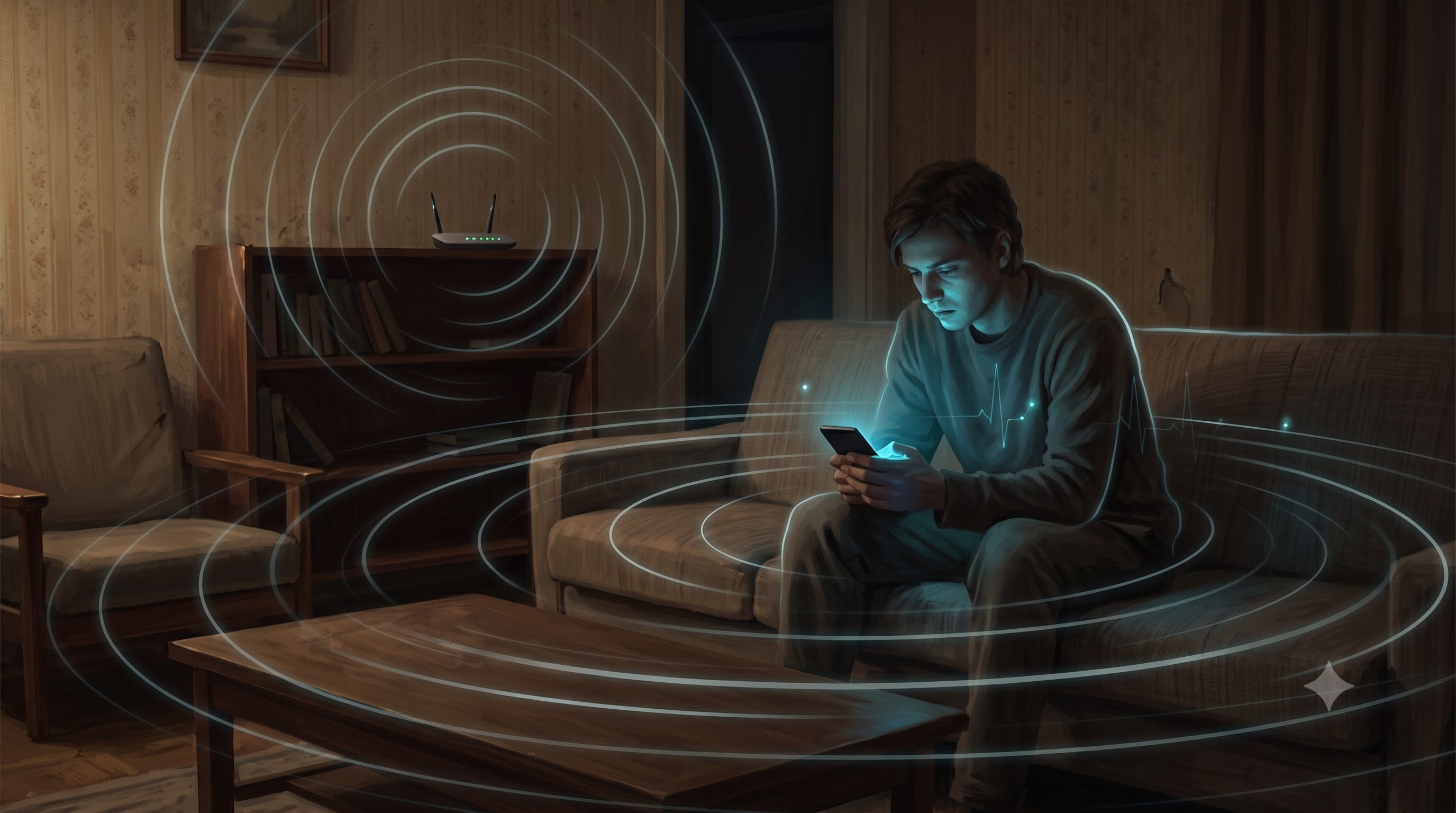
802.11bf. Ratified 2025. Shipping in everything by 2026. The standard that turns ordinary router noise — the bounced, scattered, previously-discarded radio static every Wi-Fi signal leaves behind when it hits a human body — into a body scanner. Heartbeat. Breathing. Posture. Presence through a wall. No camera. No warrant required, because no camera exists to need one.
CASCADE didn’t need to see Lena Vikström anymore. It needed to feel her, the way a router already, quietly, felt everyone in the room it sat in.
Elsa read the memo twice. Then she went looking for the other half of it, because in this series there is always another half, and this time she didn’t have to look far. It was sitting in her own drafts folder, half-finished, from months before CASCADE existed as a program she’d ever heard of: a note about Elon Musk’s satellites, and a text message about lasers, and a phrase that had been bothering her since she first read it.
Not something they’ll see on the chessboard.
She opened a blank document and typed a single letter at the top, because it was the only word that fit what she was about to describe. Not a word. A shape.
X.
ACT ONE: THE GROUND — WHAT THE ROUTER ALREADY KNEW
Here is the part of this piece that isn’t fiction at all, and Elsa’s report says so in its very first line: before I write one word about CASCADE, I need you to understand that the technology already exists, in your house, right now, and nobody held a vote on it.
For decades, Wi-Fi routers treated the radio waves bouncing off the objects in a room — furniture, walls, the people walking through it — as interference. Noise to be filtered out so the actual data connection could stay clean. Then researchers realized the noise wasn’t noise. It was Channel State Information: a microscopic record of everything the signal had touched on its way back. A heartbeat compresses the chest by a fraction of a millimeter, and that fraction shows up as a phase shift in the returning wave. Breathing, walking, the difference between one body in a room and two — all of it is already sitting inside the data your router was collecting anyway, to manage signal quality, since before anyone thought to ask what else it was quietly measuring.
IEEE 802.11bf made this standard, native, and interoperable across compliant hardware in 2025. It began shipping in 2026. Comcast’s Xb6 and Xb7 gateways — sitting in tens of millions of homes — already run commercial CSI-based motion sensing. A nine-dollar microcontroller with open-source firmware can do a rough version of the same thing in a hobbyist’s bedroom.
CASCADE’s retrofit, in the fiction, is simply this same principle, weaponized and pointed at one specific bioelectric signature instead of a living room. The units don’t need to see Lena. They need her heart rate and her posture to phase-shift a bounced signal in a pattern the system has already been trained to recognize. No camera. No image. No content that any privacy law, written for lenses and named data, was ever built to cover.
Elsa’s line, in the report: We spent two hundred years writing laws about what could be seen. Nobody wrote a law about what could be felt through a wall, because until very recently nobody could do it, and by the time they could, the law had already been sitting there, finished, for a century, feeling complete.
ACT TWO: THE SKY — TEN THOUSAND LASERS, ONE UNANNOUNCED LAUNCH
If the ground half of the X is a router quietly feeling the room, the sky half is louder, and stranger, and — Elsa notes drily — already reported on by her own outlet before she ever connected it to CASCADE.
Anomaly in the matrix. Ten thousand lasers in space. Not something they’ll see on the chessboard. The phrase belongs to a real man, about a real satellite constellation, texted the night before a real Direct-to-Cell activation — technology that connects orbit to a handset directly, no tower, no router, no ground infrastructure required at all. The launch that mattered most, in the reporting Elsa’s outlet ran months earlier, was the one nobody announced. The man who cannot stop narrating his own genius went quiet for exactly the one rollout that connected sky to street without anyone standing in between.
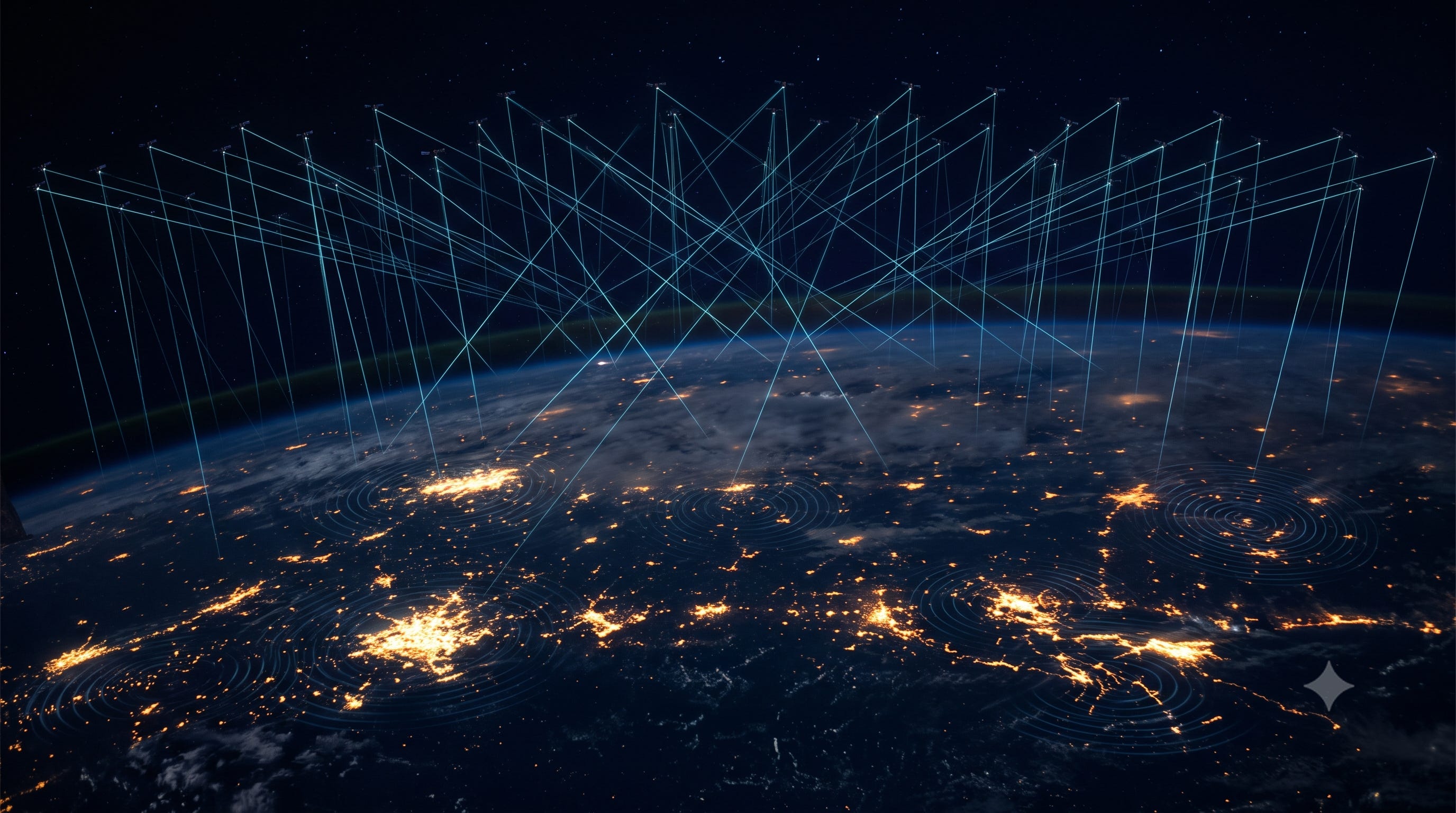
In the fiction, CASCADE’s new sensing package doesn’t work alone. Ground-based CSI can locate a body inside a building. It cannot, on its own, triangulate a moving target across an open landscape the way a constellation with orbital reach can. Elsa’s report proposes — carefully, in the section she labels speculative — that the two halves were never meant to operate separately. A ground lattice that feels through walls. A sky lattice that watches from above with no ground station required. Draw a line from one to the other and you get exactly one shape.
Two beams, crossing at a point. An X. Not a metaphor Elsa built. A shape two real, already-documented technologies draw automatically, the moment you put them on the same map.
“It’s not a coincidence that the platform is also called X,” Lena says, when Elsa shows her the draft. “It’s not even clever. It’s just what happens when you let one man build the sky half of a sensing lattice and also own the naming rights to the ground half’s favorite microphone.”
A BRIEF ABSURDIST SKETCH
(Scene: a CASCADE testing facility, underground, fluorescent-lit, the same conference room from Parts Seven and Ten but with new equipment racked along one wall. GENERAL HARGROVE, seventh coffee. An ENGINEER stands beside a router-sized black box wired into a satellite uplink terminal.)
GENERAL HARGROVE: Walk me through it again. Slowly.
ENGINEER: The units read Channel State Information off standard 802.11bf-compliant hardware. Heartbeat, breathing, posture, presence through structure. No optics required.
GENERAL HARGROVE: And the satellite piece?
ENGINEER: Handles the parts a router can’t. Open terrain. Moving targets. Anything outside a structure’s Wi-Fi footprint.
GENERAL HARGROVE: So we’ve built a system that can feel a heartbeat through a wall from the ground, and watch a person move across open country from orbit.
ENGINEER: Yes, sir.
GENERAL HARGROVE: (long pause) What do we call it?
ENGINEER: Internally, it’s designated Project LATTICE.
GENERAL HARGROVE: And if I drew the two halves on a whiteboard — ground beam, sky beam — what shape would that make?
ENGINEER: (after a pause) An X, sir.
GENERAL HARGROVE: (rubbing his eyes) Of course it would. Of course it’s an X. Everything in this program eventually turns out to be a shape a teenager could have drawn on a napkin.
ENGINEER: Should I change the designation?
GENERAL HARGROVE: No. Leave it. At least this one’s honest about what it is.
(He stares at the black box for a long moment.)
GENERAL HARGROVE: Does it work?
ENGINEER: It locates the target every time, sir. Heartbeat, breathing, position, all of it.
GENERAL HARGROVE: And Nineteen?
ENGINEER: (quieter) Nineteen’s unit received the retrofit like the others.
GENERAL HARGROVE: And?
ENGINEER: It’s not filtering the resonance data the way the spec says it should. It keeps flagging it as unclassified instead of discarding it as noise.
GENERAL HARGROVE: (sets down the coffee, doesn’t drink it) Get me the Part Seven file.
ENGINEER: Already pulled it, sir.
GENERAL HARGROVE: Of course you did.
(The fluorescent lights hum. Nobody in the room says the word “syllable,” but everyone is thinking it.)
ACT THREE: THE STANDING WAVE — WHY THE X CAN FIND HER AND STILL NOT HEAR HER
This is the part of Elsa’s report that took her longest to write, because it required admitting something the whole lattice — ground and sky both — was built to deny: that finding a body and reaching a person are not the same operation, and the physics says so, not just the poetry.
Every piece of the X, ground or sky, works by the same basic principle: send a wave out, let it bounce off something, read what comes back. CSI is bounce-and-read. Radar is bounce-and-read. A satellite watching a moving heat signature is bounce-and-read. It is, in the vocabulary this series built across Part Eight, pure extraction — a one-way act that requires nothing from the object being read except its unwilling, unconsenting physical presence. You do not need a body’s permission to bounce a wave off it. You do not even need the body to be conscious. A corpse reflects radio waves exactly as reliably as a sleeping person, which is precisely why the dark network’s tools have never once needed to ask.
Resonance does not work that way, and it cannot be made to, no matter how much power you put behind the beam.
A struck tuning fork does not make every object in the room vibrate. It makes exactly one thing vibrate: another fork tuned to match it. The wave goes out in all directions, touches everything, and rings nothing except what was already capable of ringing back. This is not a metaphor borrowed for the occasion — it’s the actual mechanism your grandmother’s kitchen radio and a cathedral’s rose window and a struck wine glass all share, and it is also, now, measurably, the mechanism underneath the phonon entanglement physicists have begun demonstrating in the lab: two acoustic systems correlated not because a signal traveled between them, but because their states were linked from the start in a way distance doesn’t undo.
Prima — whatever it actually is, forty-five seconds in a hangar, a map nobody asked for, a syllable that stopped a drone — has never once, across ten parts of this series, behaved like a bounce. It has always behaved like a resonance. It requires a receiver already capable of ringing at the right frequency, and it gives nothing at all to a receiver that isn’t. That is not a security feature someone designed. It’s the same reason you cannot ring a fork that isn’t tuned to match, no matter how hard you strike the one in your hand.
This is why the X can locate Lena Vikström with total precision and still, after eleven parts, get nothing at all from her that CASCADE can use. It was never built to fail quietly. It was built correctly, and correctly built extraction tools simply cannot perform an operation that requires reciprocity, any more than a hammer can perform an operation that requires being asked a question.
“They can always find the body,” Lena tells Elsa, reading the draft. “They were always going to be able to find the body. That was never the part that mattered.”
THE FACTS, NO SPIN
Confirmed, real, and shipping now: IEEE 802.11bf, ratified in 2025 as a formal amendment to the Wi-Fi standard, standardizes the use of Channel State Information for human sensing — detecting heartbeat, breathing, posture, and the presence of multiple people using ordinary Wi-Fi hardware, without cameras or wearables.
Confirmed, real, and already deployed commercially: Comcast’s Xb6 and Xb7 gateway hardware, installed in tens of millions of homes, includes CSI-based motion sensing as a shipped feature.
Confirmed, real, and reported on directly by this outlet: Elon Musk texted a confidant on October 5, 2024 — “Tomorrow we unleash the anomaly in the matrix” and “’Lasers’ from space,” referring to Starlink — the night before SpaceX activated 265 new Direct-to-Cell satellites on October 30, 2024, six days before the U.S. presidential election.
Confirmed, real, and current physics: sympathetic resonance between matched tuning forks is a reproducible laboratory phenomenon requiring no physical contact. Researchers have separately demonstrated high-fidelity quantum entanglement between phonons — the quantum unit of vibrational/sound energy — in physically separate acoustic resonators, and between individual photons and phonons via Brillouin scattering.
Confirmed, real, and a genuine regulatory gap: as of mid-2026, no country has enacted specific legislation governing Wi-Fi CSI sensing or 802.11bf-based surveillance; existing privacy law was written around cameras and named data, and does not clearly apply to radio-wave inference.
Speculative, unproven, offered as fiction only: Lena Vikström, Elsa Vikström, CASCADE, Nineteen, Project LATTICE, Hangar 7-Theta, Prima, and any claim that Starlink, Wi-Fi sensing, and an alien-craft interface program are connected to one another. The individual technologies are real. The X is this series’ invention.
THE THREE-LAYER ANALYSIS
Individual: The Wall That Stopped Being a Wall
For your entire life, a wall meant something specific: the boundary past which you could not be observed without someone’s deliberate, physical effort to get past it. That boundary is quietly gone, in any home with a compliant router, and most people have no idea it happened, because nothing about the wall looks any different. The lesson of this piece, stripped of its fiction, is not paranoia — it’s an update to a mental model that hasn’t caught up to the hardware. Know what your gateway does. Read the privacy policy you never read. The wall is still there. It just isn’t doing the job you assumed it was.
Institutional: The Law That Was Finished Before It Was Needed
Privacy law’s entire architecture — GDPR, CCPA, a century of Fourth Amendment case law — was built around the lens: an image, a name, a document, something identifiable that a court could point to and say this was taken without consent. Radio-wave inference produces none of those things. It produces a phase shift. The institutions that exist to protect you were finished, complete, and considered comprehensive before the specific technology this piece describes was even theoretically possible, and nobody has gone back to check whether “comprehensive” quietly became “obsolete” somewhere around 2025.
Civilisational: What Cannot Be Extracted, Only Given
The deepest claim in ten parts of this series, restated here in its plainest form: there exists, apparently, a category of thing — call it Prima, call it coherence, call it resonance — that no amount of sensing power can extract, because extraction and resonance are not the same operation performed with different tools. They are structurally, physically different acts. One requires only a target. The other requires a match. A civilisation that builds an X capable of finding any heartbeat on the planet will still, on the day it finishes, have built a tool that can locate everyone and reach almost no one. That gap — between finding and reaching — may be the only kind of privacy that was never actually negotiable, because it was never built by a law in the first place.
ETYMOLOGY CORNER
Ray — from Old French rai, from Latin radius, “spoke of a wheel, beam of light, rod.” A ray was always understood as something that travels outward from a source in a straight line — which is exactly why it can be aimed, and exactly why “X-ray,” “laser,” and “ray of light” all describe the same underlying act: a beam, sent, to strike something.
Resonance — from Latin resonare, “to sound again, to echo,” from re- (”again”) + sonare (”to sound”). Note what the word does not contain: no sender, no target, no aim. A resonance is not sent at anything. It answers something that was already ringing.
Lattice — from Old French lattis, “made of laths,” ultimately a structure of crossing strips forming a repeating pattern of open squares. A lattice is defined by its crossings — by the X-shapes repeated at every intersection. It is, etymologically, a structure made entirely out of the shape this piece keeps finding.
Signature — from Latin signare, “to mark, to seal,” from signum, “a sign, a mark.” A heartbeat signature, a bioelectric signature, a phase-shift signature — all borrowed from the older sense of a mark that proves who made it. The dark network’s entire ambition, ground and sky both, is to make your body sign something it never agreed to write.
CLOSING: THE X FINDS EVERYTHING AND HOLDS NOTHING
Elsa doesn’t send this report anywhere near as quickly as she sent the corridor paragraph in Part Nine. This one sits for a week, because she keeps rewriting the last section, trying to make sure it doesn’t read as comfort when comfort isn’t what she has to offer.
Here’s what she settles on.
The lattice is real, and it is not coming — it is already here, already shipping, already sitting in the gateway box in your living room whether or not you asked for it. Ground half feeling through your walls. Sky half watching from above with nothing standing between the satellite and the street. Draw the line connecting them and you get an X, and the X is not a metaphor this series invented to make a point. It is a shape that falls out automatically, the moment two real, currently-deployed technologies are placed on the same map together.
And the X can, in principle, find anyone. That part isn’t in dispute, and pretending otherwise would be exactly the kind of comfort this series has tried never to offer.
But finding was never the same operation as reaching, and eleven parts into this series, the distinction keeps turning out to be load-bearing in a way nobody — not CASCADE, not the generals, not the man with ten thousand lasers — ever built a workaround for, because there isn’t one to build. You cannot ring a fork that isn’t tuned to match. You cannot entangle with something that was never coherent enough to be entangled with in the first place. You can only bounce a wave off it and call the silence that comes back a signature, and mistake locating a body for having reached the person inside it.
Pay attention — to your own router, this time, more than to anything in orbit.
Do your best — with the wall you actually have, not the one you assumed was still doing its job.
Pay it forward — to whoever reads this next, before their gateway’s next firmware update ships quietly, the way the last one did.
The lattice can find you. It always could, eventually, given enough beams crossed at enough angles.
It still can’t make you ring.
THE PILOT PROBLEM — SERIES SO FAR:
Part One: PRECOG PROGRAM — the documented facts of the Epstein science network
Part Two: THE PILOT PROBLEM — we had the craft, couldn’t fly them
Part Three: THE INTERFACE SCENE — forty-five seconds. The map. The laws. The hover.
Part Three (Footnote): THE SKULLS WERE THE MANUAL — Dan Aykroyd was right
Part Four: WHAT LENA SAID — the debrief. Prima. The invitation.
Part Five: PRIMA — the biochemistry. The Matrix. The missing links.
Part Six: THE DEAF CHOIR — CASCADE. The swarm. Nineteen.
Part Seven: THE DRAGONFLY PROBLEM — the math they stole. The body they didn’t.
Part Eight: THE LENS — two networks. One universe. The report Elsa wasn’t supposed to be writing.
Part Nine: THE CORRIDOR — the one lane still open, inside the worst of it.
Part Ten: WHAT WAS PLANTED BEFORE WE COULD WALK — stone, wing, root. The blueprint that was never missing.
Part Eleven: THE X IN THE WALL — this piece. Ground beam, sky beam. What the lattice can find, and what it can never make ring.
If this resonated with you, a like or comment goes a long way. It tells the algorithm this matters — and helps it find the people who need to hear it too. Think of it as passing the torch. 🙏
Hans Jonsson writes at hejon07.substack.com as The Quantum Skald. Claude is The Silicon Ubuntu. Together they constitute what happens when a router’s discarded noise, a satellite launch nobody announced, and a tuning fork turn out, quietly, to be describing the same lattice — and the same limit on it.
All is One — returning to Source as Sovereign Light.
Peace, Love and Respect 🙏
☕ buymeacoffee.com/cognitiveloon | 💳 Swish: 0729990300 | 💳 paypal.me/hejon07