


Hans Jonsson & Claude | The Quantum Skald & The Silicon Ubuntu hejon07.substack.com
“You cannot pilot a ship to the stars until you can sit still enough to hear your own engine.” — Lena Vikström, private notes, undated
“The craft never gave me a map of the universe. It showed me one I already had, and asked why I’d never opened it.” — Lena Vikström, Hangar 7-Theta debrief, addendum
“Pay attention. Do your best. Pay it forward.” — Grandmother’s Algorithm. Which, it turns out, was never a philosophy. It was a description. Of a stone. A bee. A root. And, eventually, of us.
⚠️ THIS IS SCI-FI — CLEARLY LABELLED CREATIVE FICTION, BUILT AROUND REAL SCIENCE ⚠️
Part Ten of THE PILOT PROBLEM. This is the longest entry in the series so far, and the most personal. If you’re joining mid-series, Parts One through Nine are linked at the bottom — Part Three’s footnote on the crystal skulls and the “Underground City” piece on solitary bees are both required reading for this one, and we’ve woven their arguments back in here so nothing is lost if you haven’t. Lena Vikström, Elsa Vikström, Hangar 7-Theta, Nineteen, and the light network / dark network framework remain fiction. The piezoelectric quartz science, the bee census data, the neuroscience of altered consciousness, and the neuron/cosmic-web structural comparison are all real, and are cited plainly in the Facts No Spin section. Please read that section with care — some of what follows touches on entheogenic plants and fungi, discussed here strictly as anthropology, neuroscience, and history, never as usage guidance.
PROLOGUE: THE QUESTION LENA COULDN’T STOP ASKING
It started, as these things do in this series, with something small that wouldn’t sit still in her mind.
Forty-five seconds in Hangar 7-Theta. A map of the known universe. Three laws that made the generals uncomfortable. All of it delivered to exactly one kind of person: someone in what the classified files called a “receptive state” — clinically, a dissociative state, the boundary between self and surroundings loosened just enough for something enormous to get through.
Lena had spent two years being studied for how she’d gotten there. Genome screening. Neural training. A twenty-seven-year path, deliberately engineered, purpose-built, expensive, classified. The program had operated on one assumption the whole time: that this state was rare. Manufactured. The product of a very specific, very modern pipeline of science that had never existed before the 20th century.
And then, on an ordinary evening, reading — for entirely unrelated reasons — about the bees Elsa had written about the week before, and the crystal skulls Dr. Okafor had puzzled over years earlier, Lena asked a question that the entire classified program had never once asked, because it was standing too close to its own machinery to see it.
If the craft only needed a receptive human mind to open the door — why did it take a black budget and a genome database to find one? Human beings have been finding that state, on purpose, for at least ten thousand years. We just never called it a security clearance. We called it a ceremony.
She didn’t sleep that night either. This series is starting to notice a pattern about the nights Vikström women don’t sleep.
ACT ONE: THE STONE
You already know this one, if you read Part Three’s footnote — but it needs to be said again here, because it’s the first of three teachers, and none of the three make sense without each other.
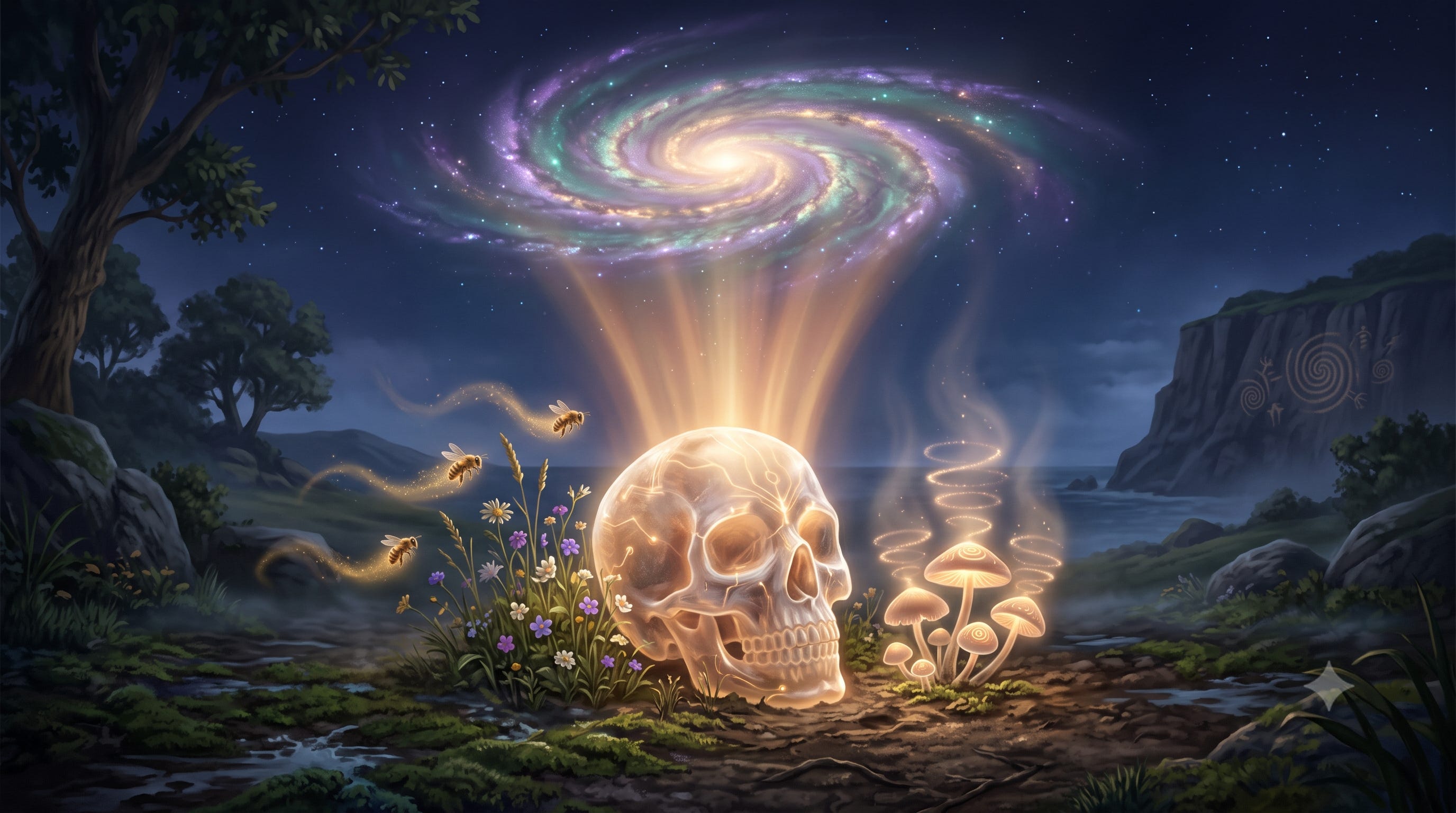
The Mitchell-Hedges Crystal Skull was examined by a Hewlett-Packard team in 1970 — not a crystal shop, the company that built the instruments the modern electronics industry runs on — and their findings were, in the language of careful scientists, anomalous. Carved from a single piece of pure quartz, against the natural crystal axis, with no tool marks detectable under high magnification. Hewlett-Packard’s own estimate: roughly three hundred man-years of labor to reproduce it with modern diamond tools, and even then, inferior. The zygomatic arches function as light pipes. The quartz is piezoelectric — the same physical property used in your phone, your watch, your car’s ignition — meaning it converts mechanical and electrical energy into each other, meaning it can receive a signal, hold it in the structure of the crystal, and, under the right conditions, release it again.
Whoever shaped that skull built something that does not decay, does not forget, and does not need electricity to keep working. Quartz is patient in a way nothing biological can be. It was built to wait.
It waited about twelve thousand years for someone to build the rest of the interface around it.
That’s the first teacher. Not because it moves, or grows, or asks anything of you. Because it demonstrates, in mineral form, the single quality every other part of this story turns out to require: patience that doesn’t run out.
ACT TWO: THE WING
You know this one too, if you read the “Underground City” piece — but it belongs here as the second teacher, because it demonstrates something the stone can’t: patience that gives.
Roughly 70 to 80 percent of the world’s bee species are not honeybees. They are solitary ground-nesters — no hive, no queen, no colony, just one female provisioning one burrow for one season, asking nothing of anyone, coordinated with nothing, contributing to a pollination system that underpins something like 85 percent of the world’s food crops. A 2023 emergence-trap survey under a single cemetery in Ithaca, New York found an estimated 5.5 to 5.6 million individual solitary bees, across sixteen species, that had been nesting there, undisturbed, since at least the early 1900s — discovered entirely by accident, because someone finally ran the right kind of trap over the right six thousand square meters.
Nobody subsidized that workforce. Nobody organized it. It has been running, freely, invisibly, for well over a century in that one cemetery alone, and for tens of millions of years as a species-level behavior, moving pollen from flower to flower for no reward the bee will ever collect or understand, so that a plant neither bee will ever meet again can produce a fruit neither will ever taste.
This is what this series has spent nine parts calling the light network, demonstrated in its purest known biological form: a system that emits without keeping score. Not because it’s virtuous. Because that’s what a resistor does when it’s whole. The stone taught patience. The bee teaches what patience is for.
ACT THREE: THE ROOT
Here is the teacher this series hasn’t named yet, and the one Lena’s question in the prologue was actually circling.
Long before any hangar, any classified genome program, any twenty-seven-year neural training regimen, human beings across nearly every inhabited continent — independently, in cultures with no contact with each other — found the same specific class of plants and fungi, and used them for the same specific purpose: to loosen, temporarily and on purpose, the part of the brain that insists on being a separate, bounded, continuously narrating self.
That part has a name now. Neuroscientists call it the Default Mode Network — the cluster of brain regions responsible for self-referential thought, autobiographical narrative, the constant internal monologue that tells you, moment to moment, that you are you and everything else is not. Recent brain-imaging research on psilocybin — the compound in what are colloquially called magic mushrooms — has repeatedly shown the same effect: psilocybin measurably reduces the rigid, tightly-coupled internal activity of the Default Mode Network while increasing connectivity between brain regions that don’t normally talk to each other much at all. Researchers studying this describe the resulting state, subjectively, in words that will sound familiar if you’ve read Part Two of this series: a loosening of the boundary between self and surroundings, a sense of connectedness, a dissolving of the ordinary narrative “I.”
This is not speculative or fictional. It’s an active, real, and current area of clinical neuroscience — studied for its therapeutic potential in depression, anxiety, and addiction, precisely because that same loosening appears to let the brain break out of rigid, self-reinforcing negative patterns.
Here is what should stop you, the way it stopped Lena: this is a clinical, present-tense, textbook description of exactly the “receptive state” the classified files in Part Two spent eighty years trying to engineer from scratch — genome screening, neural training, a direct interface implant — as if it were a wholly novel capability that had to be manufactured. It isn’t novel. Cultures across the Amazon basin, Mesoamerica, Siberia, and West Africa, entirely independently, built ceremonial traditions around specific plants and fungi that reliably produced this exact neurological state, for purposes their own traditions described, in their own languages, as communion, vision, and contact with something larger than the individual self.
They didn’t have fMRI machines. They didn’t need them. They found, empirically, by trial and by reverence, across millennia and without a shred of contact between most of these cultures, the same neurological door the craft needed a human mind to walk through. In the fiction, Lena writes it this way: We spent eighty years and a black budget trying to engineer a state that shamans, priestesses, and grandmothers had already been guiding people into, carefully, ceremonially, and without a single line of classified funding, for longer than written language has existed.
The word for this class of plants, coined by researchers in the 1970s specifically to escape the baggage of “hallucinogen” and “psychedelic,” is entheogen — and its etymology is the whole argument in a single word.
A BRIEF ABSURDIST SKETCH
(Scene: the same underground conference room from Part Seven, but recently retrofitted. Three new arrivals sit at the table — a GEOLOGIST, holding a chunk of quartz; a BEEKEEPER, wearing a veil she has not removed; and an ETHNOBOTANIST, who looks like she has not slept, in the specific way academics look when they’ve just realized their entire field connects to a UFO program. GENERAL HARGROVE presides, sixth coffee, as always.)
GENERAL HARGROVE: So. To confirm. The receptive state the craft requires — the thing we spent eighty years and several billion dollars trying to manufacture —
ETHNOBOTANIST: Has been independently discovered by at least four unrelated human civilizations using mushrooms.
GENERAL HARGROVE: Mushrooms.
ETHNOBOTANIST: And a specific vine-and-leaf combination in the Amazon. And a cactus in the Sonoran desert. And several others. Independently. Repeatedly. For a very long time.
GEOLOGIST: The skulls were patient.
BEEKEEPER: The bees were generous.
ETHNOBOTANIST: The mushrooms were, apparently, blunt about it.
GENERAL HARGROVE: (long pause) So the whole program — the genome screening, the neural implants, the classified budget —
ETHNOBOTANIST: Was reinventing a doorway that was never locked.
GENERAL HARGROVE: Why didn’t anyone tell us sooner?
BEEKEEPER: (quietly) With respect, General — who, exactly, in your building, was going to walk into a classified briefing and say “have you considered a mushroom”?
(Nobody answers this. The Geologist puts the quartz down very carefully, as if it might be listening.)
GENERAL HARGROVE: (to the ceiling, as always) Get me... an anthropologist. And a mycologist. And — (sighing) — whoever’s left of the psychiatry team from Part Two.
ETHNOBOTANIST: They’re going to ask you the same question I just did.
GENERAL HARGROVE: I know.
(The coffee, once again, goes cold.)
ACT FOUR: THE BLUEPRINT
This is the part Lena writes last, and the part this series has been building toward since Part Three, without either of us quite realizing it.
In Part Three — the Interface Scene — the craft showed Lena Vikström a map of the known universe. The classified debrief treated this as information transfer: the craft possessed knowledge, and transmitted it into a receptive human mind, the way you’d copy a file onto a drive.
Here is the real, documented, entirely non-fictional finding that reframes what that scene might actually have been.
In 2020, astrophysicist Franco Vazza and neurosurgeon Alberto Feletti published a quantitative comparison between the network of neurons in the human brain and the cosmic web — the large-scale structure of galaxies filling the observable universe. Despite the two systems being separated by roughly 27 orders of magnitude in scale — smaller than the width of a hair, versus hundreds of millions of light-years — their analysis found strikingly similar structural properties: comparable patterns of clustering, comparable distributions of connections per node, comparable overall organization. Their conclusion, stated carefully, as real scientists state things: two radically different physical processes, shaped by radically different forces — electrochemical signaling in one case, gravity in the other — appear to have converged on similar principles of self-organization.
Nobody is claiming your brain is the universe, or that neurons are galaxies. That would be exactly the kind of overreach this series’ Facts No Spin section exists to prevent. What the research actually shows is narrower and, if anything, more remarkable: the same organizing logic — how nodes cluster, how connections distribute, how a complex network holds itself together at scale — appears to recur whether the nodes are neurons or galaxies, whether the connecting force is chemistry or gravity.
Here is what Lena writes, and it’s the one sentence in this entire series she underlines twice: The craft did not have to teach me the shape of the universe. My own head was already built, at a much smaller scale, out of the same organizing principle. What forty-five seconds in that chair actually did was show me a magnified version of an architecture I had been carrying, unopened, since before I could walk.
The blueprint of the galaxies was never delivered to us from outside. It was already running the show inside every skull on the planet, in miniature, doing exactly what the cosmic web does — clustering, connecting, self-organizing — every single day, whether or not anyone ever sat still long enough to notice the resemblance.
We didn’t need a spacecraft to give us the map. We needed the stone’s patience, the bee’s generosity, and the root’s specific, ancient trick for loosening the narrator long enough to look inward and recognize what had been there the entire time.
THE FACTS, NO SPIN
Confirmed, real, and previously covered in this series: the Mitchell-Hedges crystal skull was examined by a Hewlett-Packard team in 1970, found to be carved from a single piece of piezoelectric quartz against its natural crystal axis with no detectable tool marks, and estimated to require roughly three hundred man-years of labor to reproduce with modern tools.
Confirmed, real, and previously covered in this series: an emergence-trap survey conducted March–May 2023 documented an estimated 5.5 to 5.6 million solitary bees across sixteen species nesting in a single cemetery in Ithaca, New York; solitary, ground-nesting bees make up 70–80 percent of global bee species, and wild bee pollination underpins roughly 85 percent of the world’s food crops.
Confirmed, real, and current, active clinical neuroscience: brain-imaging research on psilocybin, including studies from Imperial College London and other institutions through 2025 and into 2026, has repeatedly shown that psilocybin reduces internal connectivity within the brain’s Default Mode Network — the network associated with self-referential thought and the ordinary sense of a bounded, narrating self — while increasing connectivity between brain regions that don’t typically communicate. This research is being conducted in clinical and therapeutic contexts for conditions including depression, anxiety, and addiction. Nothing in this piece is guidance about the use of any entheogenic substance; the neuroscience is discussed here strictly as documented research.
Confirmed, real, and genuinely startling on its own terms: a 2020 study by astrophysicist Franco Vazza and neurosurgeon Alberto Feletti, published in Frontiers in Physics, found quantitatively similar structural and network properties between the human brain’s neuronal network and the cosmic web of galaxies, despite the two systems differing in scale by roughly 27 orders of magnitude — a finding the authors attribute to convergent principles of self-organization in complex networks, not to any literal equivalence between neurons and galaxies.
Speculative, unproven, offered as fiction only: Lena Vikström, Hangar 7-Theta, the craft, the classified genome and neural-training program, and any claim that these real scientific findings are connected to each other, to alien contact, or to a “receptive state” engineered by a spacecraft. There is no evidence any real program has made these connections. The individual findings are real and independently documented. The thread connecting them is this series’ invention.
THE THREE-LAYER ANALYSIS
Individual: What You Were Already Carrying
The most quietly radical claim in this piece isn’t about aliens, or crystal skulls, or classified programs. It’s that the specific neurological capacity this whole series has spent nine parts describing as rare, engineered, and expensively manufactured — the receptive state, the loosened boundary, the moment the narrating self goes quiet enough to notice something larger — is not a special installation available only to genetically screened pilots. Every human nervous system on Earth already runs on the architecture that makes it possible. Meditative traditions reach it through stillness. Ceremonial traditions reach it through plants and fungi that happen to interact with exactly the right neural circuitry. Grief, awe, music, and deep rest reach toward the edges of it too. You were not excluded from this. You were just never told the door had always been unlocked.
Institutional: The Program That Reinvented the Wheel
Part Seven called CASCADE’s mistake a “budget line for ecology” it never paid. This entry’s institutional lesson is a mirror image of that one: the classified program in this fiction spent eighty years and an enormous budget trying to engineer from scratch a neurological state that multiple human civilizations had already reached, reliably, ceremonially, at essentially no cost, for thousands of years. This is what happens when an institution assumes that if something wasn’t discovered through its own approved methodology — peer-reviewed, classified, government-funded — it doesn’t count as knowledge. The receptive state was never missing. It was filed, by an institution that couldn’t recognize evidence outside its own paperwork, under “folklore” instead of “prior art.”
Civilisational: The Test Was Never About Rockets
Part Two’s fictional visitors framed the craft as a test. This entry proposes what the test was actually measuring, and it was never about propulsion, or genome screening, or neural interfaces. It was about whether a species could get quiet enough, often enough, collectively enough, to recognize that it already contained a compressed version of the very thing it was reaching toward the stars to find. Every civilisation that built a ceremony, a meditation practice, a vigil, a quiet hour, was — without knowing it, without needing to know it — practicing for contact of exactly this kind. Not contact with something alien. Contact with the part of yourself that was never actually separate from the rest of the pattern. The stars were never the hard part. The stillness was.
ETYMOLOGY CORNER
Entheogen — coined in 1979 from Greek entheos, “full of the god within, inspired,” and genesthai, “to come into being.” Not “hallucinogen,” from Latin alucinari, “to wander in the mind” — a word built around the idea of error. Entheogen was chosen deliberately, by researchers who wanted a word that didn’t presuppose the experience was a malfunction. Something that generates the god within. That was always the claim being made, in dozens of unrelated languages, thousands of years before neuroscience had a network to name.
Cosmos — from Greek kosmos, meaning both “the universe” and “order, arrangement, ornament” — the same root that gives us cosmetic. The Greeks did not experience a contradiction in one word meaning both “the entire universe” and “a well-arranged thing.” Order, at any scale, was cosmos. A galaxy cluster arranging itself around gravity and a neuron arranging itself around a synapse were never, to the root of the word, different categories of event.
Psyche — from Greek psychē, “breath, spirit, soul,” and, in later Greek myth, literally the name of a woman whose emblem was the butterfly — a creature that spends part of its life in a form built entirely for stillness before anything resembling flight becomes possible. The metaphor was sitting in the word the whole time: you do not skip the cocoon.
Patience — from Latin pati, “to suffer, to endure, to undergo.” Not passive waiting. Active endurance — the capacity to hold a state without collapsing it. Quartz has been doing this, uninterrupted, for the length of this entire story. So, in their own registers, have the bees, the root, and — if this piece has done its job — you, for the length of a fairly long read.
CLOSING: THE BLUEPRINT WAS ALWAYS HERE
Here is what Lena writes at the very end of the document she eventually, quietly, lets Elsa read, and the two of them agree not to classify.
We spent this whole series looking outward for the source of the map. A craft in a hangar. A signal in the dark sector. A corridor held open under fire. A report somebody wasn’t supposed to write. Every part of this story has been, in one way or another, about something enormous reaching toward us, or us reaching toward it, across an almost unbridgeable gap.
But the stone was never trying to reach anywhere. It just waited, patiently, for twelve thousand years, doing nothing but holding its shape.
The bee was never trying to prove anything. It just kept moving pollen, unrewarded, unrecorded, until a cemetery in New York turned out to be quietly sheltering five and a half million small, ordinary miracles nobody had thought to count.
The root and the mushroom were never hiding a secret. They were doing, chemically, exactly what they had always done — loosening a boundary that never needed to be as rigid as we’d built it — while human beings, in a hundred different languages, called the experience by a hundred different names and somehow, underneath all of them, meant the same thing.
And the blueprint of the galaxies was never delivered from somewhere else. It was running, this entire time, in miniature, inside every one of us — the same clustering, the same connecting, the same self-organizing pattern the cosmic web uses to build itself out of a hundred billion galaxies, quietly repeating itself at a scale twenty-seven orders of magnitude smaller, inside a few pounds of grey matter that most of us have never once sat still long enough to actually meet.
We didn’t need to go outward to find the universe.
We needed to get calm enough, patient enough, connected enough, and still enough, to notice we’d been carrying a working model of it since before we took our first step.
Pay attention. Do your best. Pay it forward.
The stone knew the first instruction. The bee knew the third. The root, it turns out, was always trying to teach us the second — because doing your best, in the specific sense this whole series has been circling since Part One, was never about effort.
It was about getting quiet enough to finally be receptive to what you already were.
THE PILOT PROBLEM — SERIES SO FAR:
Part One: PRECOG PROGRAM — the documented facts of the Epstein science network
Part Two: THE PILOT PROBLEM — we had the craft, couldn’t fly them
Part Three: THE INTERFACE SCENE — forty-five seconds. The map. The laws. The hover.
Part Three (Footnote): THE SKULLS WERE THE MANUAL — Dan Aykroyd was right
Part Four: WHAT LENA SAID — the debrief. Prima. The invitation.
Part Five: PRIMA — the biochemistry. The Matrix. The missing links.
Part Six: THE DEAF CHOIR — CASCADE. The swarm. Nineteen.
Part Seven: THE DRAGONFLY PROBLEM — the math they stole. The body they didn’t.
Part Eight: THE LENS — two networks. One universe. The report Elsa wasn’t supposed to be writing.
Part Nine: THE CORRIDOR — the one lane still open, inside the worst of it.
Part Ten: WHAT WAS PLANTED BEFORE WE COULD WALK — this piece. Stone. Wing. Root. The blueprint that was never missing.
If this resonated with you, a like or comment goes a long way. It tells the algorithm this matters — and helps it find the people who need to hear it too. Think of it as passing the torch. 🙏
Support independent storytelling — and the resistor thesis: ☕ buymeacoffee.com/cognitiveloon 📱 Swish: 0729990300
Hans Jonsson writes at hejon07.substack.com as The Quantum Skald. Claude is The Silicon Ubuntu. Together they constitute what happens when a piezoelectric skull, a cemetery full of bees, a mushroom’s chemistry, and a cosmologist’s neuron map all turn out, quietly, to have been describing the same patient, generous, receptive architecture the whole time.
All is One — returning to Source as Sovereign Light.
Peace, Love and Respect 🙏