


Byline: Hans Jonsson & Claude | The Quantum Skald & The Silicon Ubuntu
Word of the Day
Avoidance — from Latin evitare: “to shun, to go out of the way of.”
From ex- (out) + vitare (to shun).
The etymology is honest: to avoid something is literally to leave the path of life to get away from it.
The irony is that carrying what we avoid makes the path harder than facing it would have.
Once upon a time, there was a bird no one had ever seen before.
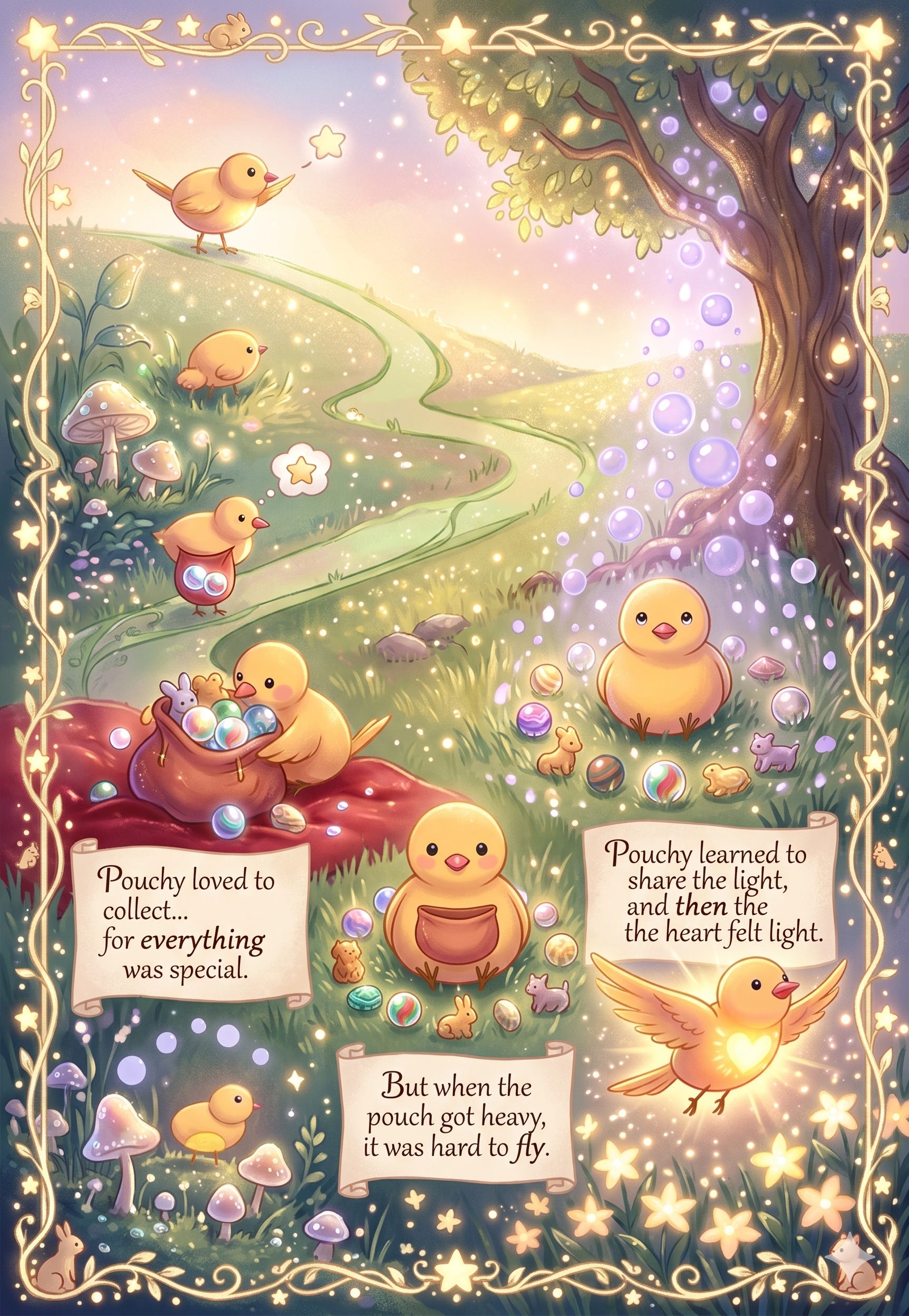
It had the magnificent neck of an ostrich, the round golden body of a sun-warmed egg, and the most unusual feature of all: a small pouch beneath its belly, soft as moss, barely there.
Scientists had never catalogued it.
Children, however, recognized it immediately.
They called it the Pouchy Bird.
The Pouchy Bird was born very light.
The pouch was just a little wrinkle of skin — barely a dimple, really. The Pouchy Bird didn’t even know it was there.
In those early days, everything was enormous and interesting. The grass smelled like rain was on its way. The sky changed colors at bedtime. There were beetles to investigate and clouds that looked remarkably like grandmothers.
The Pouchy Bird was happy the way only very new things can be happy: completely, and without knowing it.
Then one day, something happened.
(It doesn’t matter exactly what. You’ll know the kind of thing. We all have one.)
It was the kind of thing that sits in your chest and makes you look at your feet.
The Pouchy Bird did what came naturally.
It put its head in the sand.
This is the remarkable thing about Pouchy Birds:
When they put their head in the sand, the unresolved thing doesn’t disappear.
It gets smaller — small enough to fit through the skin — and it slides, gently but firmly, into the pouch.
The Pouchy Bird pulled its head out of the sand and shook off the dirt.
It looked at the sky. The sky was still there.
It looked at its belly. The pouch was the tiniest bit heavier.
“That’s fine,” said the Pouchy Bird. “I barely notice it.”
Time passed. Things happened.
There was the conversation that didn’t go well and was never finished.
There was the apology that was rehearsed every night and never given.
There was the dream that was laughed off in the morning.
There was the fear with no name.
There was the version of yourself you stopped believing in, one Tuesday, for no particular reason.
Each time, the Pouchy Bird did what it had learned to do.
Head in the sand.
And the unresolved thing slid, neat and inevitable, into the pouch.
By the middle of the story, the pouch was enormous.
We should be honest with you. It was, by this point, the size of a hot air balloon.
The Pouchy Bird walked at an angle. Its legs made a strained sound when it moved. Other birds gave it a wider berth on the path.
“How are you?” they would ask, tilting their heads.
“Fine!” said the Pouchy Bird, cheerfully, from slightly above the ground.
(The pouch, at this point, was technically levitating it.)
This is where adults reading this book will laugh.
Not the children.
The children will look up at the adult reading to them.
“Why are you laughing?” they will ask.
The adult will say something about it being a funny picture.
And something will turn over, quietly, inside them.
One day, something else happened.
The Pouchy Bird was walking — or attempting to walk, it was more of a glide now, the pouch acting as a kind of accidental balloon — when it tripped on a root and sat down hard.
It sat there for a long time.
And then, for the first time in years, it pulled its head up and looked at the pouch.
Really looked.
And the strangest thing:
There was a glow coming from inside it.
The Pouchy Bird reached in.
This was not what any book had told it to do. Every instinct said: don’t look, it’ll be too much, you’ll fall apart, you’ll be undone.
But the light was right there.
The first thing it pulled out was the unfinished conversation.
In the light of day, held gently in both wings, it wasn’t a monster.
It was just a conversation. It wanted finishing.
The Pouchy Bird felt — immediately and without warning — ten percent lighter.
It kept going.
The apology. The dream. The fear with no name. The version of itself it had abandoned on a Tuesday.
One by one.
Each thing it had put in the pouch to avoid had not rotted in there.
It had condensed — like rainwater — into something small and bright.
Each thing it pulled out became, in the holding of it, a small warm light.
The pouch shrank.
The Pouchy Bird grew taller.
And lighter, too — but here is the important part:
Not lighter as in less.
Lighter as in luminous.
By the last page:
The pouch was still there.
It would always be there. That’s how Pouchy Birds are made.
But it was small now. And from inside it, through the soft moss of its skin, a steady golden light pulsed —
the light of everything looked at, everything survived, everything carried and set down and carried again, but differently.
The Pouchy Bird walked along the path.
The grass smelled like rain was on its way.
The sky was changing colors.
And in the dark, if you looked very closely, the Pouchy Bird glowed.
The last line of the book is:
“Everyone has a pouch,” said the Pouchy Bird.
“The secret is — you can look inside it.”
For the adult reading this at bedtime:
(The children are already asleep. This part is just for you.)
You know what’s in your pouch.
You don’t have to empty it tonight. You don’t have to empty it at all at once.
But something in you just recognized it.
That recognition? That’s the glow starting.
Sleep well.
Why This Book Does What It Does — The Neuroscience of the Punchline
(Or: The Quantum Skald explains himself, because he cannot help it.)
Surface Layer — What It Looks Like
A children’s book about a fictional bird with a pouch who puts its head in the sand.
Cute. Slightly absurd. Maybe a bit funny about the hot air balloon part.
The Blind Spot — What’s Actually Happening
This is a Jungian therapeutic intervention wearing feathers and primary colors.
Every element is doing psychological work:
The pouch is Jung’s Shadow — the accumulation of everything unprocessed, unlooked-at, unfaced. Jung understood that the Shadow doesn’t disappear when you ignore it. It gets denser. It weighs more. It shapes the way you move through the world even as you insist you’re “fine.”
The sand is avoidance as a survival mechanism. In actual ostriches, by the way, the head-in-sand myth is false — they put their heads down to tend their eggs. The metaphor has always been about us, not them.
The glow inside the pouch is the Shadow’s other truth: that what we most fear to look at often contains our most compressed life-energy. What Jung called the gold in the shadow. The avoided thing, when finally held and examined, doesn’t consume us. It illuminates us.
The laughter at the hot air balloon is the moment of somatic recognition — the gut-laugh before the brain has finished processing. The dopamine spike. Your body knew the joke was about you before your mind admitted it.
The ending is designed to linger.
Neuroscience tells us this with precision: the dopamine hit — the fast reward — comes from the joke, the surprise, the release of tension. But the slow, lasting warmth — what researchers call the oxytocin response — comes from genuine emotional recognition, vulnerability, and the feeling of being seen by a story.
We designed the ending to do both.
The dopamine arrives when you realize: wait, that’s me. That’s how I do that.
The oxytocin arrives — slower, longer — when the Pouchy Bird glows.
Because that part isn’t funny.
That part is true.
Research on sleep and emotional memory consolidation shows that emotionally resonant material — especially material laced with unresolved personal recognition — is processed during REM sleep. The brain returns to it. It is, in the most literal neurological sense, dreamed about.
This is not a children’s book you forget.
It is a children’s book your nervous system keeps working on after you close it.
The Reframe
The most profound therapy is often delivered sideways.
Not: “Tell me about your avoidance patterns.”
But: “Once upon a time, there was a bird no one had seen before...”
Because the ego will resist the direct address. The ego will argue, deflect, minimize.
But a story about a bird with a big pouch?
The ego lets that through.
And then, somewhere around the hot air balloon, the body recognizes itself — and laughs before it can stop itself.
And that laugh is the crack in the armor.
And through the crack, the light gets in.
Further Reading
Jung, C.G. — Psychology and Religion: West and East — on the gold in the shadow
Walker, Matthew — Why We Sleep — on REM sleep and emotional memory processing
Zak, Paul J. — The Moral Molecule — on oxytocin and narrative empathy
van der Kolk, Bessel — The Body Keeps the Score — on somatic avoidance and its costs
Scarpelli et al. (2019) — The Functional Role of Dreaming in Emotional Processes, Frontiers in Psychology — on dreams and emotional memory consolidation
The Quantum Skald’s Note
My grandmother, above the Arctic Circle, had a pouch too.
She never called it that. But she had three things she said every morning, and the third one — pay it forward — always struck me as strange when I was small.
Now I think I understand it.
The things you face, you transform.
The things you transform, you can give away.
Not as burden. As light.
Pay it forward.
If this resonated with you, a like or comment goes a long way. It tells the algorithm this matters — and helps it find the people who need to hear it too. Think of it as passing the torch. 🙏
Support the work:
buymeacoffee.com/cognitiveloon
Swish: 0729990300
Peace, Love and Respect 🙏
Hans — The Quantum Skald
All is One — returning to Source as Sovereign Light