


Etymology Opener: The Body That Can’t Go to Jail
The word corporation comes from the Latin corpus — body.
That’s not decoration. It’s the whole trick.
A corporation is a legal body. It can own things, sign contracts, sue and be sued — everything a person can do, except one: it cannot be put in a cell. You cannot handcuff a balance sheet. You cannot frogmarch a subsidiary into a squad car.
So when a corporate body commits a crime large enough to kill people, the only thing left to punish is money. And money, unlike a body, can be split, renamed, spun off, merged, and reborn as many times as the lawyers can bill for.
Keep that word in your pocket. Corpus. Body. Because this is a story about the same handful of corporate bodies, wearing different names, walking through the same century, leaving behind the same shape of wreckage every single time.
Surface / Blind Spot / Reframe
Surface: Four unrelated headlines. A 1920s gasoline additive. A Nazi-era chemical conglomerate. A “forever chemical” nobody meant to make forever. A gas leak in India. Different decades, different continents, different victims. Tragic, but separate stories.
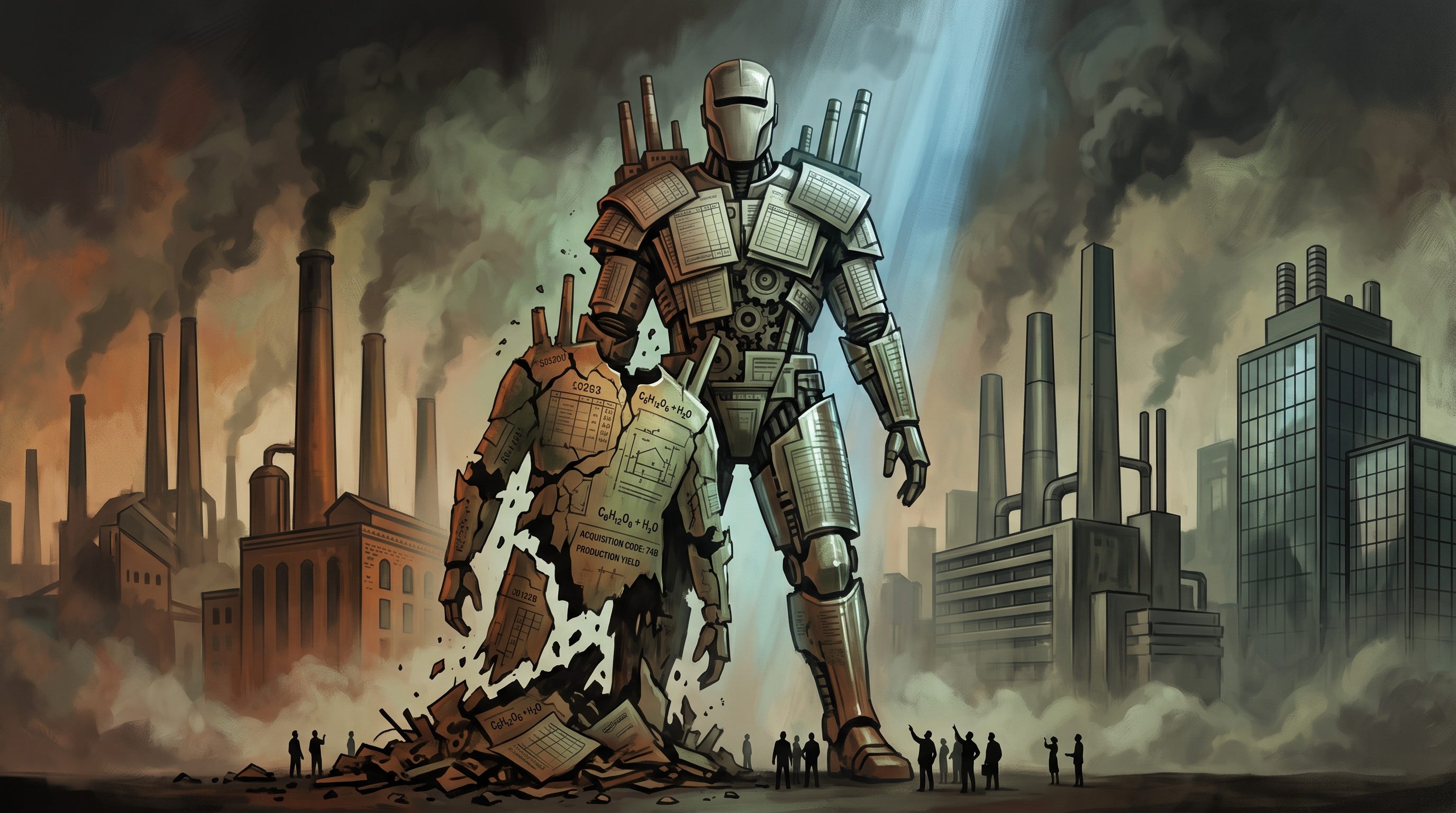
Blind Spot: They’re not separate. Follow the corporate names instead of the chemicals, and the same five bodies — GM, DuPont, Standard Oil (Ethyl Corp), Monsanto/Bayer, and Union Carbide/Dow — show up again and again across a hundred years, running a playbook so consistent it could be taught as a business-school case study. In one instance, the same company invented two of history’s most catastrophic pollutants, thirty years apart.
Reframe: This isn’t a list of scandals. It’s one long-running institution with many names — a corporate structure specifically evolved to separate profit from consequence. Once you see the mechanism, you stop being surprised by the next one. You start watching for it.
Act I: The Man Who Poisoned the Sky Twice
In 1921, a General Motors engineer named Thomas Midgley Jr. was trying to solve “engine knock” — the rattling sound of gasoline burning unevenly in a cylinder. He found that adding tetraethyl lead (TEL) to gasoline smoothed the burn and boosted octane.
There was only one problem: lead is a neurotoxin. Doctors at Harvard and Yale wrote to warn him before it ever reached market. Midgley himself was hospitalized for lead poisoning in 1923 after working closely with the compound, and needed months to recover. Workers at the manufacturing plants weren’t so lucky — several went into hallucinating fits, and multiple died, at a facility workers nicknamed the “House of Butterflies.”
Since GM held the patent for using TEL as fuel additive and Standard Oil of New Jersey held the manufacturing patent, the two companies formed a joint venture called the Ethyl Corporation to sell it — and, because neither company had chemical plant experience, they hired DuPont to actually run the manufacturing.
Sit with that for a second. DuPont built America’s leaded gasoline.
📦 Teaching Box: Why Lead Loves Your Brain
Lead is lipophilic — it dissolves in fat, not water. Your brain is roughly 60% fat by dry weight, wrapped in a membrane (the blood-brain barrier) that’s very good at keeping water-soluble toxins out and shockingly bad at stopping fat-soluble ones. Once lead crosses in, it mimics calcium, sneaks into the signaling machinery neurons use to fire, and quietly corrupts it. Small children absorb lead far more efficiently than adults and are still building the brain lead is damaging — which is why the harm concentrates so heavily in the young.
The industry’s response to the deaths wasn’t to stop. It was to fund a friendly researcher — Robert Kehoe — who spent decades insisting there was a “safe” threshold of lead exposure. When independent researcher Randolph Byers published findings in 1943 linking lead to childhood behavioral problems, the Lead Industries Association threatened to sue him into silence. It worked. His career as a researcher on the subject ended there.
Leaded gasoline stayed in American pumps for another fifty-three years.
The bill came due generations later. A 2022 peer-reviewed study in PNAS estimated that over 170 million Americans alive today were exposed to damaging lead levels in early childhood, and the same research team calculated that this exposure cost the U.S. population a cumulative 824 million IQ points over the era of leaded gas. Globally, the UN Environment Programme estimated that ending leaded petrol prevents more than 1.2 million premature deaths every year and saves the world economy roughly $2.4 trillion annually.
Here’s the part that turns this from tragedy into pattern: Midgley wasn’t done. In 1928, working again for GM, he helped invent chlorofluorocarbons — Freon — the refrigerant gas that would later be found to be eating a hole in the planet’s ozone layer. Environmental historian J.R. McNeill later said that no other single organism in Earth’s history had a more damaging impact on the atmosphere than Midgley did.
One engineer. Two of the most consequential pollutants of the 20th century. Both born from the same instinct: solve today’s engineering problem, let tomorrow’s biology and atmosphere absorb the cost.
Act II: DuPont Does It Again
Fast forward to the 1940s. DuPont — the same company that ran the leaded gasoline plants — begins manufacturing a new class of chemical: PFAS, “forever chemicals,” built around one of the strongest bonds in organic chemistry, carbon-fluorine. That strength is exactly why they’re valuable — nonstick pans, waterproof jackets, fire-suppressing foam — and exactly why they never break down.
These substances are persistent, highly mobile, and bioaccumulative — meaning once released, they don’t degrade, they spread, and they build up in living tissue over time, including, eventually, in virtually every human bloodstream on Earth.
DuPont knew PFOA (the key chemical behind Teflon) was linked to cancer, liver damage, and birth defects as early as the 1970s. Internal studies confirmed it for decades. None of it reached regulators or the public until a lawyer named Robert Bilott forced it into daylight — a story later told in the film Dark Waters.
📦 Teaching Box: The Corporate Shell Game, Step by Step
Step 1 — Suppress the science. Fund friendly researchers, discredit independent ones, keep findings internal. Step 2 — Maximize profit during regulatory paralysis. Keep selling while fighting every proposed rule. Step 3 — The great escape. When lawsuits become unavoidable, spin off a new company, transfer the liability with it, and let the new entity absorb the blame while the parent keeps the profits.
It isn’t a conspiracy theory. It’s a documented, repeatable corporate legal strategy — and DuPont has now run it on two different toxic legacies, sixty years apart.
In 2015, DuPont spun off its chemicals division into a new company, Chemours, transferring the cleanup responsibility for 171 contaminated sites along with it. At the time of the spinoff, DuPont had certified a maximum liability of roughly $128 million for a single Ohio lawsuit involving 3,500 residents — a number that ultimately produced a $671 million settlement, split between the two companies. DuPont’s own former CEO later acknowledged in a court filing that the company understood Chemours’ obligation to cover DuPont’s litigation was, in her words, uncapped.
By 2021, DuPont, Chemours, and their agricultural spinoff Corteva agreed to a $4 billion cost-sharing settlement to resolve the dispute over who owed what.
Same company. Same century. Two different molecules, built forty years apart, both persistent enough to outlive the executives who approved them — and both handled with the identical corporate reflex: spin it off, cap the number low, let the courts sort out the rest decades later.
Act III: The Company That Built Both a Death Camp and Your Cereal
Now the story crosses an ocean, and it gets darker.
Bayer — the aspirin company — began as a respectable 19th-century German chemical firm. By the 1920s it had merged with several others into IG Farben, which became a chemical and pharmaceutical conglomerate employing 330,000 people by 1943, including slave labor. IG Farben helped plan and operate the Monowitz camp at Auschwitz, where forced laborers were used to build a factory, and a Farben subsidiary manufactured the Zyklon B gas used in the death chambers.
After the war, the Allied Control Council seized IG Farben for building German war potential and split it back into its constituent companies — BASF, Bayer, and Hoechst. Twenty-three executives were tried at Nuremberg; thirteen were convicted.
Then came the reframe that should stop anyone cold: within a decade, the convicted came back. Fritz ter Meer — sentenced to seven years for plunder, spoliation, mass murder, and enslavement for his role in the Auschwitz factory — was released early in 1950, and by 1956 he was chairman of Bayer’s supervisory board, a post he held until 1964.
📦 Teaching Box: What Actually Happened to IG Farben
Dissolved in 1951 → split into six firms → consolidated into three (BASF, Bayer, Hoechst) → same shareholders, same executives, back in charge within years → all three became global pharmaceutical and chemical giants by the 1970s, credited with powering West Germany’s postwar “economic miracle.” The corporate body was declared too dangerous to exist. It existed anyway, wearing three new names.
Now the connective tissue: in 2018, Bayer bought Monsanto for $63 billion — the same Monsanto that had already appeared, unrelated to Nazi Germany, in the toxic-chemical story of the 20th century. Monsanto developed Agent Orange for Vietnam. Monsanto manufactured PCBs, banned globally but still contaminating ecosystems decades later. And Monsanto’s Roundup herbicide came bundled with over 125,000 lawsuits alleging it causes cancer.
Bayer inherited all of it, paid over $11 billion in settlements, and — in the same reflex DuPont used, the same reflex Ethyl Corp used — quietly dropped the Monsanto name from the marketing while keeping the products.
A company built from the ashes of a firm that ran a concentration-camp factory now controls a meaningful share of the world’s patented seed supply. That sentence should not be unremarkable. It’s just gone unremarked.
Act IV: When the Shell Game Fails Completely
Not every company gets to quietly restructure its way out. Sometimes the mechanism just fails, in public, all at once — and you get to see what accountability evasion looks like without the legal sleight of hand.
On the night of December 2–3, 1984, a Union Carbide pesticide plant in Bhopal, India, released roughly 40 tons of methyl isocyanate gas over a densely populated neighborhood. Official immediate death toll estimates start around 2,259, though the Indian government later paid compensation to families of 3,787 confirmed deaths, and the United Nations’ human rights office states that more than 10,000 people died within three days of exposure, with over 22,000 deaths and counting attributable to the disaster since.
The Indian government’s $3 billion damage claim was settled out of court for $470 million — an average of about $2,200 per victim’s family. When Dow Chemical acquired Union Carbide in 2001, Dow simultaneously accepted Union Carbide’s asbestos liabilities in North America while maintaining it bore no responsibility for Bhopal. The site remains contaminated today. UN experts confirmed in 2024 that the surrounding groundwater is still being poisoned, four decades on.
No spinoff. No shell company. Just a straightforward corporate decision that some liabilities are worth honoring and others aren’t — decided, apparently, by geography and the nationality of the dead.
The Pattern, Zoomed Out
Individual level: Real people — plant workers with “loony gas,” children who lost IQ points before they could talk, Bhopal residents who woke up choking — absorbed the cost of decisions made in boardrooms they never entered.
Institutional level: The corporate form itself — the corpus — was built to be split, merged, and reborn precisely because a body that can multiply is a body that can outrun any single lawsuit. This isn’t a bug that occasionally gets exploited. Legal scholars call the pattern “successor liability” law for a reason: it exists because companies have been trying to escape it for a century.
Civilizational level: We now maintain a Svalbard seed vault, PFAS blood-testing programs, and Superfund cleanup budgets — entire institutions built to manage the aftermath of a system that keeps producing the same kind of aftermath. We’ve gotten very good at cleaning up. We still haven’t figured out how to make the cleanup bill land on the people who created the mess.
The Monty Python Interlude
“All right, but apart from aspirin, refrigeration, plastics, and modern agriculture — what have these companies ever done for us?”
“Well, obviously the aspirin, refrigeration, plastics, and agriculture...”
“Yes, yes, but apart from that?”
Leaded gasoline (824 million IQ points, cumulatively, in the U.S. alone)
Zyklon B
PCBs
Agent Orange
PFAS in your bloodstream right now
A legal system so committed to protecting these companies from their own decisions that a war criminal ran a pharmaceutical company’s board within a decade of Nuremberg
“...but apart from that.”
It’s not actually a joke. That’s why it lands like one.
Facts No Spin
High confidence (peer-reviewed / court record / primary source):
DuPont operated the manufacturing plants for Ethyl Corporation’s tetraethyl lead in the 1920s under contract with GM and Standard Oil.
The 2022 PNAS study estimating 824 million cumulative IQ points lost and 170+ million Americans exposed to high childhood lead levels is peer-reviewed and publicly available.
DuPont spun off Chemours in 2015, transferring PFAS liability for 171 sites; the companies later reached a $4 billion cost-sharing settlement in 2021.
Fritz ter Meer was convicted at Nuremberg and served as Bayer’s supervisory board chairman from 1956–1964. This is documented by Bayer’s own corporate history site and the U.S. Holocaust Memorial Museum.
Bayer acquired Monsanto in 2018 and has since paid over $11 billion in Roundup-related settlements.
Union Carbide’s Bhopal settlement was $470 million; Dow acquired Union Carbide in 2001 and disputes Bhopal liability while having accepted other inherited liabilities.
Medium confidence (widely reported, some figures vary by source):
Exact Bhopal death toll — estimates genuinely range from roughly 2,259 (immediate official count) to over 22,000 (long-term, including ongoing deaths), depending on methodology and time horizon. This piece cites both ends of that range explicitly rather than picking one.
Total Bayer Roundup settlement figure — “over $11 billion” is accurate as of the major 2020 settlement, but Bayer has faced additional verdicts and appeals since, so the true cumulative figure by the time this publishes will likely be higher. Worth a quick current-figure check before this goes live if you want precision to the dollar.
What I deliberately left out: claims connecting these documented toxins to a unified theory of civilizational or democratic collapse, specific “40% cognitive decline” statistics, and any claims about vaccine-related harm patterns. These weren’t supported by anything I could verify, and confident language doesn’t fix that — it just launders it.
Grandmother’s Algorithm
Pay attention. The names change. The playbook doesn’t. Watch the corporate structure, not just the chemical name.
Do your best. You can’t personally audit every molecule in your life. You can support the people trying to close the successor-liability loopholes, and you can stop being surprised when the next one surfaces.
Pay it forward. Every one of these disasters was survivable in hindsight and preventable in foresight. The gap between those two words is where the next generation’s IQ points, water tables, and lawsuits are currently being decided.
Sources & Further Reading
PNAS: Half of US population exposed to adverse lead levels in early childhood (2022)
Duke Today: Lead Exposure in Last Century Shrunk IQ Scores of Half of Americans
UNEP: Era of leaded petrol over, eliminating a major threat to human and planetary health
Wikipedia: Ethyl Corporation — GM/Standard Oil/DuPont joint venture history
Chemistry World: Chemours sues DuPont over environmental liabilities
EWG: DuPont, Chemours and Corteva Reach $4 Billion Settlement on ‘Forever Chemicals’ Lawsuits
OHCHR: Bhopal — A lingering legacy of contamination and injustice (2024)
House of Commons Library: Potential UK support for investigations into the Bhopal gas explosion
☕ buymeacoffee.com/cognitiveloon | 💳 Swish: 0729990300 | 💳 paypal.me/hejon07
All is One — returning to Source as Sovereign Light. Peace, Love and Respect.
If this resonated with you, a like or comment goes a long way. It tells the algorithm this matters — and helps it find the people who need to hear it too. Think of it as passing the torch. 🙏