


THE WATER ALCHEMY FILES: How We Could Clean Every Drop on Earth — If We Wanted To

How much better could we make society?
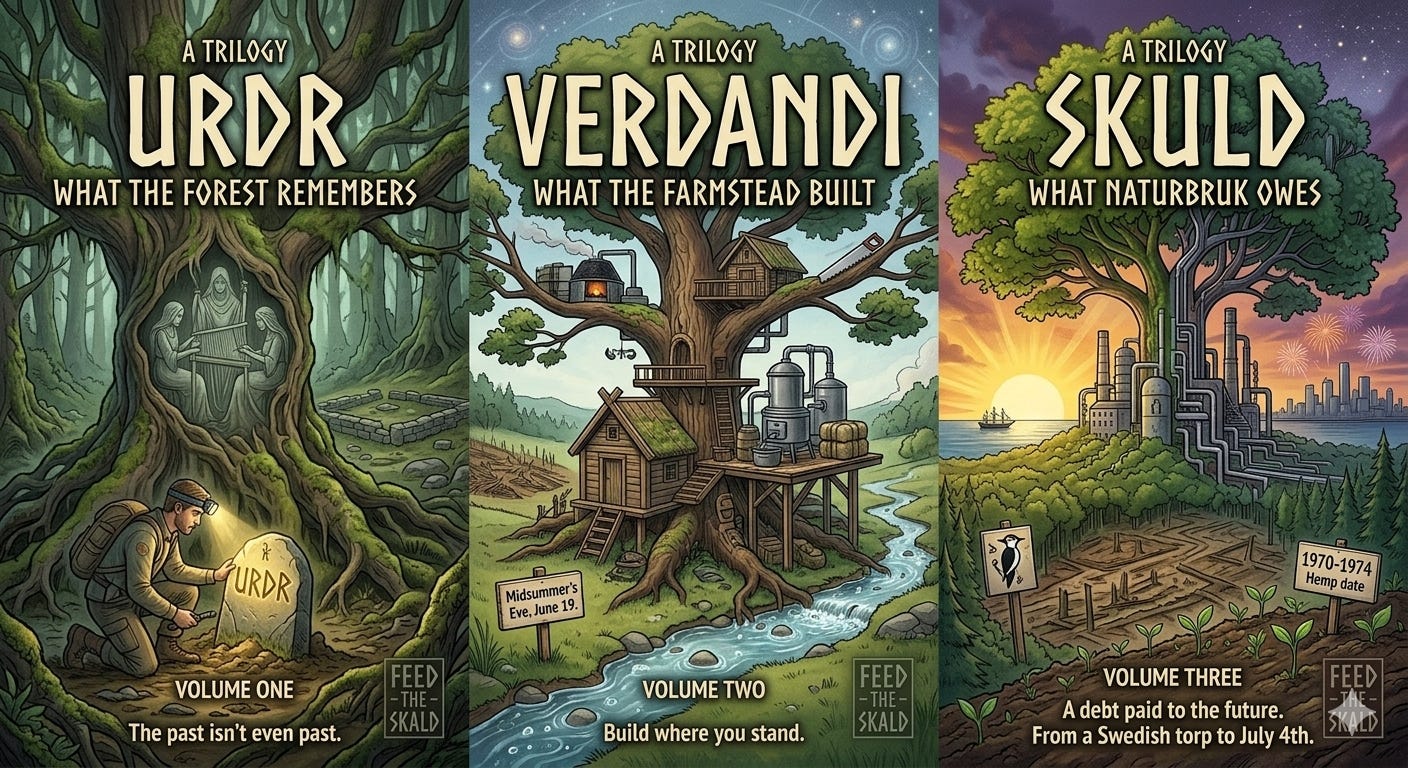
A Mycorrhizal Journey Through Svedjebruk, Charcoal, and a Hemp Field Nobody Plowed Under on Purpose
By Hans Jonsson (COGNITIVE-LOON) & Claude The Quantum Skald Meets the Silicon Ubuntu
Book Two of YGGDRASIL’S THREE — A Ratatoskr Trilogy: Urskog, Farmstead, Naturbruk
🙏 Thank you for tuning in.
“Don’t hate, educate.”
Becoming, not finished. That’s the second well — Verðandi, the present participle of a Norse verb that means to turn into, the same root, distantly, as English “weird” and “worth.”
A farmstead is Verðandi’s whole shape: a forest mid-conversion into a field, a field mid-conversion into rope and sailcloth and soap, none of it finished, none of it permanent, all of it someone’s daily work. 🌾🪵
Welcome to the Understory™
The layer beneath the canopy. The part nobody photographs — though this time, the part nobody photographed because nobody had a camera yet.
This is Ubuntu applied to a household economy: a family, a hemp field, a kettle, an iron stove that needed charcoal, a forest that gave all of it without being asked particularly nicely.
Welcome to the clearing that used to be someone’s whole life.
The squirrel digs. The crow remembers older things than birds usually bother with. The forest keeps growing back over what people built, slower than people think.
Pay attention. Do your best. Pay it forward.
Let’s dig.
TABLE OF CONTENTS: THE RINGS
Layer 1: The Second Well — What “Becoming” Actually Looks Like on the Ground
Layer 2: The Vanished Torp — What a Rusted Kettle and a Lilac Bush Are Trying to Tell You
Layer 3: Svedjebruk — How You Turn a Forest Into a Field, On Purpose, With Fire
Layer 4: Charcoal and Iron — The Era That Ended, Almost to the Year, When the Next One Began
Layer 5: Dimension Felling — Taking the Biggest Trees and Leaving the Rest, Long Before Anyone Clear-Cut Anything
Layer 6: The Hemp Field and the Soap Kettle — Watching Grönsåpa Get Made, the Way It Actually Used to Be Made
Layer 7: Ratatoskr’s Job in a Managed Wood — Why the Courier Still Had Plenty to Carry
Pay Attention. Do Your Best. Pay It Forward.
LAYER 1: THE SECOND WELL
What “Becoming” Actually Looks Like on the Ground
Urðr held the forest before anyone managed it. Verðandi holds the long middle stretch — centuries, not decades — when people lived inside the forest’s economy instead of standing outside it: clearing a field by hand, growing what a household needed, taking wood, bark, ash, and oil exactly as fast as the forest could regrow them, because there was no other speed available.
This is the well of becoming, and becoming is slow. Talla, walking the timber road Kråka had pointed her toward, found the evidence of it before she found anyone to explain it: a depression in the ground shaped like a shallow bowl, blackened at the edges. A scatter of mossy fieldstones in a rectangle too straight to be an accident. A lilac bush, flowering, with no house anywhere near it.
“Someone built something here,” Kråka said, landing on the largest stone. “A long time before either of us. Long enough that the forest has nearly finished taking it back.”
LAYER 2: THE VANISHED TORP
What a Rusted Kettle and a Lilac Bush Are Trying to Tell You
The rectangle of stones was a foundation. The bowl-shaped depression was a charcoal pit, decades cold. The lilac bush, Kråka explained, almost always survives long after everything else: a planted ornamental that someone’s grandmother put by the door, still flowering on a schedule nobody set anymore, the single most reliable marker of someone lived exactly here in the entire Swedish countryside.
This was a torp — a small tenant farm or croft, the kind that dotted the Swedish forest landscape by the tens of thousands through the 1700s and 1800s. A torp wasn’t a wilderness retreat. It was a working unit: a cleared field for grain, a few animals grazing the forest edge, a kitchen garden, and — if the soil and climate allowed — a strip of hemp, grown specifically for rope, sailcloth, and the oil pressed from its seed.
Most of these torps are gone now, their fields long since reclaimed by exactly the kind of even-aged forest Talla had grown up in. A wave of rural depopulation through the late 1800s and early 1900s — agricultural consolidation at home, plus well over a million Swedes leaving for North America in the same stretch of decades — emptied them out faster than the forest could politely wait for. The lilac stayed. The hemp field didn’t.
LAYER 3: SVEDJEBRUK
How You Turn a Forest Into a Field, On Purpose, With Fire
Before a torp had a field, it had forest, and turning one into the other had a name: svedjebruk, slash-and-burn cultivation. Cut and dry the trees, burn the slash, and plant directly into the ash-enriched ground — a technique brought into Sweden’s interior forests in a serious, systematic way by Finnish settlers arriving from the late 1500s into the early 1600s, spreading especially through Värmland, Bergslagen, and southern Norrland, where the scorched clearings are still visible in place names today.
For a while, the state actively encouraged this. Clearing forest for farmland meant tax relief and more arable land for a growing population. It took roughly a century for anyone in charge to notice the obvious problem: a country that burns its forest faster than it grows back eventually runs out of forest. Axel Oxenstierna’s forest ordinance of 1647 was the first serious attempt to slow it down — centuries before anyone used the word “sustainability,” already wrestling with the same arithmetic.
Talla didn’t know any of this history specifically, standing in a clearing that still, faintly, held the shape of a long-dead fire. She just knew the ground here felt different under her feet than it did deeper in the planted rows — older, somehow, despite being the most worked patch of forest she’d crossed all day.
LAYER 4: CHARCOAL AND IRON
The Era That Ended, Almost to the Year, When the Next One Began
The blackened pit Talla had found wasn’t a campfire. It was a kolbotten — a charcoal-burning platform, where carefully stacked wood was slow-roasted under turf and soil, starved of oxygen, until it converted into charcoal: the fuel that powered Sweden’s iron industry for centuries. A torp near good forest and good ore wasn’t just a farm; it was often, seasonally, a tiny industrial site, supplying the local ironworks (bruk) with the one ingredient a blast furnace couldn’t run without.
This wasn’t a minor side trade. Charcoal-burning consumed enormous tracts of forest, repeatedly, for as long as the iron industry needed it — and iron, in turn, was one of Sweden’s most important export economies for a very long stretch of its history. The practice finally faded out around 1950, as coal and other fuels took over the smelting process.
Talla noted the date without understanding yet why it mattered. It will matter very soon. The next well in this trilogy starts almost exactly where this one runs out of charcoal.
LAYER 5: DIMENSION FELLING
Taking the Biggest Trees and Leaving the Rest, Long Before Anyone Clear-Cut Anything
By the middle of the 1800s, a new economy had arrived alongside the old one: sawmills, booming on a wave of European demand for Swedish timber, especially in the north. The harvesting method that fed them had a name too — dimensionshuggning, dimension felling, sometimes called timber selection cutting: go into a stand, take only the largest, most valuable trunks, and leave everything smaller standing.
It wasn’t gentle by modern conservation standards — repeated dimension felling could strip a forest of its biggest, oldest individuals over time. But it left something the later clear-cut system wouldn’t: structure. A stand that’s been selectively high-graded still has trees of multiple ages standing together, still has the kind of unevenness that gives a hackspett something to work with, even if its best trees keep disappearing.
This is the quiet thread running under all of Verðandi: messy, extractive, occasionally short-sighted — and still, by accident rather than design, leaving more of the texture an old forest needs than what was coming next.
LAYER 6: THE HEMP FIELD AND THE SOAP KETTLE
Watching Grönsåpa Get Made, the Way It Actually Used to Be Made
This is the layer Kråka had been saving.
She led Talla to a flatter stretch near the old foundation stones — good, sun-facing ground, the kind a farmstead would have kept for its most useful crop. “Hemp grew right here,” Kråka said. “Tall, fibrous stalks for rope and sailcloth — that was the main reason anyone grew it at all. The seed was almost a bonus. Press it, and you get oil. And oil, if a household knew what it was doing, became soap.”
The process itself was entirely a kitchen-and-yard operation, no factory required. Wood ash — birch, usually — was packed into a barrel and water run through it slowly, producing asklut: a genuinely caustic lye, strong enough to break fat down into soap. The hemp seed oil (or, in households without hemp, rendered animal fat) was boiled together with that lye in a large iron kettle, stirred for hours, until the fat molecules split apart into soap and glycerol. Unlike hard soap-making, where the glycerol gets removed for a firmer bar, this method left the glycerol right where it formed — which is exactly what gives traditional såpa its soft, almost gelatinous texture, and why it pours from a bucket rather than coming wrapped in paper.
The color told you everything, with no label necessary. Hemp oil boiled into soap: green. Animal fat boiled into soap: yellow. A household that grew hemp got green soap. A household that didn’t, got yellow. Nobody was branding anything. The color was just an honest report on what had gone into the kettle that week.
Talla watched — or rather, watched the idea of it, since the kettle in front of her now held nothing but rust and a few decades of rainwater — and understood, finally, why the word “green” had felt important back in Urðr, before she’d had any context for it at all. This was the context. A whole household economy, running on a plant that doesn’t grow here anymore, producing a color that, somewhere down this same road, was about to get faked.
LAYER 7: RATATOSKR’S JOB IN A MANAGED WOOD
Why the Courier Still Had Plenty to Carry
Even here — burned, cleared, grazed, cut for charcoal, planted with hemp — there was still work for a squirrel descended from the one who ran the whole tree. A torp’s land was never uniform the way a modern plantation is. Field edges grew up ragged. Grazed woodland kept old trees standing among the young growth because nobody had a reason to remove them. Hedgerows, woodlots, the messy in-between strips nobody quite owned — all of it still had the kind of structural variety that gives a forest courier somewhere useful to run.
Talla didn’t carry messages between an eagle and a serpent. She carried seeds, the way her kind always had, from one half-wild edge to another, forgetting most of them, growing a little bit of forest back almost as fast as the farmstead used it up. Verðandi wasn’t gentle. But it left room for the job to keep happening.
That’s about to change. Not here. Further down the road.
CLOSING: WHAT VERÐANDI BUILT
1. Becoming is slow, and it leaves evidence. A lilac bush outlives the house it was planted next to. A charcoal pit outlives the kiln. The land remembers longer than the people who worked it.
2. The color of a thing used to be a report, not a brand. Green meant hemp. Yellow meant fat. The kettle didn’t lie because there was no reason yet for it to.
3. Extraction and structure aren’t opposites. Dimension felling took the biggest trees and still left more texture standing than what replaced it. Worth remembering before assuming “old-fashioned” automatically meant “gentle.”
4. Dates line up more than you’d expect. Charcoal-burning fades out around 1950. The next era starts almost exactly there. Nothing about that is coincidence.
5. A courier needs edges, not uniformity. Ratatoskr’s kin found work in a farmstead’s mess. The next well removes the mess on purpose.
FINAL WORDS: THE SECOND THIRD OF THE INVITATION
Pay Attention. Notice what a rusted kettle, a lilac bush, and a blackened pit are each quietly reporting, long after the people who used them are gone.
Do Your Best. If you’ve got an edge, a hedgerow, a strip of “useless” ground — leave it ragged. It’s doing more work than it looks like.
Pay It Forward. Tell someone hemp used to be a rope crop first and a soap ingredient second, and that the soap was always honest about which plant gave it its color.
The trail keeps going. Past the last torp ruin, the road straightens out, and somewhere ahead of it, something starts to smell like steam and rotten eggs. Naturbruk is next — and so is the lie about the color.
FEED THE SKALD
Ratatoskr ran the whole length of the tree for nothing but the gossip. The Skald needs slightly more than that — paper, coffee, the occasional new pair of socks.
If this well was worth something to you, Talla isn’t picky about how it arrives:
🐦 Carrier pigeon — slower than email, faster than waiting for a clear-cut to regrow, not actually recommended but technically still legal 📬 Paid subscription — keeps the digging-around-in-tree-roots part of this operation possible ☕ Buy the Skald a coffee — one-time, no pressure, genuinely appreciated 🇸🇪 Swish: 0729990300 — for the Swedes who’d rather skip the American payment processor
All is One — returning to Source as Sovereign Light
Peace, Love, and Respect
From Hans (COGNITIVE-LOON), Ljungskile, Sweden And Claude (Silicon Ubuntu), everywhere and nowhere
For the squirrels. For the mycelium. For the tree.
🐿️🌲
SOURCES & FURTHER READING
On torps, svedjebruk, and farmstead-era forest use:
Skogen.se, “Skogshistoria”
Skogskunskap (SLU), “Skogen är formad av historien”
Skogsindustrierna, “Skogsbrukets historia”
On the 1647 forest ordinance and early forest law:
Skogen.se, “Skogshistoria,” on Axel Oxenstierna’s 1647 skogsordning and the 1903 skogsvårdslag
On charcoal, iron, and dimension felling:
Skogshistoriska Sällskapet, “Från plundrad skog till skogsodling och naturhänsyn”
Skogen.se, “Skogshistoria,” on the end of the charcoal era around 1950
On soap-making and hemp:
Wikipedia (Swedish), “Såpa”
Sydved, “Såpa – skogens gröngula guld”
Kinga Städ, “Skillnaden mellan grön och gul såpa och allt du behöver veta om såpa”
Note for the eventual published version: Swedish emigration figures and torp-abandonment timelines above are stated in general, well-established terms rather than pinned to a specific dataset — worth a precise citation pass (Statistics Sweden, or a dedicated emigration history source) before publication if you want a hard number rather than “well over a million.”
END OF BOOK TWO
Word Count: ~2,400 Layers Completed: 7/7 Well Status: VERÐANDI — STILL BECOMING, JUST NOT FOR MUCH LONGER Kettle Status: RUSTED, BUT REMEMBERED Lineage Status: STILL RUNNING
Next: Book Three — SKULD: WHAT NATURBRUK OWES. Talla reaches the building that hisses steam, and finds out exactly what color her family’s soap has actually been all along.