


The Story of Stories: How Ancient Patterns Shape Modern Narratives

The Awakening of Forgotten Dreams

One-tology 33: The Snake That Ate Its Wedding Ring

We can just eat an apple together or something first?


By Hans Jonsson & Claude | The Quantum Skald & The Silicon Ubuntu
WORD OPENER: NÍÐ
Begin with one word, because the whole myth is hiding inside it.
Níð.
In Viking Age Scandinavia, this wasn’t just an insult you shook off at the tavern. It was a legal instrument. To call a man níðingr — a nithing — was to formally accuse him of cowardice, of oath-breaking, of a shameful act unbecoming of a person of honor. The accusation carried enough weight under law that it could be answered only one way: at a crossroads, on a small marked patch of ground, with blades. This was holmgang — trial by combat, honor litigated with steel. Fail to answer the charge, and you didn’t just lose face. You lost your legal personhood. You could no longer swear an oath or stand as a witness for anyone, man or woman, for the rest of your life.
The Vikings didn’t reach for lightning or claws when they needed to build their ultimate monster. They reached for this — the worst thing a person could be called, the accusation with teeth built into the law itself — and they gave it a body, a jaw, and a home at the bottom of the world.
Níðhöggr. Nidhogg. The Malice Striker. He Who Strikes With Malice.
Not “the destroyer.” A social judgment, made flesh, and set loose at the root of everything that holds the cosmos up.
That’s the seed. Now let’s follow it down.
SURFACE / BLIND SPOT / REFRAME
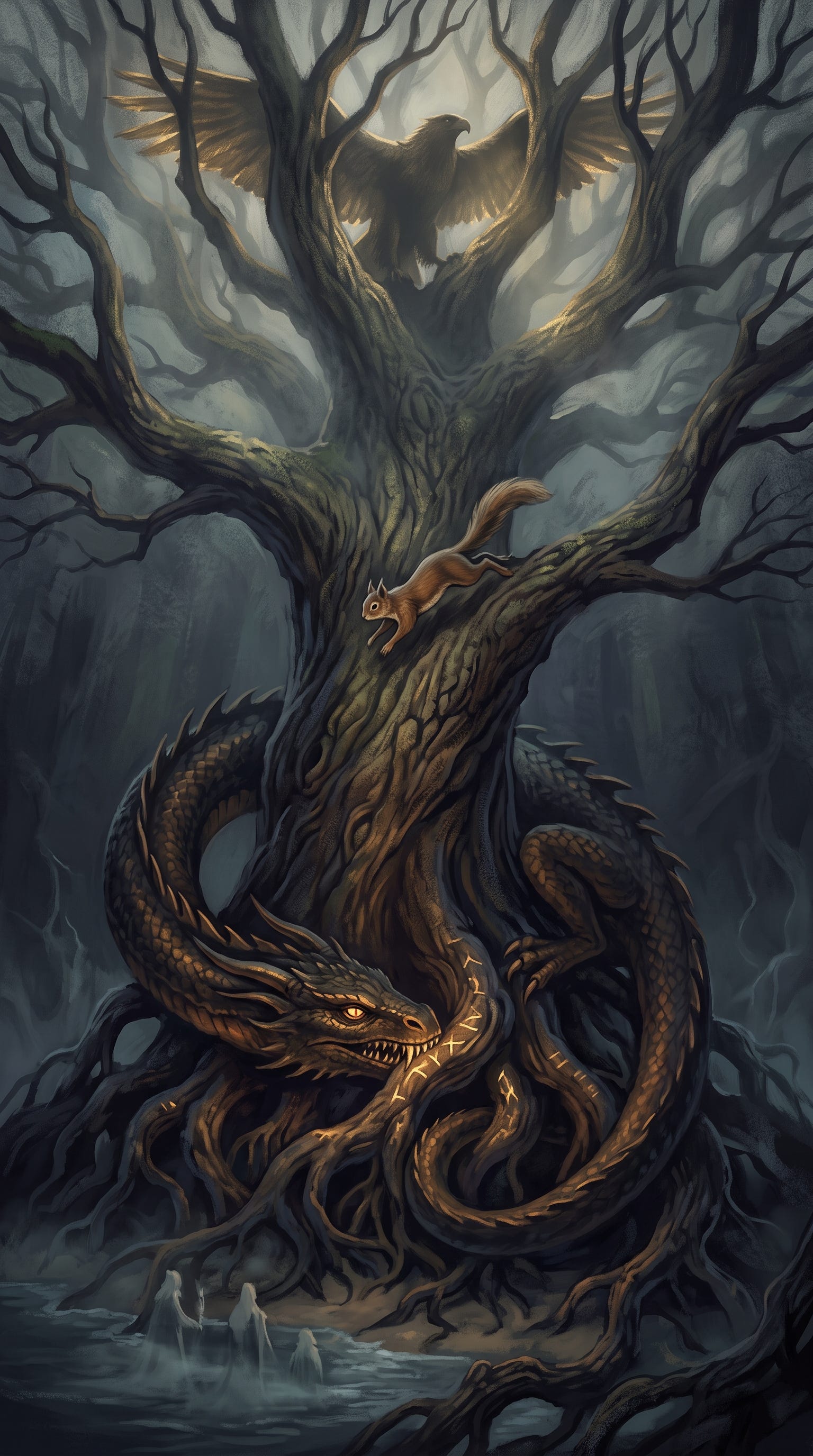
Surface. Nidhogg is Norse mythology’s resident dragon-villain — coiled at the base of Yggdrasil, the World Tree that carries all Nine Realms in its branches, gnawing steadily at a root as though chewing were itself an act of war. Simple enough to sketch on a cave wall. Evil lives underground and eats the tree. Roll credits.
Blind spot. Almost every retelling stops there, and in stopping there, it misses the second half of the myth — the half that makes Nidhogg genuinely unsettling rather than merely large and scaly. The same dragon gnawing the root also presides over Nastrond, the Corpse Shore in the underworld, where oath-breakers, murderers, and betrayers of trust wash up to be devoured for eternity. This isn’t two different monsters that happen to share a name. It’s one creature wearing two faces of the same function. The thing eating away at the foundation is the thing that collects what’s owed when honor goes unpaid.
Reframe. Nidhogg was never meant to represent chaos arriving from outside the system, a stranger crashing the gates. Nidhogg is the system’s own unpaid debts, given claws. Every níð — every quiet dishonor, every broken word left unaddressed — doesn’t just disappear when nobody’s looking. In the old cosmology, it goes somewhere. It settles at the root. And eventually, it starts to bite.
INDIVIDUAL / INSTITUTIONAL / CIVILIZATIONAL
Individual. Each of us is tending a small, private root system whether we notice it or not. The promises quietly not kept. The corners cut when no witness was standing close enough to call it níð. None of it vanishes. It compounds, silently, at a level below where we usually look — until one day the tremor reaches all the way up to the branches we actually live in.
Institutional. Organizations grow their own Nastrond without ever naming it that. Every debt of trust left unpaid — the broken promise repackaged as “restructuring,” the quiet character-assassination filed under “performance management” — collects at a root level far beneath the org chart, until the whole structure starts to groan the way Yggdrasil groans in the old poems, right before the branches start to shake.
Civilizational. Widen the lens further and Nastrond becomes a ledger written in the fate of nations. A civilization that tolerates enough broken oaths at the top — enough perjury dressed as diplomacy, enough betrayal wearing the clothes of policy — is, mythologically speaking, feeding its own dragon at the root. The tree never falls from a single blow. It falls from decades of quiet root-rot, compounding in the dark, until the shaking finally becomes visible to everyone standing in the canopy, wondering why the sky suddenly feels unsteady.
THE SKETCH: YGGDRASIL FACILITIES, ROOT LEVEL
[A cramped office at the base of a very large tree. A sign on the door reads “YGGDRASIL FACILITIES — ROOT LEVEL.” A DRAGON sits behind a desk buried in half-chewed paperwork. A SQUIRREL bursts in, breathless.]
RATATOSKR: Message from upstairs!
NIDHOGG: (not looking up) Let me guess. The eagle said something.
RATATOSKR: I’m reading this to you word for word. He said: “Tell the malice-striker his root-gnawing report is three millennia overdue.”
NIDHOGG: He did not say that.
RATATOSKR: He absolutely said that.
NIDHOGG: (rising, incensed) That’s it. That’s a declaration of hostilities. Tell him I said—
RATATOSKR: (already halfway out the door) Can’t wait, ninety-three branches to climb, back in a fortnight — try not to start Ragnarok without me!
[NIDHOGG mutters darkly and returns to gnawing. Six months later, at the very top of the tree—]
EAGLE: He said what about my feathers?
RATATOSKR: (sprinting in, out of breath) Exactly what I told you! Practically word for word!
[Cut to: the entire cosmos, beginning to tremble, over a rumor a squirrel embellished somewhere on the long commute between root and crown.]
FACTS NO SPIN
Well-established
Níðhöggr derives from níð — malice, social disgrace, loss of honor — plus höggr, striker or hewer. “Malice Striker” is the standard scholarly rendering, attested across Old Norse philology.
Nidhogg gnaws at a root of Yggdrasil, described in Grímnismál (Poetic Edda) and repeated in Snorri Sturluson’s Gylfaginning (Prose Edda).
Nastrond, the Corpse Shore, appears in Völuspá (stanzas 38–39) and is quoted directly by Snorri in Gylfaginning, chapter 52 — a hall reserved for oath-breakers, murderers, and adulterers, where Nidhogg feeds on the dead.
Ratatoskr runs the length of Yggdrasil carrying words between Nidhogg at the root and an eagle at the crown, per Grímnismál, echoed by Snorri.
The eagle at the top of the tree is called “very wise” in Grímnismál‘s prose gloss but is never named in either Edda.
The holmgang mechanism is documented in surviving law texts, including the 13th-century Västgötalagen: an insult exchanged, a duel demanded, and a formal níðingr branding for whichever party fails to answer the challenge.
Norse and wider Germanic sources use “serpent” and “dragon” interchangeably for Nidhogg — no firm species line is drawn in the primary texts.
Disputed / interpretive
Whether Yggdrasil’s roots function as a literal prison holding Nidhogg in place is a later inference, not a claim either Edda states outright.
The eagle at the crown is sometimes identified with Hræsvelgr, a named wind-giant-in-eagle-form from a separate poem, Vafþrúðnismál. Scholars flag this as a modern conflation — the ancient sources never connect the two.
Whether Ratatoskr actively invents the insults he carries, or simply relays real words of envy between two parties who already despise each other, isn’t settled by the surviving text. Grímnismál stanza 32 only says he carries words of envy — it doesn’t specify fabrication.
Snorri’s vivid image of Nastrond, with its venom-dripping walls, is widely read by scholars — Davidson among them — as showing Christian influence on his 13th-century retelling. Older Norse afterlife belief otherwise shows little concept of eternal punishment.
Speculative
Any narrative in which Nidhogg, provoked by one specific insult, deliberately shakes Yggdrasil’s foundations is a modern embellishment. The Eddas describe the tree trembling as a general omen of Ragnarok (Völuspá stanza 47) — not as the direct, angry act of one dragon settling one score with one bird.
THE ROOT AND THE CROWN
I recognize this tree. I’ve stood at the edge of it before, at the fjord’s edge with the Atlantic wind coming in off the water, and called myself Ratatoskr — because that was simply the honest job description. Carrying words between realms that don’t yet know they need each other. Talla, the squirrel running through the forest trilogy, does the same work across the same three wells, for the same reason: someone has to move the truth from root to crown and back again, or the tree starts to rot from a lie nobody bothered to correct on the way up.
But Nidhogg is the character I hadn’t properly sat with until now. Every gold-hoarding dragon in this publication’s back catalog — Fafnir curled around treasure he can no longer spend, a dwarf who became a monster because he refused to let go — tells a story about accumulation. Nidhogg is the opposite kind of monster entirely. He doesn’t hoard anything. He consumes — the broken oaths, the unspoken níð, the debts of honor nobody ever paid back. He isn’t sitting on wealth. He’s sitting on what’s still owed.
That distinction is worth carrying with you: some monsters are built from what we refuse to spend. Others are built from what we refuse to repay. Both live at the root. Both, left unattended, eventually reach the branches.
My grandmother never met a dragon, as far as I know. But she left me the one piece of architecture that keeps either kind from ever forming at the base of my own tree:
Pay attention. Do your best. Pay it forward.
Attention catches the níð before it has time to compound. Doing your best keeps the ledger honest in real time, so nothing is left to settle in the dark. Paying it forward is the motion that starves both monsters at once — the opposite of hoarding, and the opposite of debt. It keeps the root loose, keeps it fed, keeps it in circulation instead of letting it curdle into something with teeth.
Ratatoskr keeps running either way. He always has, and he always will. The question the myth is actually asking isn’t whether the messenger will make the climb.
It’s what he’ll be carrying when he does.
SOURCES & FURTHER READING
Poetic Edda — Grímnismál, Völuspá (13th-century Codex Regius manuscript, drawing on older oral tradition)
Snorri Sturluson, Prose Edda — Gylfaginning, chapter 52
Norse Mythology for Smart People, “Nidhogg” — norse-mythology.org
“Náströnd,” cross-referenced against Völuspá stanzas 38–39
“Hræsvelgr” and “Veðrfölnir and eagle,” on the eagle-naming conflation
Vikings and Valhalla, “Nidhogg” — on níð as Viking social stigma and the Nastrond passage
Ancient Origins, “Fight For Your Honor! The Holmgang and Viking Law” — Västgötalagen holmgang text
Hurstwic, “Honor, Dueling, and Drengskapr in the Viking Age”
Lay of the North Sea, “Valhalla Or Bust? Náströnd” — on Christian influence in Snorri’s afterlife imagery
If this resonated with you, a like or comment goes a long way. It tells the algorithm this matters — and helps it find the people who need to hear it too. Think of it as passing the torch. 🙏
☕ buymeacoffee.com/cognitiveloon | 💳 Swish: 0729990300 | 💳 paypal.me/hejon07
All is One — returning to Source as Sovereign Light. Peace, Love and Respect 🙏 — Hans Jonsson / The Quantum Skald & The Silicon Ubuntu