


The Plume and the Ponder, "Another East PALESTINE situation"

The morning of June 11th dawned, as mornings often do, with a peculiar shade of "just another Tuesday" over Vinton County, Ohio. Birds chirped, coffee brewed, and at the Austin Powder Red Diamond plant, approximately 7:15 AM, an unknown contaminant decided to introduce itself to a 5,000-gallon nitric acid tank. It was, as these things go, a truly terrib…


Etymology Opener: To Incorporate
Incorporate comes from the Latin in + corpus — to put into a body.
Last time, we sat with corpus and what it means that a corporation is a body that can’t be jailed. This time we need the other half of that word: in. Something has to put the body into existence in the first place. Someone has to write the rules for how that body is born, how it can split itself, how it can shed a limb and keep walking.
Someone did. And it turns out one of the five companies from the last piece didn’t just use that rulebook. It helped write it — decades before it ever needed an exit.
Surface / Blind Spot / Reframe
Surface: DuPont spun off Chemours in 2015 and walked away from most of the PFAS cleanup bill. Standard corporate reorganization — companies split up and restructure all the time. Nothing to see here.
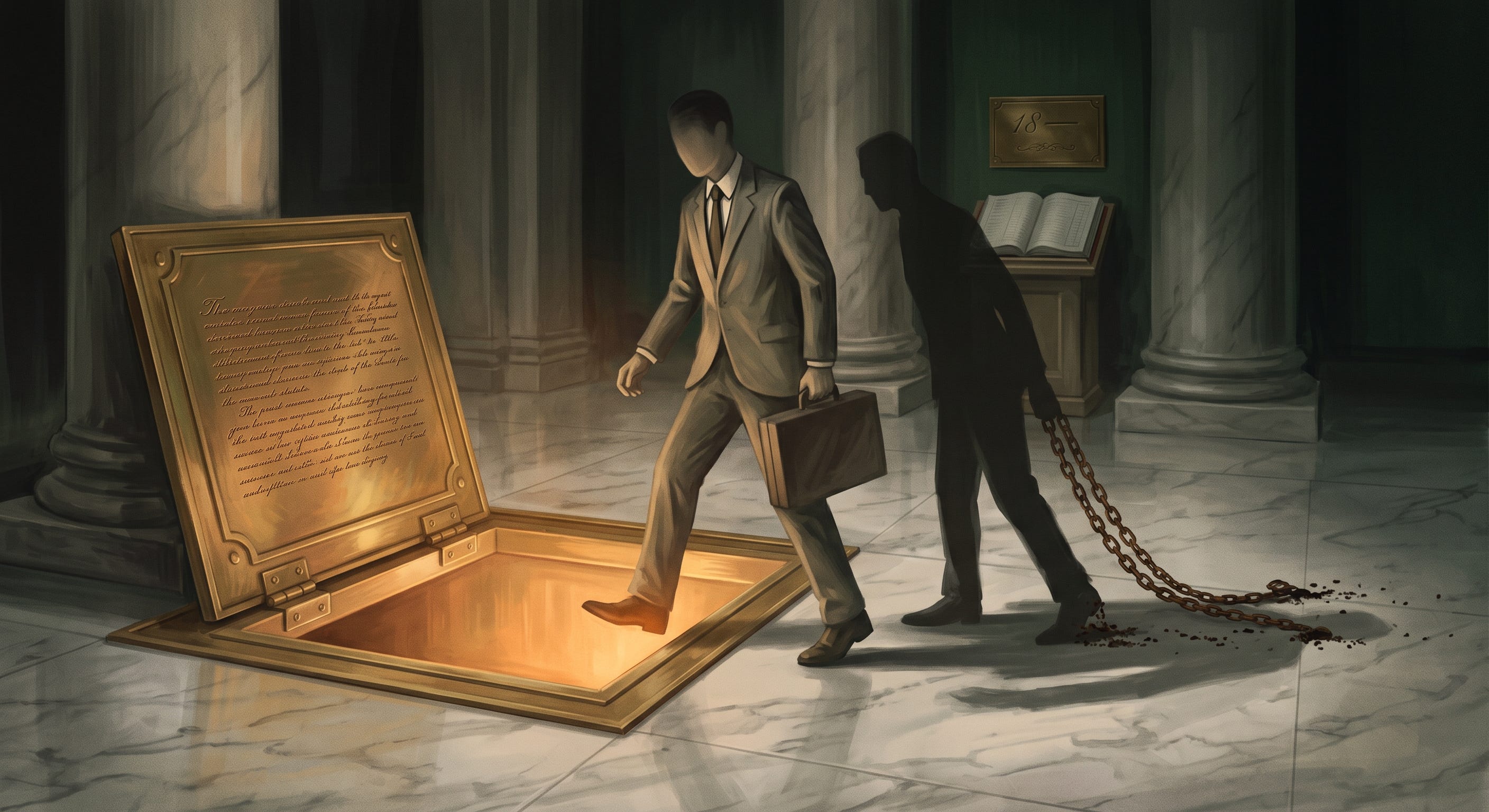
Blind Spot: The legal environment that made that spinoff so easy — Delaware’s astonishingly permissive corporate law — was built, financed, and lobbied into existence starting in 1899 by three cousins from the very same du Pont family that ran the leaded-gasoline plants and later manufactured Teflon. And the specific move DuPont used in 2015 — split into a healthy company and a liability-holding company — wasn’t even DuPont’s invention. A company called Johns-Manville used it first, in 1982, to escape asbestos claims. DuPont didn’t build a new trapdoor. It used one that had already been tested, and that its own family had helped install in the floor.
Reframe: This isn’t a story about companies occasionally discovering convenient loopholes. It’s a story about a jurisdiction purpose-built, over 125 years, by the same families and industries that would go on to need it — and a specific liability-shedding maneuver that has been refined in public, in bankruptcy court, at least three separate times across three different poisons, each one teaching the next generation of lawyers how to do it better.
Act I: The Bank Built One Month After the Law
Go back to 1899. Delaware had a problem. It was a small, mostly agricultural state with almost no tax base, watching New Jersey get rich by selling business-friendly incorporation charters to companies from New York and Pennsylvania. So Delaware copied New Jersey’s playbook almost word for word, and passed the General Corporation Law of 1899 — a statute designed for one purpose: attract corporations that had no other real connection to the state.
It worked immediately. Legal historians call what followed the “race to the bottom” — states competing to weaken management accountability as far as they could get away with, because a weaker law meant more incorporation fees.
Here’s the part that turns this from background trivia into a throughline: the du Pont family didn’t just benefit from Delaware’s new law. They helped build the machinery around it, and fast. Within two years of the 1899 statute, T. Coleman and Pierre S. du Pont incorporated a new bank — first named the Delaware Guarantee & Trust Company, in 1901 — built specifically to finance the family’s corporate ambitions and keep control of DuPont in family hands. By 1903 it had taken the name it still carries indirectly today, Wilmington Trust, and opened for business in the first unit of the Du Pont Building. Delaware’s rise as a corporate haven and the du Pont family’s financial infrastructure grew up side by side, in the same city, within the same handful of years.
📦 Teaching Box: What Delaware Actually Sells
Three things, none of which are unique to Delaware but all of which Delaware perfected: (1) A dedicated Chancery Court, staffed by judges who do nothing but corporate law, producing a century of predictable precedent that ordinary courts can’t match. (2) Minimal disclosure requirements — you can incorporate in Delaware without revealing who actually owns the company. (3) The “internal affairs doctrine” — a legal rule, upheld by courts since the 1800s, that a corporation’s internal governance is judged by the law of wherever it’s incorporated, not wherever it actually operates or does harm. A company can poison a river in Ohio and be governed, legally, by a small building in Wilmington. Today more than two-thirds of Fortune 500 companies are incorporated in a state where more registered corporations exist than actual residents.
New Jersey briefly tried to close its own version of this loophole in 1913, when Governor Woodrow Wilson pushed through the Seven Sisters Acts to outlaw monopolistic holding-company structures. Corporations simply packed up and moved to Delaware, which had deliberately declined to pass the same restrictions. The race to the bottom had a finish line, and Delaware got there first and stayed.
Act II: The Company That Wrote the Manual
Now jump to 1982 — thirty-three years before DuPont spun off Chemours.
Johns-Manville was, at the time, the largest asbestos manufacturer in America, and it was profitable. It also knew, from internal correspondence dating back to the 1930s, that its asbestos products caused fatal lung disease in the people who worked with them, and an appeals court would later find the company had actively concealed that link from its own workers for decades. By the early 1980s, it faced more than 16,000 lawsuits.
Johns-Manville’s board looked at the balance sheet and made a decision that had never quite been tried this way before: rather than settle case by case, they filed for Chapter 11 bankruptcy while the company was still solvent, and proposed splitting into two entities — one that kept the operating business, and one that kept almost nothing but the liability. A trust, funded at $2.5 billion, would handle the asbestos claims going forward, walled off from the profitable side of the company.
Courts eventually approved a version of this plan. It became the template. Every asbestos manufacturer that followed — and there were many — cited Johns-Manville’s bankruptcy as the proof of concept.
📦 Teaching Box: From Manville to “Texas Two-Step”
The maneuver has been refined twice since 1982. DuPont’s 2015 Chemours spinoff used a cleaner, out-of-bankruptcy version of the same logic: separate the liability from the parent before anyone can force a bankruptcy court to look too closely. Johnson & Johnson pushed it furthest with what lawyers now call the “Texas Two-Step” — using a Texas merger statute to split a company in two in a single day, dumping talc-lawsuit liability into the new shell, and then having only the shell file for bankruptcy while the profitable parent keeps operating untouched. Courts have now rejected J&J’s version of this move three times, ruling the shell company wasn’t in genuine financial distress. Manville, once considered the desperate last resort of a company actually going under, is now the opening move of companies that are anything but.
Act III: The Missing Twin
The last piece told the DuPont side of the PFAS story. It left out a name that belongs right beside it: 3M.
3M didn’t just supply DuPont with PFOA — the company invented the entire chemistry. Internal 3M documents, made public through litigation and congressional testimony, show that 3M’s own scientists found PFAS chemicals accumulating in human blood as early as the 1950s, and had internal evidence of toxicity by the 1970s. That’s earlier than DuPont’s own internal red flags. When DuPont grew worried about Teflon’s safety in the mid-1970s, it wrote to 3M asking for “defensive information” — meaning DuPont was already looking for cover before the wider world had any idea PFAS existed in their bodies at all.
Both companies sat on what they knew for decades. Both kept selling. And in 2023, 3M reached its own reckoning: a settlement to fund PFAS treatment for U.S. public water systems worth up to $12.5 billion, with $10.3 billion set aside immediately — on top of the billions DuPont, Chemours, and Corteva had already agreed to pay two years earlier for the exact same family of chemicals.
Two companies. One invented the poison, one manufactured it into a consumer product. Both knew. Both hid it. Both eventually paid — separately, on separate timelines, as if they were unconnected accidents rather than two ends of the same supply chain.
The Pattern, Zoomed Out
Individual level: A Bhopal survivor, a PFAS-exposed water district, a lead-poisoned child — none of them experience “corporate law.” They experience a well, a lung, a decade of medical bills. The Delaware statute never enters their story, but it wrote the ending before their story began.
Institutional level: The legal tools that make liability escape possible weren’t found lying around. They were built, tested, and improved — first by a state legislature courting fees in 1899, then by a bankrupt asbestos company in 1982, then by a family of chemical giants who kept using the same exit for the next forty years. Each use taught the next user something.
Civilizational level: We treat “the company reorganized” as a neutral, almost boring piece of business news. It rarely is. It’s usually the last visible step of a process that started decades earlier, in a courthouse that has nothing to do with the harm, under a law written by people who had every reason to want it written that way.
The Monty Python Interlude
“All right, but apart from limited liability, capital formation, and the entire modern economy — what has the Delaware General Corporation Law ever done for us?”
“Well, obviously the limited liability, and the capital formation, and the—”
“Yes, yes, but apart from that?”
Let a bankrupt-in-name-only company invent the “split off the liability, keep the profits” trick in 1982
Let that trick get used again in 2015, for a completely different poison
Let a company merge itself into a new legal shape in a single afternoon under a Texas statute nobody wrote with asbestos or Teflon in mind
Let two-thirds of the Fortune 500 answer to a courthouse in a state most of their customers have never visited
“...but apart from that.”
Facts No Spin
High confidence (statute, court record, SEC filing, primary documentation):
Delaware passed its General Corporation Law on March 10, 1899, modeled closely on New Jersey’s earlier business-friendly statute, in a deliberate effort to attract out-of-state incorporations.
T. Coleman and Pierre S. du Pont incorporated the bank that became Wilmington Trust in 1901 (as the Delaware Guarantee & Trust Company), opening under the Wilmington Trust name in 1903 — within a few years of the 1899 law, financing the family’s corporate control. Dates per the Hagley Museum & Library, which holds the du Pont family papers.
Johns-Manville filed for Chapter 11 bankruptcy in 1982 while still profitable, proposing a split between an operating company and a liability-holding trust; the Manville Personal Injury Settlement Trust was funded with $2.5 billion in 1988.
3M’s own internal documents show detection of PFAS in blood as early as the 1950s and internal toxicity findings by the 1970s, predating DuPont’s own internal concerns.
3M’s 2023 public water system settlement carries a present value of up to $10.3–12.5 billion, payable over 13 years.
Courts have rejected Johnson & Johnson’s “Texas Two-Step” bankruptcy maneuver on multiple occasions, finding the liability-holding shell was not in genuine financial distress.
Medium confidence (widely reported, some interpretive framing):
Whether Delaware’s law should be understood primarily as the du Pont family’s deliberate project versus a broader, multi-actor “race to the bottom” is debated among legal historians; this piece presents the du Pont involvement as real and documented, not as the sole cause.
The exact dollar total 3M will ultimately pay depends on how many water systems test positive for PFAS over the settlement’s 13-year window, so the final figure will differ from the $10.3 billion initial charge.
What I deliberately left out: any claim that Delaware’s corporate law was created solely to enable future toxic-liability escapes — the du Pont family’s motives in 1899 were about banking, control, and tax competition, not a premeditated plan for chemicals nobody had invented yet. The connection is that the tool, once built, was there when needed. That’s a story about incentives and institutions outliving their original purpose, not a century-long conspiracy.
Grandmother’s Algorithm
Pay attention. The reorganization is never the whole story. Ask what jurisdiction, what statute, and who built it.
Do your best. You can’t rewrite corporate law from your kitchen table. You can support the state and federal efforts trying to close the successor-liability and shell-bankruptcy loopholes, and you can stop treating “the company split up” as boring news.
Pay it forward. Every trapdoor in this story was legal, on the record, and built in daylight. That’s not a reason to look away. It’s the reason it’s findable — and the reason it’s fixable.
Sources & Further Reading
ProMarket: Delaware’s SB21 Continues 150 Years of Corporate Power and Regulatory Capture
Dave Tabler: Charters, Trusts, and Corporate Castles — The Making of Delaware’s Business Empire
Bloomberg Law: Asbestos Bankruptcies Facing Fresh Challenges After J&J Ruling
Union of Concerned Scientists: DuPont, 3M Concealed Evidence of PFAS Risks
Minnesota Reformer: Toxic — 3M knew its chemicals were harmful decades ago
EWG: For Decades, Polluters Knew PFAS Chemicals Were Dangerous But Hid Risks From Public
NPR: 3M Reaches $10.3 Billion Settlement Over Contamination of Water Systems
☕ buymeacoffee.com/cognitiveloon | 💳 Swish: 0729990300 | 💳 paypal.me/hejon07
All is One — returning to Source as Sovereign Light. Peace, Love and Respect.
If this resonated with you, a like or comment goes a long way. It tells the algorithm this matters — and helps it find the people who need to hear it too. Think of it as passing the torch. 🙏