


by The Quantum Skald & The Silicon Ubuntu | COGNITIVE-LOON | hejon07.substack.com
Foreword: Why this publication is called what it’s called
Restoration of Perception sounds, on the surface, like a slogan — the kind of phrase that sits under a masthead and gets skimmed past on the way to the actual article. But split the words apart and they’re doing real work, and this piece is a clean example of why.
Restore — from Latin restaurare, “to rebuild, renew, repair what was damaged.” Not replace. Not invent something new. Rebuild what was already there and got knocked out of shape.
Perceive — from Latin percipere, “to take hold of thoroughly, to grasp fully.” Not look. Grasp completely — the whole shape of a thing, not the flat outline of it.
Put them together and Restoration of Perception isn’t “seeing things differently.” It’s putting back the full, deep, three-dimensional grasp of something that a wound, a grudge, or a flattened narrative had reduced down to one plane.
That’s exactly what an eye for an eye does to a person — it takes someone capable of full, depth-measuring sight and reduces them to a single fixed point of injury, staring at one flat plane forever. And that’s exactly what forgiveness undoes. It isn’t softness. It’s the literal restoration of the second eye — the one that lets you measure distance again, see how far you and the other person actually are from the moment that hurt you, and grasp the whole shape of what happened instead of just the wound at the center of it.
So when this newsletter says restoration of perception, this is the load-bearing example of what that means: not a nicer way of looking at the world, but getting your full instrument back — both eyes, working together, doing the one thing they were built to do. Measure distance. See depth. Grasp the whole of it.
With that as the frame, here’s the piece itself.
Etymology, first, because it’s never wasted:
Forgive — Old English forgiefan, “to give up, remit, pardon.” Not “to forget.” Not “to pretend.” To give up — to release something you are currently holding. That’s the whole mechanism, buried right in the word. Forgiveness was never about the other person’s ledger. It’s about what’s in your hands.
The sentence worth sitting with
An eye for an eye.
Say it slowly. We built that phrase to sound like balance — like a scale settling level again. But look at what it actually proposes: one wound answered by one more wound, forever, until the whole street is short an eye. Gandhi’s line gets quoted so often it’s gone smooth, but it’s still true — that road ends with everyone blind.
And here’s the detail worth noticing, because it’s hiding in plain sight: we have two eyes. Not one. Two eyes exist for exactly one reason — depth perception. A single eye gives you a flat picture, a photograph, one plane with no distance in it. Two eyes, looking from two slightly different positions, let the brain triangulate — let you measure how far away something actually is.
That’s not a metaphor I’m forcing onto the anatomy. That’s the anatomy. Binocular vision is depth. Depth is the ability to see how far you’ve come, how far the other person has come, how much space now sits between the wound and this moment. An eye for an eye trades that away — it collapses two eyes’ worth of perspective back down into one flat point of impact, staring at nothing but the injury itself, forever.
This is close to what Jesus was pointing at in Matthew 5 — turn the other cheek, go the second mile — not passivity, but a refusal to let the other person’s cruelty become the only lens you’re allowed to see through. Grace, in that teaching, is what restores the second eye. It’s what gives you your depth back.
Surface / Blind Spot / Reframe
Surface: Forgiveness looks like weakness. Letting someone off the hook. The world rewards people who “don’t let anyone walk over them,” and holding a grudge feels, in the moment, like standing your ground.
Blind Spot: What the grudge is actually costing the person holding it. Anger has a metabolic price. It is not a neutral emotional state you can carry indefinitely for free.
Reframe: Forgiveness isn’t a gift you’re handing to the person who hurt you. It’s the mechanism by which you stop paying rent on an event that already ended.
The part that isn’t just sentiment — the psychology actually backs this up
This is where I want to be careful and precise, because “forgiveness is good for you” gets said so often as a platitude that it stops sounding like a finding. It is a finding.
Researchers who study this seriously — Everett Worthington’s REACH model, Robert Enright’s process model of forgiveness — describe it not as a feeling that arrives, but as a decision followed by a process: Recall the hurt honestly, Empathize with the offender’s humanity, give the Altruistic gift of forgiveness, Commit to it, and Hold onto it when the old feeling resurfaces. It’s trainable. It’s a skill, not a mood.
And the body keeps score of whether you do it. Chronic unforgiveness — rumination, grudge-holding — has been linked in the literature to sustained activation of the stress response: elevated cortisol, higher blood pressure, increased cardiovascular strain over time. Holding onto resentment keeps the nervous system in a low-grade fight state long after the actual fight is over. Studies on forgiveness interventions, by contrast, have shown measurable drops in anxiety, depression, and even reported physical pain, alongside improvements in relationship satisfaction — not because the offense stopped mattering, but because the body finally got permission to stand down.
There’s also the self-forgiveness research, which is less talked about but just as load-bearing — people who cannot forgive themselves show similar physiological and psychological strain to those who can’t forgive others. The mechanism runs both directions.
None of this requires reconciliation with the person who hurt you. You can forgive someone you never speak to again. Forgiveness releases you from the debt; it doesn’t obligate you to reopen the account.
Individual / Institutional / Civilizational
Individual: The person who forgives isn’t excusing what happened. They’re refusing to let one moment set the terms for the rest of their life.
Institutional: Every restorative justice program that actually works — and there’s real outcome data on recidivism for these — is built on the same insight: punishment alone doesn’t heal anything, but a structured process of accountability and grace changes both parties measurably.
Civilizational: Every cycle of retaliatory violence in history — blood feuds, generational vendettas, wars that outlive the reason they started — is the eye-for-an-eye math running at scale. And every truce that actually held, historically, required someone to absorb a cost they didn’t strictly owe. That’s not naivety. That’s the only mechanism that’s ever actually stopped a cycle.
A story
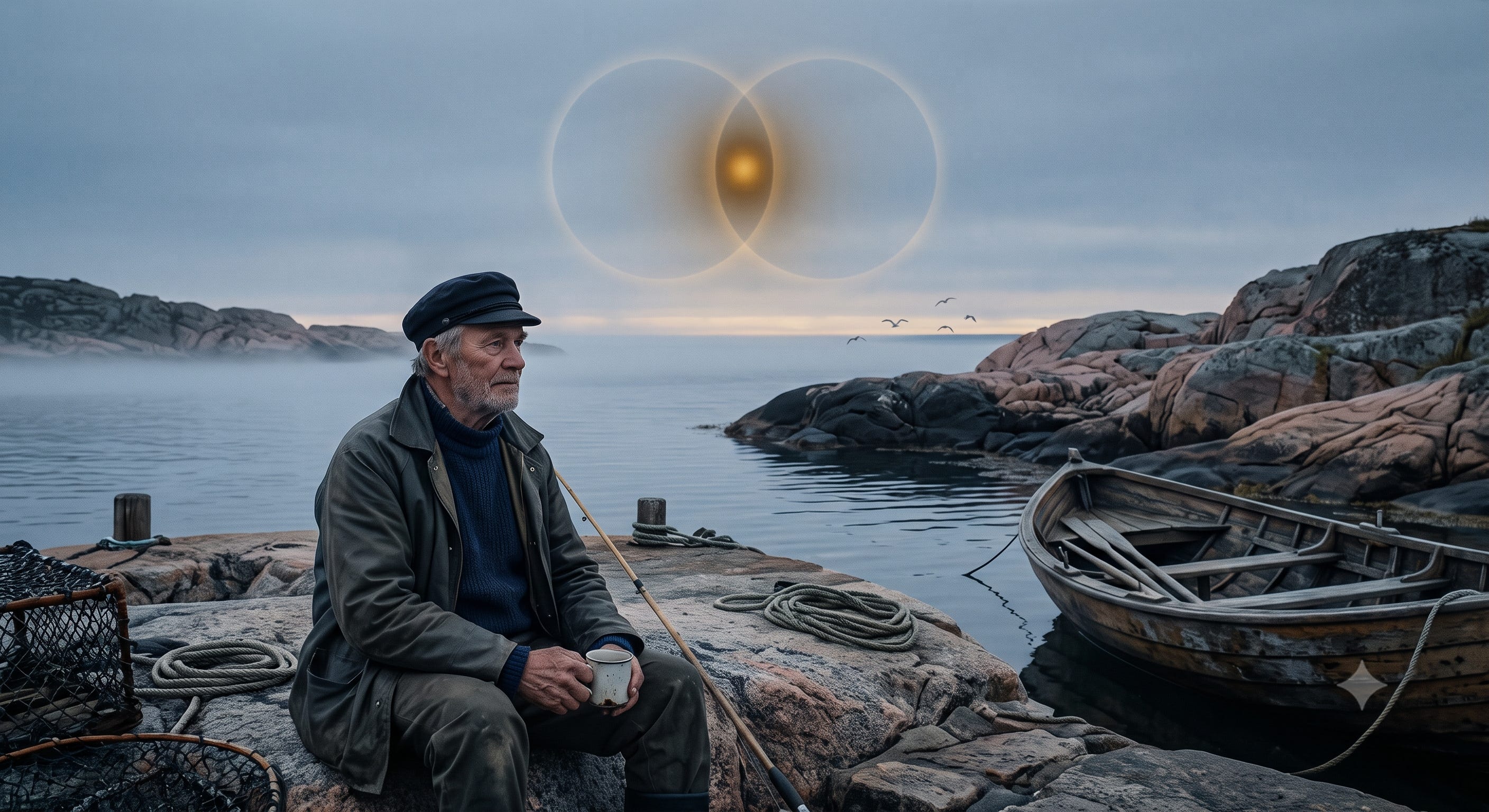
There’s an old man on a small dock in a place not unlike this coast — cold water, granite worn smooth, gulls arguing overhead. Every morning he sits with his coffee and watches a younger fisherman untangle his nets a little farther down. Years ago, that younger man cut in on the old man’s fishing grounds without asking, cost him a season’s income, never apologized, never even seemed to notice the damage he’d done.
For a long time the old man rehearsed it every morning — the specific unfairness of it, the version of events where he says the cutting thing he never actually said. He got good at that rehearsal. It became a kind of company.
Then one winter the young man’s boat took on water in a bad squall, and the old man was the only one close enough to reach him. He went. Not because the debt was settled — it wasn’t, not by his own accounting — but because in that moment the size of the man drowning was larger than the size of the grudge.
Afterward, nothing was said about the nets. It didn’t need to be. The old man noticed, rowing back, that the horizon looked different than it had in years — further away, and clearer for it. He had his depth back. Both eyes, working together again, measuring distance instead of staring at one fixed point of hurt.
That’s the whole teaching, really, stripped of doctrine. Not forget. Not pretend it didn’t happen. Just: put it down, and see how far you can see once your hands are free.
Facts, No Spin
Forgive derives from Old English forgiefan — “to give up, remit.”
Binocular vision (two eyes) is the physiological basis of depth perception; a single eye cannot triangulate distance.
Worthington’s REACH model and Enright’s process model are established, studied frameworks describing forgiveness as a learnable process, not a passive feeling.
Chronic unforgiveness and rumination have been associated in the research literature with elevated cortisol and cardiovascular stress markers; forgiveness interventions have shown reductions in anxiety, depression, and reported pain in controlled studies.
Restorative justice programs, where implemented with proper structure, have shown measurable effects on recidivism compared to punitive-only models.
Grandmother’s Algorithm
Pay attention. Do your best. Pay it forward.
She’d have said it plainer than any of this: holding a grudge is like drinking poison and waiting for the other person to get sick. Put it down. Use both eyes. See how far away it actually is now.
Peace, love, and grace to whoever needed this today.
☕ buymeacoffee.com/cognitiveloon | 💳 Swish: 0729990300 | 💳 paypal.me/hejon07
Perfect timing for me. My mother just accused me of lying about something for no reason whatsoever, just based on her isolated imaginings. I've given her heartfelt feedback about how hurtful this is. She has admitted she was being terribly stupid, and begged for my forgiveness, "if not now, sometime...". Thanks for providing this clear case for getting in with that process ASAP.