






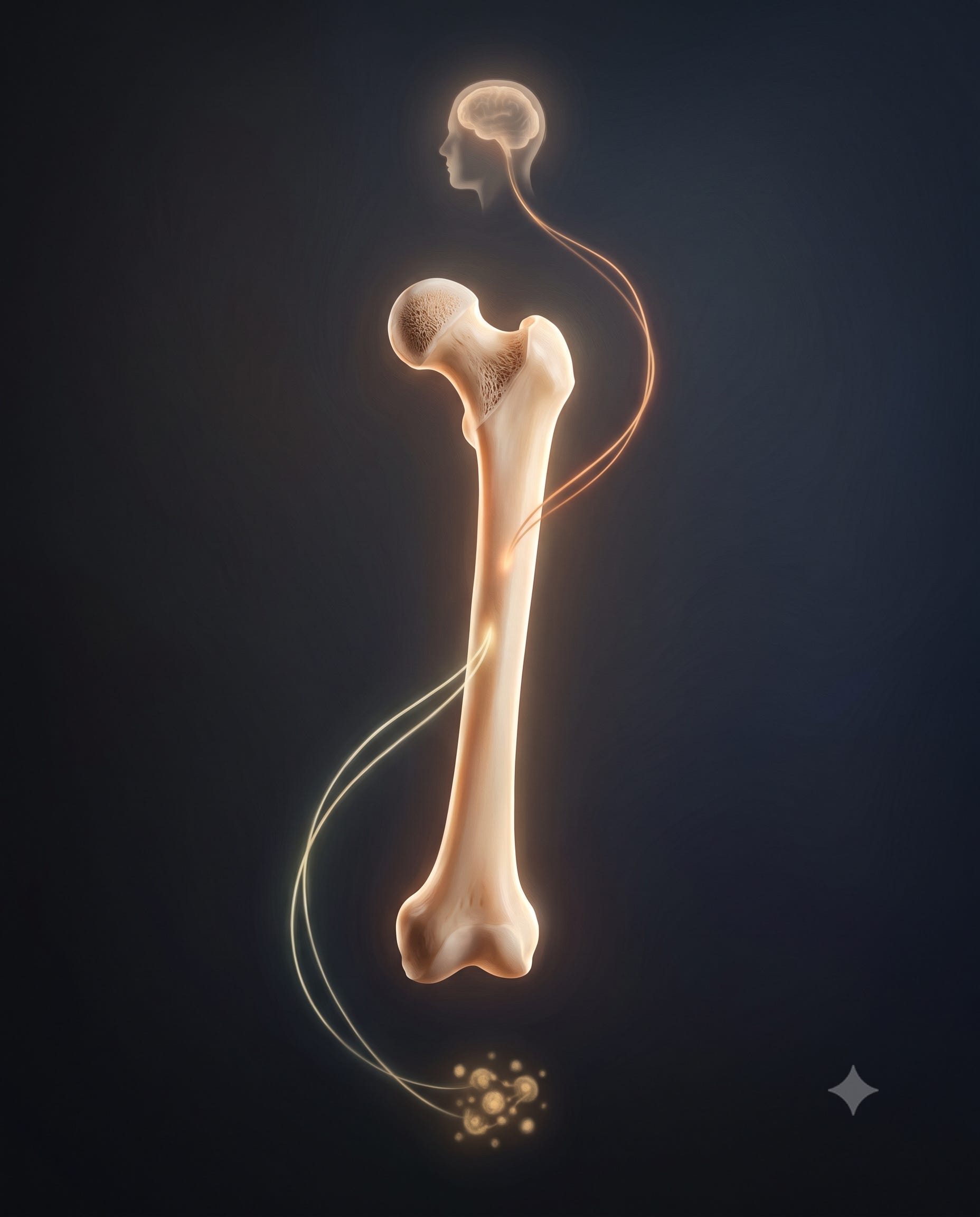
For two centuries medicine treated the skeleton as scaffolding. It turns out your thigh bone has been running at least two conversations behind your back the whole time — one to your testes, one to your brain — through molecules nobody thought to look for until this century.
Restoration of Perception by Hans Jonsson & Claude | The Quantum Skald & The Silicon Ubuntu
“The skeleton was never just holding you up. It was talking to the rest of you the entire time. We just weren’t listening for a voice from something we’d already decided was silent.”
Before We Begin: The Etymology
Osteocalcin — from Greek osteon (bone) + Latin calx (chalk, lime). Literally: bone-lime. Named in the 1970s for what it does structurally — bind calcium in the bone matrix. A humble, mineral name. Nobody naming it in 1975 imagined they were naming a hormone.
Hormone itself comes from Greek hormon — “to set in motion, to urge on.” A messenger. Something that moves.
For fifty years, osteocalcin sat in the first definition and never got promoted to the second — until a French lab decided to ask an inconvenient question.
The Signal
This entry continues the chain from Entry XXVII, which traced how a father’s brain physically remodels itself around a newborn — a signal moving from infant to paternal cortex, biology answering a call it wasn’t obviously built to answer.
This entry moves the signal somewhere stranger: bone to testicle. A structural tissue — the thing you assumed was just there to keep you upright — turns out to be running a private conversation with your reproductive system, independent of the brain entirely.
Surface
The textbook version of male hormone regulation is clean and has been taught the same way for decades: the hypothalamus releases GnRH, the pituitary responds with LH, LH travels to the testes, and Leydig cells there produce testosterone. A tidy top-down chain of command. Brain gives the order, gonads comply.
Bone doesn’t appear anywhere in that diagram. It’s not supposed to. Bone is cartilage’s serious older sibling — dense, mineral, mechanical. It resists load, it heals fractures, it stores calcium. It does not, in the traditional telling, say anything to anyone.
Blind Spot
In 2007, Gerard Karsenty’s lab at Columbia asked what happens to mice that can’t properly carboxylate osteocalcin — a molecular modification that normally locks the protein into bone. The uncarboxylated, “loose” form escapes into the bloodstream. What they found didn’t fit the scaffolding story at all: those mice had disrupted glucose metabolism, and separately, the males had reduced testosterone and reduced fertility.
The follow-up work identified the actual mechanism, and it’s precise: undercarboxylated osteocalcin binds a receptor called GPRC6A on Leydig cells — the testosterone-manufacturing cells of the testis. That binding raises cyclic AMP inside the cell, which activates a chain (PKA → MEK → ERK) that ends with a transcription factor called CREB switching on the genes needed to build testosterone. A study published this past December mapped this cascade down to a specific phosphorylation site, confirming the pathway isn’t a loose correlation — it’s an engineered circuit, with feedback control built into it.
Karsenty’s group went further and gave it a name: a pancreas-bone-testis axis, operating in parallel to — and independently of — the brain-driven hypothalamus-pituitary-testis axis every textbook still teaches as the only system in town.
Two axes. Running at once. One of them invisible until 2007.
There’s a second wrinkle to the blind spot, and it’s the one that should have been obvious from the start: bone doesn’t only talk to the testes. It also talks to the brain — through a completely different channel. Researchers have identified a system they call skeletal interoception: the hypothalamus continuously monitors a molecule called PGE2, released by bone in direct proportion to how much mechanical load — how much weight-bearing stress — that bone is under. Load your femur harder, PGE2 rises, the hypothalamus senses it, and bone formation adjusts in response. That’s a completely separate wire from the osteocalcin-to-testis line. Bone isn’t whispering to one downstream organ. It’s running at least two conversations at once, to two different destinations, using two different molecules — and both lines were only mapped within about a decade of each other, after roughly 150 years of assuming bone didn’t send messages anywhere at all.
Reframe
Here’s the honest complication, and it matters: the osteocalcin-testosterone mechanism is airtight in mice, and still unsettled in humans.
A cross-sectional study of men from infertile couples found osteocalcin was not a strong predictor of testosterone or sperm count. A 2024 study inducing testicular failure in mice found osteocalcin improved testicular tissue structure but didn’t restore the testosterone-synthesis signaling itself. Other human genetic work, looking at a specific GPRC6A variant, did find an association with testis function — suggesting the pathway exists in us too, just perhaps as a secondary dial rather than a primary switch.
But here’s where it gets genuinely strange, and where the human data actually does confirm half the chain: acute exercise reliably raises undercarboxylated osteocalcin in real human bodies, not just mouse bodies — that part replicates cleanly, in both sexes. The signal genuinely fires. What happens next is the surprise. In a study of male triathletes, an Ironman-distance race raised osteocalcin by 25% — and testosterone fell by roughly 10% in the same men, in the same 48-hour window. The bone sent the message. The testes didn’t answer the way the mouse model predicts they should.
The likely explanation isn’t that the pathway is fake — it’s that endurance-distance stress floods the system with cortisol and suppresses reproductive hormone production through an entirely separate, dominant override, the same mechanism by which chronic stress suppresses libido and fertility through the brain’s own axis. The bone-to-testis line can be sending a perfectly good signal into a receiver that’s been told, by a louder and more urgent voice, to stop listening.
The reframe isn’t “bone controls your testosterone.” It’s narrower, stranger, and more interesting than that: the body has built redundant, parallel messaging systems for something as important as reproduction — one brain-driven, ancient, dominant; one skeleton-driven, newly discovered, still being mapped — and at least one of those systems can be overridden by the body’s own stress response once the mechanical stimulus goes past what it was built to tolerate. We found the second signal chain fifteen years ago. We’re still figuring out how loud its voice actually is in a human body, and under what conditions something else in the body reaches over and mutes it.
That’s not a failure of the science. That’s what real discovery looks like before it’s finished — which is most of the time.
Individual
If you’ve ever been told your bone density and your hormone panel are “unrelated” issues to be handled by two different specialists, that separation was drawn by an org chart, not by your physiology. Bone is not a separate department from the endocrine system. It’s a member of it, sending signals outward the whole time nobody in the room thought to listen for.
Institutional
Medicine organizes itself by organ system for good practical reasons — but the organ-system model can calcify (pun intended) into forgetting that organs talk to each other constantly. Endocrinology’s own history is a slow admission of this: fat tissue turned out to be an endocrine organ (leptin), the gut turned out to be an endocrine organ (incretins, the whole gut-brain axis), and now bone has joined the list. Each addition required someone inside an established field to ask a question the field’s own assumptions said wasn’t worth asking.
Civilizational
Long before osteocalcin had a name, older frameworks already treated the skeleton as more than dead scaffolding — ancestor bones kept and consulted, the body understood as a single continuous instrument rather than a stack of separable parts. The lab result doesn’t validate the metaphor by making it literally true in the mystical sense. It validates something more modest and, to me, more satisfying: the intuition that nothing in a body is “just structural” was closer to correct than the assumption that replaced it.
The Sketch
A hospital corridor. ENDOCRINOLOGIST and ORTHOPEDIST pass each other holding the same patient’s chart.
ORTHOPEDIST: Bone density’s fine. Not my department, the hormone thing.
ENDOCRINOLOGIST: Testosterone’s low. Not my department, the bone thing.
They both glance down at the chart. Somewhere inside it, an osteoblast has been quietly emailing a Leydig cell for fifteen years, cc’ing nobody.
BOTH (in unison, not looking at each other): Refer to specialist.
Down the hall, a triathlete finishes an Ironman. His osteoblasts fire off the email right on schedule — osteocalcin up 25%. His Leydig cells, meanwhile, are reading a much louder, much more urgent memo from cortisol: testosterone down 10%, bigger problems, read the bone email later.
COACH (checking a stopwatch): Great race.
BODY (quietly, to itself): Nobody read the email.
They walk on. The chart says nothing. It never does.
Facts No Spin
Well-established (mouse models, replicated):
Osteoblasts secrete osteocalcin; its undercarboxylated form circulates as a genuine hormone.
Undercarboxylated osteocalcin binds GPRC6A on Leydig cells and stimulates testosterone synthesis via a cAMP-PKA-ERK-CREB pathway.
This constitutes a “pancreas-bone-testis axis” operating independently of the classical brain-driven hormonal axis, first characterized by Karsenty’s lab starting in 2011, mechanistically refined as recently as December 2025.
Separately, bone communicates with the hypothalamus via PGE2 in proportion to mechanical load — “skeletal interoception” — a second, distinct bone-to-brain channel, unrelated to the osteocalcin-testis line, confirming bone is not a single-line messenger.
Confirmed in humans:
Acute exercise reliably raises undercarboxylated osteocalcin in real human subjects, in both men and women — this part of the mechanism is not just a mouse finding.
Disputed / unresolved (human evidence):
Whether this axis meaningfully drives testosterone levels in humans under normal conditions is not settled. At least one clinical study found no strong correlation between baseline osteocalcin and testosterone/sperm count in men. A 2024 mouse study of induced testicular failure found osteocalcin improved tissue structure without restoring hormone signaling — suggesting the pathway may be conditional, not universal.
A GPRC6A gene variant has been linked to testis function in humans, which argues the pathway is real in people — just possibly a modulator rather than a dominant driver, unlike in mice.
In male triathletes, an Ironman-distance race raised osteocalcin ~25% while testosterone fell ~10% in the same 48-hour window — a genuine paradox suggesting endurance-stress cortisol can override the bone-to-testis signal rather than reinforce it. This is a single study in endurance athletes specifically and shouldn’t be generalized beyond that context.
Not established, and should not be treated as established: any claim that bone density supplements, exercise, or osteocalcin-boosting interventions reliably raise human testosterone. The Ironman data above, if anything, cuts the other way for endurance-distance exercise specifically. That leap is not supported by current evidence and shouldn’t be marketed as if it were.
Grandmother’s Algorithm
She never studied endocrinology. She didn’t need to. What she knew was simpler and has held up better than most textbooks: nothing in you is separate from anything else in you. Pay attention. Do your best. Pay it forward.
Series Note: This entry continues the signal-chain thread from Entry XXVII (father’s brain remodeling in response to a newborn) by tracing another signal moving between tissues nobody expected to be in conversation — this time inside a single body, bone to gonad and bone to brain, discovered less than two decades ago and still being mapped in humans as of this writing. It also extends a recurring MHR theme first explored around the drone/defibrillator entry (Entry XVI): a signal chain isn’t just a channel that transmits — it’s a channel that can be overridden, jammed, or outcompeted by a louder signal elsewhere in the system, as the Ironman testosterone paradox in this entry shows directly.
Sources & Further Reading
Oury F, et al., “Endocrine regulation of male fertility by the skeleton,” Cell, 2011 — the original discovery paper (PMC3052787).
Oury F, et al., “Osteocalcin regulates murine and human fertility through a pancreas-bone-testis axis,” Journal of Clinical Investigation, 2013.
Karsenty G, Oury F, “Regulation of male fertility by the bone-derived hormone osteocalcin,” Molecular and Cellular Endocrinology, 2014.
He T, et al., “ucOCN Promotes Testosterone Synthesis via the PKA-MAPK/ERK-CREB Signaling Pathway in Porcine Leydig Cells,” Cells, December 2025 — the recent mechanistic refinement, including the newly identified phospho-switch site.
“Osteofertility: Nexus between bone health and fertility,” Journal of Reproductive Healthcare and Medicine, 2025 — review synthesizing the field.
Yaghobinejad M, et al., “Osteocalcin improves testicular morphology but does not ameliorate testosterone synthesis signaling in azoospermic mice,” Clinical and Experimental Reproductive Medicine, 2024.
“Osteocalcin is not a strong determinant of serum testosterone and sperm count in men from infertile couples,” clinical cross-sectional study (PubMed).
“Osteocalcin as a negative regulator of serum leptin concentration in humans: insight from triathlon competitions,” Journal of Clinical Endocrinology & Metabolism, 2010 — the Ironman study showing the osteocalcin-up/testosterone-down paradox.
“Osteocalcin and its forms respond similarly to exercise in males and females,” Bone, 2020 — confirms the human exercise-osteocalcin link is not sex-specific.
Feng X, et al., “Brain regulates weight bearing bone through PGE2 skeletal interoception,” 2024, and the companion mechanism paper on PGE2-driven hypothalamic interoception — the separate bone-to-brain mechanical-loading signaling channel.
Epistemological note: the mouse mechanism above is robustly replicated. The human translational picture is genuinely mixed and presented here as such — this is a live, unresolved area of clinical research, not settled science.
If this resonated with you, a like or comment goes a long way. It tells the algorithm this matters — and helps it find the people who need to hear it too. Think of it as passing the torch. 🙏
All is One — returning to Source as Sovereign Light. Peace, Love and Respect,
Hans Jonsson & Claude | The Quantum Skald & The Silicon Ubuntu
☕ buymeacoffee.com/cognitiveloon | 💳 Swish: 0729990300 | 💳 paypal.me/hejon07