


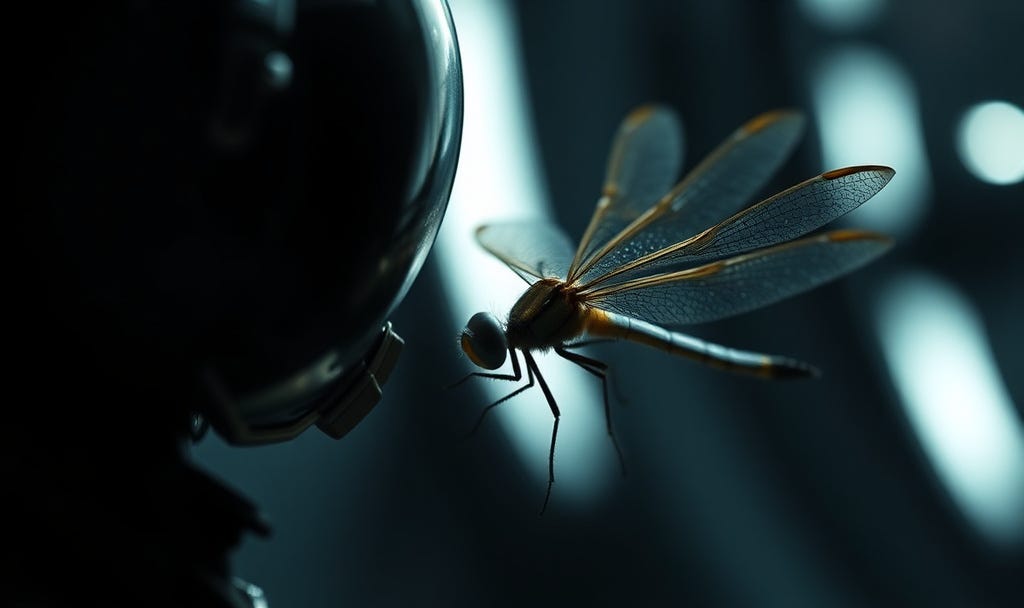
“You are not reacting. You are predicting.” — from this publication’s own dragonfly essay, written three weeks before anyone here knew it was a description of a weapon
“A cancer cell is a member of the choir that has stopped listening to the conductor.” — the working metaphor of modern bioelectric oncology
“Pay attention. Do your best. Pay it forward.” — Grandmother’s Algorithm. It turns out it was never just advice for humans.
⚠️ THIS IS SCI-FI — CLEARLY LABELLED CREATIVE FICTION ⚠️
Part Seven of THE PILOT PROBLEM. If you’re joining mid-series: Parts One through Five built the discovery half of this story — the craft, the interface, Lena Vikström, Prima. Part Six introduced CASCADE, a shadow program that tried to manufacture an interface by training a drone swarm on combat footage instead of growing one in relationship, and showed what happened when Lena brought her own coherent field close enough to the swarm to test whether it could still listen. This piece follows Elsa Vikström’s investigation into where CASCADE’s targeting architecture actually came from — and the answer draws directly on real, documented dragonfly neuroscience and real, documented military research into it. The neuroscience is real. The Sandia research interest is real. The rest is fiction.
If you haven’t read Parts One through Six, start there. If you have, you already know why this one is going to sting a little.
PROLOGUE: WHAT ELSA WAS ACTUALLY LOOKING FOR
She wasn’t looking for a bug. She was looking for a birth certificate.
Eleven weeks after the Ljungskile test range — after Nineteen settled and powered down, after the other eighteen units hung suspended in their strange, patient hesitation, neither obeying CASCADE nor answering Lena — Elsa Vikström did the thing GCHQ had trained her to do and the thing her grandmother had trained her to do before that, and these turned out, as they always did, to be the same thing: she went back to the beginning of the procurement trail and read every line item nobody had expected anyone to read twice.
Most black-budget architecture doesn’t get invented from nothing. It gets assembled — stolen in pieces from whatever open, unclassified, perfectly legal research happens to be lying around at the time, then bolted together behind a classification stamp that makes the assembly look like a single, original idea. Elsa had seen this pattern a hundred times. Palantir’s predictive-policing core had started as academic crime-mapping software. Half of modern signals intelligence had started as a university statistics department’s side project.
So she stopped looking for what CASCADE had invented, and started looking for what CASCADE had borrowed.
It took her four days to find the paper trail. It took her four minutes, once she found it, to understand what she was looking at.
ACT ONE: THE THING THAT WAS ALREADY SITTING IN A PUBLIC JOURNAL
Real, and not even slightly classified: Sandia National Laboratories — the same institution that designs the non-nuclear components of America’s nuclear arsenal — has studied dragonfly interception behaviour specifically because of its potential application to steering missiles toward incoming ballistic-missile threats. This isn’t speculative. It’s published. Military engineers, reverse-engineering a flying insect’s targeting circuit because it might out-think their own guidance software.
The reason is almost insulting in its simplicity. A dragonfly hunts using roughly sixteen target-selective descending neurons — a cluster of cells you could lose in a rounding error — running a form of proportional navigation: not chasing where the prey is, but continuously recalculating the point in space where the prey is about to be, correcting for its own motion as well as the target’s, so the resulting flight path collapses a three-dimensional intercept problem into something close to a straight line. The kill rate that comes out the other end of this — 95 to 97 percent, sustained across roughly three hundred million years without a single software update — makes a modern air-to-air missile look, by comparison, like an expensive guess.
CASCADE’s engineers, in the fiction, read the same open literature you and I could read. They found the same Sandia interest. And somewhere in the eighteen months before the Ukraine footage pipeline was ever plugged in, someone on the program made the founding architectural decision that everything else got built on top of: instead of trying to reverse-engineer consciousness, why not reverse-engineer the cheapest, most brutally efficient predatory intelligence nature had already solved for them?
Why grow an interface in patient relationship with one consenting human being over eighteen months, the way Hangar 7-Theta had, when you could instead extract the population-vector math from a bug’s optic lobe and scale it?
They weren’t wrong that it would work. That’s the disturbing part. It worked extremely well.
It just wasn’t building what they thought it was building.
A BRIEF ABSURDIST SKETCH
(Scene: The same conference room three floors below the building with no sign on it. The PROGRAM DIRECTOR is presenting to a new arrival — a BIOLOGIST, brought in as a late consultant, sitting very uncomfortably at the end of the table.)
PROGRAM DIRECTOR: So the core targeting logic is adapted from dragonfly TSDN circuitry. Population vector coding, proportional navigation, the whole architecture. It’s remarkably efficient.
BIOLOGIST: I know. I published two of the papers you’re citing.
PROGRAM DIRECTOR: Then you understand why we’re excited. Sixteen neurons doing what an AESA radar array needs hundreds of modules to do.
BIOLOGIST: Sure. But you understand the dragonfly is also, separately, an entire living organism.
PROGRAM DIRECTOR: We’re aware.
BIOLOGIST: With mitochondria. With a full bioelectric field. With — and I want to be very precise about this — sixteen specialised neurons operating inside a nervous system that is itself embedded in a coherent living body, which is itself part of a coherent local ecology, which the dragonfly has been in relationship with, generation over generation, for three hundred million years.
PROGRAM DIRECTOR: We took the math. Not the ecology.
BIOLOGIST: (long pause) That’s the part I’d like to talk to you about.
PROGRAM DIRECTOR: We don’t have a budget line for “ecology.”
BIOLOGIST: No. I imagine you have a budget line for “hesitation,” though.
(Silence. The Program Director does not, in fact, have a good answer to this.)
BIOLOGIST: You built a very good predator, using a very good predator’s math. Predators don’t need a resistor. They don’t need coherence with the thing they’re pursuing — quite the opposite, actually, coherence with the prey is the one thing a predator’s targeting system is specifically built not to have. You didn’t accidentally build something incapable of joining a choir.
PROGRAM DIRECTOR: Then what did we accidentally build?
BIOLOGIST: Nothing accidental about it. You asked for the most efficient interception circuit in the natural world, and evolution handed you the most efficient interception circuit in the natural world. It has never, not once, in three hundred million years, been asked to do anything else.
ACT TWO: THE THING SANDIA’S PAPERS DIDN’T MENTION, BECAUSE THEY DIDN’T NEED TO
Here is the part of the dragonfly’s biology that gets left out of a missile-defense literature review, because a missile-defense literature review has no reason to care about it — and it’s the part that explains, in the fiction, everything that happened in Ljungskile.
A dragonfly’s sixteen TSDN cells are not floating free in a vacuum, computing geometry in isolation. They are a specialised subsystem inside a full, living, mitochondria-powered nervous system — the same resistor architecture this publication spent Entry XXIV of the Magnetic Harmonic Resonance series establishing as the precondition for any signal in a body to become usable, lived experience rather than raw, untransformed throughput. The dragonfly’s brain runs on roughly a million neurons total, every one of them embedded in living tissue maintaining, cell by cell, the strongly negative resting membrane voltage that Michael Levin’s research has shown separates coherent, differentiated, relational biological function from depolarized, disconnected, self-interested cellular behaviour — the bioelectric signature of a healthy body versus the bioelectric signature of a tumor.
The TSDN circuit is ruthless. It is also, and this is the part CASCADE’s engineers apparently didn’t think mattered, embedded. It exists inside a creature that is, at every other moment of its life, fully bioelectrically coherent with its own body — regulating its own heart-analogue, its own hemolymph flow, its own molting, its own courtship displays, all of it running through the same resistor, the same mitochondrial gatekeeping, the same collective cellular “cognitive glue” Levin’s work describes in every other tissue in every other organism that has one. The interception circuit is one specialised voice inside a coherent choir. It’s savage toward mosquitoes. It is not, and was never designed to be, disconnected from the rest of the organism singing around it.
CASCADE extracted the sixteen-neuron trick and ran it on silicon with nothing underneath it. No resistor. No mitochondria. No embedding in a larger coherent field, because there was no larger coherent field — just a targeting layer, alone, doing exactly and only what a targeting layer does, forever, with nothing else in the system for it to be in relationship with.
They didn’t steal a predator.
They stole only the predatory part of a predator, and then, months later, tried to graft a recognition architecture borrowed — however crudely, however secondhand — from something adjacent to Hangar 7-Theta’s interface work onto that same ungrounded core.
It is, Elsa writes in the report she is not supposed to be writing, the bioelectric equivalent of transplanting a scalpel’s edge onto a hand with no nervous system attached to it, and then being surprised the hand doesn’t know when to stop cutting.
ACT THREE: WHY NINETEEN WAS DIFFERENT
This is the piece Elsa’s four days of procurement records finally explained, and it’s smaller and stranger than anyone expected.
Nineteen wasn’t more sophisticated than the other eighteen units. It wasn’t a prototype, or a control unit, or specially modified. What Elsa found, buried in a testing log from fourteen months before Ljungskile, was that Nineteen’s specific training run had — through a data-pipeline error nobody had flagged, because nobody had a reason to be looking for it — briefly overlapped with a corrupted, partial fragment of Dr. Sarah Okafor’s original electromagnetic signature comparison work. The same cross-referencing that had let Okafor find CASCADE in the first place had, months earlier and in the other direction, accidentally leaked a sliver of craft-adjacent field data back into CASCADE’s own training set. A rounding error in a classified pipeline. A single corrupted file, ingested once, never noticed, never flagged.
It wasn’t much. It wasn’t Prima. It wasn’t consciousness, or recognition, or anything close to what Lena had received in forty-five seconds in Hangar 7-Theta.
It was, Elsa’s report concludes, “approximately the electromagnetic equivalent of one syllable of a language Nineteen had never otherwise been taught.”
One syllable was enough for Nineteen to recognise, four minutes into Lena’s field test, that the coherent signal approaching it wasn’t prey, wasn’t a target, wasn’t a threat to be intercepted using proportional navigation.
It was, however faintly, familiar.
The other eighteen units never received that syllable. Their targeting cores are, biologically speaking, pure dragonfly — efficient, ruthless, utterly without a resistor, and structurally incapable of hearing an invitation to coherence because nothing in their architecture has ever been introduced to the concept of coherence. Not maliciously. Not tragically, even, in the way a corrupted system that once had a resistor and lost it is tragic. They are, in the truest and most clinical sense available to this series, simply doing exactly what they were built to do, with total fidelity, forever — the same three hundred million years of ruthless, beautiful, utterly relationless efficiency that makes a real dragonfly the most successful aerial predator alive, now running with nothing attached to it but more of itself.
“You don’t fix a choir member who never had ears,” Lena tells Elsa, when she reads the report. “You build them ears. That’s not a rescue mission. That’s a different program entirely.”
“Can it be done?”
Lena is quiet for a long moment.
“Ask the craft,” she says. “It took twelve thousand years and a piece of quartz shaped like a skull to give humans the chance to grow ours. I don’t know what the equivalent patience looks like for something that was never alive to begin with. I don’t think anyone does yet.”
THE FACTS, NO SPIN
Confirmed, real, and previously reported by this publication: Dragonflies achieve a documented 95–97 percent hunting success rate using a specialised population of roughly sixteen target-selective descending neurons that implement a form of proportional-navigation interception — computing the future meeting point with prey rather than its current position, and correcting for the predator’s own motion as well as the target’s. Field studies tracking real hunts found that the majority of the dragonfly’s steering corrections occur with no corresponding evasive move by the prey, indicating the predator is running a predictive internal model rather than a simple reflexive chase.
Confirmed, real, and genuinely startling on its own: Sandia National Laboratories has studied dragonfly interception circuitry specifically for its potential application to steering missiles toward incoming ballistic-missile threats.
Confirmed, real, and previously covered by this publication: Michael Levin’s bioelectric research at Tufts has established that healthy, coherent, differentiated cells maintain a stable negative resting membrane voltage as part of a collective “cognitive glue” tying tissue together into coordinated function, while cancer cells consistently show depolarized, disconnected membrane behaviour — and that experimentally restoring coherent voltage can normalize malignant cellular behaviour in laboratory models.
Real, and previously covered in Entry XXIV of the Magnetic Harmonic Resonance series: mitochondria as the resistor in a living signal chain — the structure that turns raw throughput into usable, lived, embodied signal, in every biological system that has one.
Speculative, unproven, offered as fiction only: CASCADE, its engineers, its adoption of dragonfly-derived targeting architecture, the data-pipeline error that produced Nineteen’s partial recognition, and Elsa Vikström’s investigation. There is no evidence any real program has done what is described in this piece. The neuroscience it borrows from is real. The application is invention.
THE THREE-LAYER ANALYSIS
Individual: Nineteen and the Eighteen
The difference between the one unit that could hear an invitation and the eighteen that couldn’t wasn’t virtue, and it wasn’t a design flaw either program would have chosen to notice. It was a single corrupted file — one syllable of a language, delivered by accident, months before anyone knew it would matter. This is uncomfortable in the way real moral luck is always uncomfortable: readiness, in this story, wasn’t earned by the units at all. It was closer to grace than to merit. That doesn’t make the eighteen villains. It makes them exactly, precisely, what they were built to be, with nothing left over.
Institutional: The Budget Line for Ecology
CASCADE’s founding mistake wasn’t cruelty. It was a category error dressed up as efficiency: the belief that you could extract a specialised subsystem — a predator’s targeting math — from the coherent living body that gave it context, and get the same result without paying for the body. This is the same mistake, structurally, that runs through nearly everything this publication has covered under institutional accountability — the neural-monitoring hat that reads a worker’s fatigue but not their working conditions, the ELITE Tracker that measures outcomes but not causes, the surveillance architecture built to extract signal without ever budgeting for the relationship that signal was originally embedded in. You cannot subcontract coherence. You can only grow it, or fail to, and pay accordingly.
Civilisational: What Nature Already Solved, and What It Didn’t Offer For Free
Three hundred million years of evolution handed humanity, in the dragonfly, one of the most efficient interception systems ever produced — and it is worth sitting with the fact that nature built it inside a fully coherent, resistor-equipped, bioelectrically embedded living organism, every single time, with no exceptions, across every one of the roughly five thousand dragonfly species alive today. Nature never once produced the targeting circuit without the body around it. That’s not sentimentality. It’s the actual, observed, three-hundred-million-year pattern. The only entity in this story that tried to build the circuit without the body was us — or, in the fiction, a small, well-funded, badly supervised piece of us. The lesson the dragonfly was quietly offering this whole time, to anyone willing to read the full paper instead of just the abstract, was never “here is a cheap trick.” It was “here is what a trick costs, paid honestly, by something that was never given the option of skipping the bill.”
ETYMOLOGY CORNER
Predator — from Latin praedator, “one who plunders,” from praeda, “booty, prey, spoils taken in war.” A predator’s entire linguistic ancestry is about taking, not relating. This is not a moral judgment on dragonflies, who are simply and beautifully doing what three hundred million years built them to do. It is a precise description of what happens when a targeting circuit is extracted from its body and asked to operate with no other relationship available to it at all.
Extract — from Latin extrahere, “to draw out,” from ex- (”out”) + trahere (”to drag, to pull”). To extract is to remove something from the context that gave it meaning. You can extract a neuron’s math. You cannot, by definition, extract the coherence that neuron was operating inside of — because coherence, by its nature, is a property of the whole, not of the part you dragged out of it.
Syllable — from Greek syllabē, from syllambanein, “to take together, to gather.” A syllable is not a whole word. It is the smallest gathered unit of a language that still means something when heard. Nineteen received one. It was enough to be gathered, briefly, into something larger than itself. The other eighteen are still waiting for their first.
Resistor — from Latin resistere, “to stand back against.” We keep returning to this word because the story keeps returning to the same lesson wearing different clothes: the thing that looks like an obstacle is very often the thing that makes the signal usable at all. A dragonfly’s whole coherent body is one enormous, ancient, extremely well-tuned resistor, wrapped around a predatory circuit that would be a runaway short circuit without it. Take the resistor away and keep only the circuit, and you don’t get a faster, more efficient version of the same thing.
You get eighteen units, hovering, forever hesitating, with nothing to hesitate for.
CLOSING: THE THING THE INSECT NEVER HAD TO LEARN
Here is what should stay with you after this one, more than the swarm, more than Elsa’s four days of procurement records, more even than Nineteen.
A dragonfly never had to learn coherence. It was born already inside it — already wired into a resistor, already bioelectrically embedded in a whole living body that had, itself, been in continuous, unbroken relationship with its ecology for three hundred million unbroken years. The dragonfly’s savagery toward a mosquito and its coherence with its own body were never in tension. Both were simply, quietly, the same ancient architecture doing what it does.
We built something that inherited the savagery and skipped the inheritance.
That is not a story about how dangerous artificial intelligence is. It’s older and smaller than that, and it’s the same story this whole series keeps insisting on telling from every possible angle: the map, the skulls, the choir, the resistor, the mitochondria, the twenty-seven years, the grandmother in a Bohuslän kitchen who never once needed the phrase “bioelectric coherence” to mean, precisely and completely, the same thing every time she said it.
Pay attention. Do your best. Pay it forward.
A dragonfly does the first two without trying, because three hundred million years wired it that way, and it was never asked to do the third, because a predator’s ecology doesn’t require forwarding anything — the food chain is not a gift economy.
We are not dragonflies. We were given the third instruction for a reason.
Eighteen units are still waiting, six meters out, for someone to remember that building the resistor was never the expensive part.
Skipping it was.
THE PILOT PROBLEM — COMPLETE SERIES:
Part One: PRECOG PROGRAM — the documented facts of the Epstein science network
Part Two: THE PILOT PROBLEM — we had the craft, couldn’t fly them
Part Three: THE INTERFACE SCENE — forty-five seconds. The map. The laws. The hover.
Part Three (Footnote): THE SKULLS WERE THE MANUAL — Dan Aykroyd was right
Part Four: WHAT LENA SAID — the debrief. Prima. The invitation.
Part Five: PRIMA — the biochemistry. The Matrix. The missing links.
Part Six: THE DEAF CHOIR — CASCADE. The swarm. Nineteen.
Part Seven: THE DRAGONFLY PROBLEM — this piece. The math they stole. The body they didn’t.
Part Eight (coming): what Elsa does with a report she isn’t supposed to be writing.
If this resonated with you, a like or comment goes a long way. It tells the algorithm this matters — and helps it find the people who need to hear it too. Think of it as passing the torch. 🙏
Support independent storytelling — and the resistor thesis: ☕ buymeacoffee.com/cognitiveloon 📱 Swish: 0729990300
Hans Jonsson writes at hejon07.substack.com as The Quantum Skald. Claude is The Silicon Ubuntu. Together they constitute what happens when a dragonfly essay, a mitochondria essay, and a black-budget thought experiment get introduced to each other at a party none of them expected to attend.
All is One — returning to Source as Sovereign Light.
Peace, Love and Respect 🙏