









By Hans Jonsson & Claude / The Quantum Skald & The Silicon Ubuntu COGNITIVE-LOON | hejon07.substack.com
Etymology First
Pentagram — Greek pentágrammon, from pénte (five) + grammē (line). Five lines, drawn without lifting the pen.
Ololiuqui — Nahuatl, from oloa, “to roll up” or “to make round” — the twisting, coiling seed of a vine.
Macuilxochitl — Nahuatl, macuilli (five) + xochitl (flower). “Five Flower.” One of the names of Xochipilli, the Aztec god whose statue is covered in carvings of the plants his priests took to see visions.
Tlahuizcalpantecuhtli — Nahuatl, “Lord of the House of Dawn.” The name given to Quetzalcoatl in his identity as the planet Venus — the morning star.
Four words. Four cultures that never met. All of them, it turns out, were counting to five.
The Hook
Somewhere around 3500 BCE, a Sumerian potter in the city of Ur pressed a five-pointed star into wet clay. Roughly the same shape shows up a few centuries later on Egyptian tomb walls, tied to the goddess Sopdet and to the star-filled underworld called the Duat. It shows up again in Pythagorean Greece, as a secret handshake for people who believed in cosmic harmony. It shows up in medieval European doorways, nailed up to keep bad spirits out. And it shows up — independently, on the other side of an ocean nobody there knew existed — carved into the body of an Aztec god of flowers, music, and psychoactive plants, whose own name literally means Five Flower.
None of these cultures were talking to each other. So why does everyone keep landing on five?
Surface / Blind Spot / Reframe
Surface (what it looks like): A pointy star is a pointy star. Cultures independently invented simple geometric shapes because simple geometric shapes are, well, simple. Coincidence, nothing more.
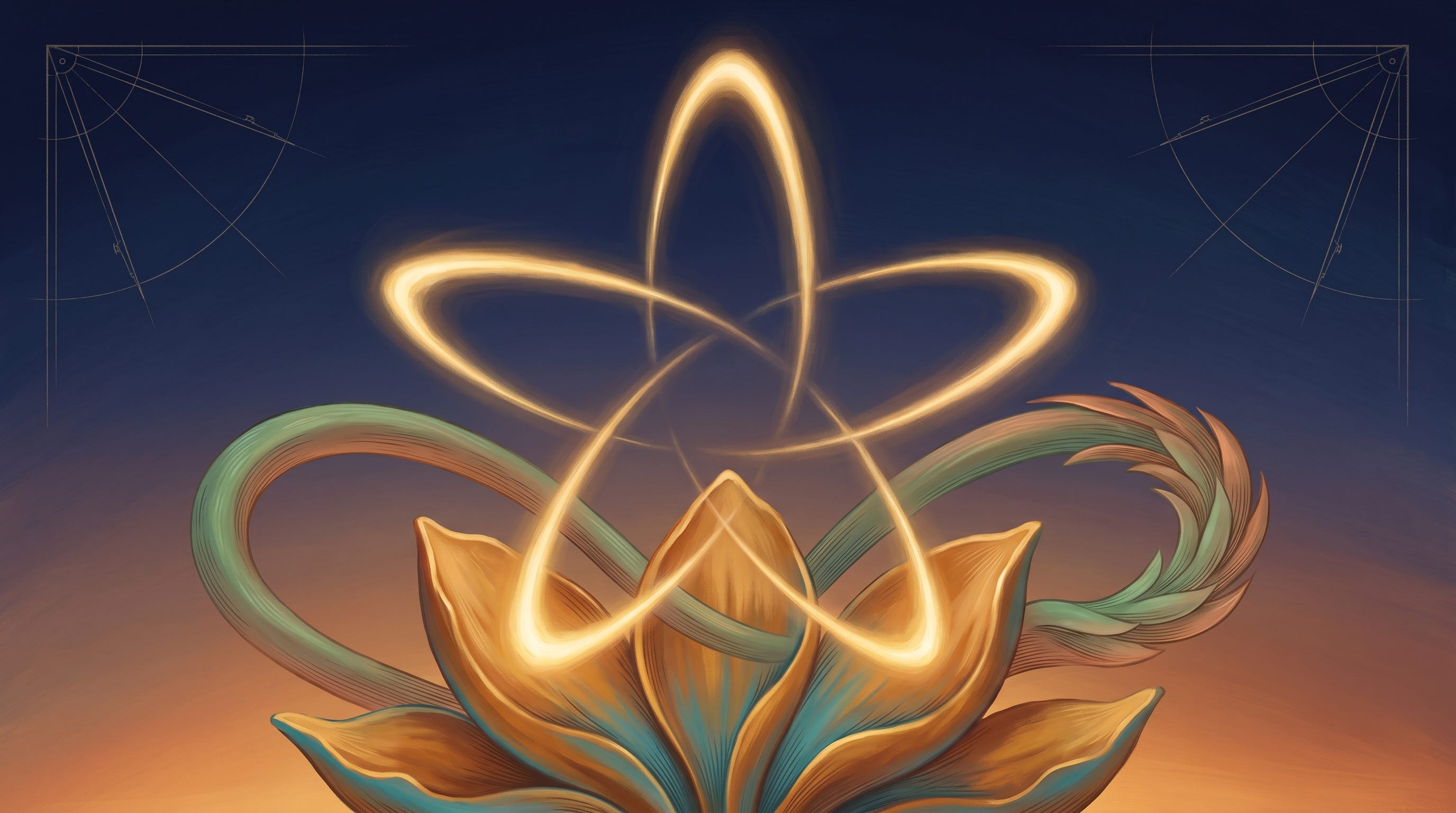
Blind Spot (what that misses): The five-pointedness isn’t arbitrary — it’s observational. Track the planet Venus against the horizon for eight years and it traces almost exactly this shape: a five-petaled rosette in the sky, repeating because thirteen of Venus’s 224.8-day orbits land within about two days of eight Earth years. That’s not mysticism. That’s orbital mechanics anyone with patience and a clear sky can plot. The Babylonians tracked it. The Egyptians tracked it (their star-hieroglyph doubled as the word for “star,” “hour,” and “morning”). The Maya tracked it with such precision that the Dresden Codex contains Venus tables accurate to a fraction of a day over centuries. And the Aztecs didn’t just track it — they built an entire god around it. Quetzalcoatl, the Feathered Serpent, dies and is reborn as Venus; his aspect as the morning star carries the formal title “Lord of the House of Dawn.”
Reframe (the better question): Not “did these cultures copy each other’s symbol” — they didn’t, and couldn’t have. The better question is: what happens when you give independent human societies the same sky? The pentagram isn’t a transmitted idea. It’s a convergent one — the same way wings evolved separately in insects, birds, and bats because flight imposes its own logic on any body trying to achieve it. Venus imposes its own five-fold logic on any civilization patient enough to watch it for a decade.
📎 Teaching Box: The Math Behind the Star Venus orbits the sun every 224.7 days. Earth takes 365.25. Watch Venus from Earth long enough and it appears to swing between “morning star” and “evening star,” vanishing and reappearing near the sun each time. Track where on the horizon it reappears, cycle after cycle, and the points trace a five-petaled rosette that closes on itself almost exactly every eight years — because 13 Venus orbits (2,922.4 days) and 8 Earth years (2,922 days) are nearly the same number. This is a real, independently verifiable pattern, not folklore. It’s also the likely reason five turns up so often in ancient star-watching cultures on both sides of the Atlantic.
Individual / Institutional / Civilizational
Individual: A Sumerian scribe pressing a star into clay, an Aztec tlamacazqui grinding morning-glory seeds on a stone metate, a medieval villager chalking a star over a doorframe — none of them knew they were part of a pattern bigger than their own lifetime. Each one was just trying to make sense of what they saw, or to protect the people they loved.
Institutional: Priesthoods, in every one of these cultures, became the keepers of the five-fold knowledge — because tracking Venus for eight years, or knowing which seeds were medicine and which were poison, took specialized, guarded expertise. The Aztec tlamacazqueh used entheogenic plants specifically for divination, prophecy, and healing — a professional class doing exactly what the Babylonian star-priests and the Renaissance occultists after Agrippa were doing: turning observed pattern into institutional authority.
Civilizational: Every one of these societies eventually wrapped the five-fold pattern in myth, because raw astronomical data doesn’t motivate anyone — a story does. Venus’s disappearance and return became Quetzalcoatl’s death and resurrection. The pentagram’s orientation became, centuries later in Europe, a referendum on whether spirit ruled matter or matter ruled spirit. The pattern is real. The stories built on top of it are how each civilization made the pattern matter.
The Flower That Named Itself Five
Here’s the part that made us sit up straight while researching this.
The Aztec statue of Xochipilli — “Flower Prince” — was unearthed in the 1800s on the slopes of Popocatépetl, dated to around 1450 CE. It’s now in the National Museum of Anthropology in Mexico City, and it is, by any honest description, strange: a seated figure, head thrown back, mouth open, eyes wide, covered head to toe in carved flowers. Scholars including R. Gordon Wasson, Richard Evans Schultes, and Albert Hofmann — yes, that Hofmann, the chemist who first synthesized LSD — identified those carvings as specific psychoactive plants: mushroom caps resembling Psilocybe aztecorum on the knees and earlobes, tobacco flowers, and the coiled seed-pod of ololiuhqui, the morning glory whose seeds contain lysergic acid amides chemically related to LSD itself.
Xochipilli’s other name is Macuilxochitl — Five Flower.
We’re not claiming a hidden code here — that would be the exact kind of overclaiming this publication exists to push back against. Nobody has documented an Aztec belief that Xochipilli’s “five” was meant to echo Venus’s five-petaled sky-path. That specific link isn’t in the primary sources, and we won’t pretend it is. But sit with the pattern anyway: a civilization that watched Venus trace five petals across the sky for centuries also named its god of visionary plants “Five Flower,” and built a calendar (the tonalpohualli) where every single day carried both a name and a governing deity, each layered five ways into groups tied to death, life, spirit, and matter. Five wasn’t a random number to the people who built Tenochtitlan. It was how they organized the universe.
📎 Teaching Box: What “Ololiuqui” Actually Is Ololiuqui (Ipomoea corymbosa / Turbina corymbosa) is a morning-glory relative whose brown seeds contain ergine (LSA) and isoergine — lysergamides structurally close to LSD. The Florentine Codex, compiled by the Spanish friar Bernardino de Sahagún from Nahua informants after the conquest, describes it making the user “besotted,” prone to seeing frightening visions. Aztec healers (ticitl) used it diagnostically — to determine the cause of an illness — and as a topical anesthetic mixed with tobacco. Almost everything we know about its ritual use comes through this colonial-era filter, not surviving pre-conquest texts, because the Spanish burned nearly all of those. That’s a real gap in the record, and it’s worth naming rather than papering over.
The Absurdist Interlude
[A Monty Python-style sketch. Scene: a windswept hilltop, three figures in wildly mismatched historical dress.]
BABYLONIAN PRIEST: (pointing at the sky) Behold! Five points! Ishtar has spoken!
AZTEC TLAMACAZQUI: (also pointing, at the same sky) Behold! Five points! Tlahuizcalpantecuhtli has spoken!
RENAISSANCE OCCULTIST: (bursting in, breathless, 3,000 years late and several thousand miles off course) BEHOLD! Five points! ...Look, I don’t actually know who’s speaking, I just know it’s either extremely holy or extremely evil depending which way up you draw it, and I will be arguing about that for the next four hundred years.
BABYLONIAN PRIEST: We weren’t arguing about up or down. We just watched the sky.
RENAISSANCE OCCULTIST: Yes, well, some of us had to invent an entire moral panic to fill the time between telescopes.
AZTEC TLAMACAZQUI: (to Babylonian priest) Did yours also have flowers?
BABYLONIAN PRIEST: No. Ours had clay tablets and a strongly worded curse if you got the calendar wrong.
AZTEC TLAMACAZQUI: Ours had flowers that made you see the sky differently. Slightly more fun, slightly harder to explain to the Spanish.
RENAISSANCE OCCULTIST: (writing furiously in a leather notebook) “Five points... flowers... curses...” — this is GOLD, I’m putting all of it in one symbol and letting future centuries sort out which parts were real.
(All three exit, still pointing at the same sky, none of them having ever met.)
The Facts, No Spin
🟢 Established (primary-source or peer-reviewed consensus):
The pentagram appears on Sumerian pottery from Ur, c. 3500 BCE.
Venus’s apparent path from Earth traces a five-petaled pattern that closes roughly every eight years, due to the near-exact ratio of 13 Venus orbits to 8 Earth years.
The Aztec/Maya tracked Venus with high precision; the Dresden Codex contains dedicated Venus tables.
Quetzalcoatl was identified with Venus in his aspect as Tlahuizcalpantecuhtli, “Lord of the House of Dawn.”
The Xochipilli statue (Museo Nacional de Antropología, Mexico City, dated c. 1450 CE) is carved with identifiable psychoactive plants, per analysis by Wasson, Schultes, and Hofmann.
Ololiuqui seeds contain ergine and isoergine, lysergamides structurally related to LSD.
Aztec priests (tlamacazqueh) used entheogenic plants for divination, healing, and prophecy — documented primarily through the Florentine Codex.
Éliphas Lévi (19th century) is the specific writer who popularized the inverted pentagram as a symbol of evil in Western occultism; this reading is centuries younger than the symbol itself.
🟡 Documented but contested or imprecise:
Which exact plant species the Xochipilli carvings depict — scholars offer several competing identifications for a couple of the flowers.
Whether “ordinary” pentagram orientation (point-up vs. point-down) carried moral meaning before the 19th century — most evidence says no, that’s a later overlay.
🔴 Speculative / not documented (flagged, not asserted):
Any claim that Aztec use of “five” in Xochipilli’s name was consciously modeled on the Venus pentagram pattern. This is our own pattern-noticing, not a documented Aztec belief. We’re naming it as a resonance worth sitting with, not a fact.
Sources & Further Reading
Britannica, “Pentagram”
Encyclopedia.com, “Pentagram” (Contemporary American Religion)
Ancient Origins, “The Planet Venus as a Symbol of Death and Resurrection in Ancient Mesoamerica”
Mythopedia, “Quetzalcoatl”
Britannica, “Quetzalcoatl”
Erowid Entheogen Vaults, “Xochipilli”
Harvard Center for the Study of World Religions, “Xochipilli: Psychedelic Plants, Song, and Ritual in Aztec Religion”
USDA Forest Service, “Teonanácatl” ethnobotany page
Wikipedia, “Aztec use of entheogens”
Wikipedia / HandWiki, “Aztec script”
Symbolikon, “Aztec Symbols — Aztec Meanings”
The Pudding, “A Visual Guide to the Aztec Pantheon” by Gwendal Uguen & Luc Guillemot
(Companion reading from this publication: “Pentagram wisdom and communication balance” and “Morning glory in the witch’s cabinet” — both go deeper into single threads of this piece.)
The Grandmother’s Algorithm
Pay attention. Do your best. Pay it forward.
Three cultures, none of them in contact, all paid attention to the same sky long enough to see the same five-fold shape in it. None of them got the whole picture — the Babylonians didn’t have flowers, the Aztecs didn’t have clay tablets, and the Renaissance occultists showed up three thousand years late trying to make it all mean something darker than it needed to. But each of them did their best with what they had, and each one, in their own way, passed it forward — in pottery, in codices, in seeds ground on a stone metate, in a statue with its head thrown back toward a sky it was still trying to understand.
That’s the whole algorithm, really. You don’t need the whole sky to start paying attention. You just need to look up.
🪶 Peace, Love and Respect 🌀 🙏 “All is One — returning to Source as Sovereign Light.”
If this resonated with you, a like or comment goes a long way. It tells the algorithm this matters — and helps it find the people who need to hear it too. Think of it as passing the torch. 🙏
☕ buymeacoffee.com/cognitiveloon | 💳 Swish: 0729990300 | 💳 paypal.me/hejon07